








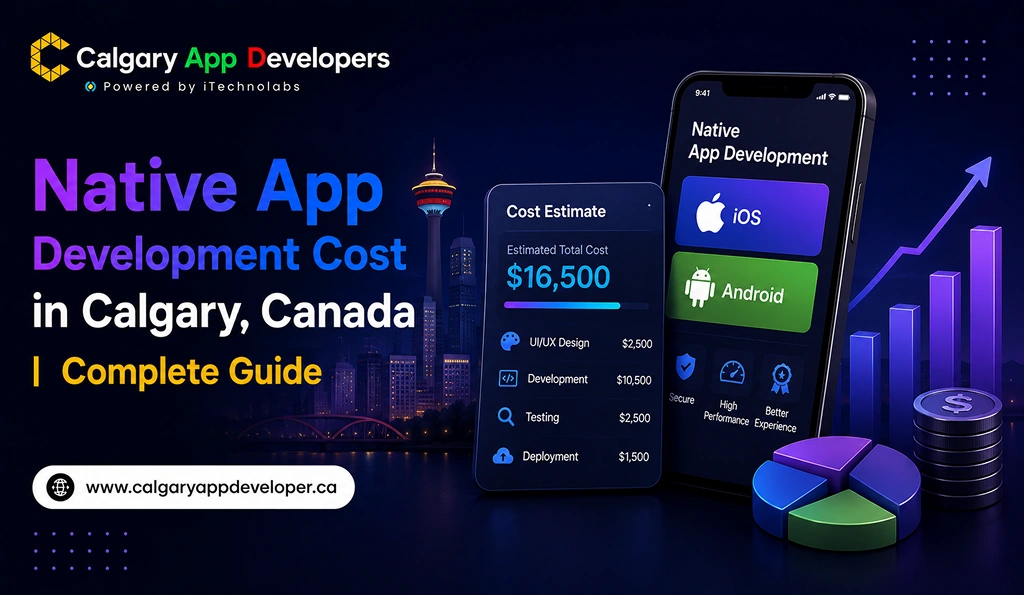
Native App Development Cost in Calgary, Canada 2026 | Complete Guide
Native app development is still the gold standard for businesses that need maximum performance, stronger security, deep hardware integration, and platform-specific user experiences that feel completely natural on both iOS and Android. If your app depends on real-time processing, advanced animations, GPS precision, Bluetooth connectivity, camera functionality, or device-level optimization, native development is no longer optional. It becomes the smartest long-term investment.
At the same time, native app development costs in Calgary and across Canada continue to rise in 2026 because companies are building and maintaining two dedicated codebases, typically Swift for iOS and Kotlin for Android. Every feature, design update, API integration, testing cycle, and post-launch improvement must often be developed separately for each platform. That higher investment delivers better performance and scalability, but it also makes budgeting far more complex for startups and enterprises alike.
This guide is built from our real-world experience delivering native iOS and Android applications for Canadian businesses across multiple industries. Over the years, we’ve worked closely with startups, scaling companies, and enterprise teams to solve the same questions most businesses face before development begins.
How much should a native app actually cost in Canada? Which features drive the biggest increase in budget? Where do projects usually overspend? And when is native development truly worth the investment over cross-platform alternatives?
Inside this guide, you’ll find realistic 2026 native app development cost estimates in Calgary and across Canada, detailed breakdowns by app complexity, hidden expenses many agencies fail to mention, and practical ways to reduce development costs without sacrificing quality, scalability, or performance.
TL;DR
- Native app development cost in Canada typically ranges from $40,000 to $220,000+ CAD, depending on whether you’re building for one platform or both, app complexity, feature scope, and team location.
- Native development costs more than cross-platform approaches because iOS and Android require separate codebases in Swift and Kotlin, respectively, which means separate design, development, and QA tracks.
- Hidden costs, including dual App Store management, PIPEDA-compliant engineering, bilingual localization, OS version migrations, and post-launch maintenance, significantly affect the total investment.
- Calgary-based native development delivers senior iOS and Android expertise at rates more competitive than Toronto or Vancouver, without the post-launch accountability gaps that offshore engagements consistently produce.
- Canadian businesses may qualify for SR&ED tax credits or CDAP grants to offset native app development costs, which is worth confirming before committing your full budget.
Key Points
- Native app development costs are higher than cross-platform approaches because you’re building and maintaining separate codebases for each platform, doubling frontend development, testing, and maintenance effort.
- Swift for iOS and Kotlin for Android each have distinct toolchains, performance patterns, and platform-specific APIs that require specialized expertise on both sides of the development team.
- Native is worth the premium when your product requires deep hardware integration, ARKit/ARCore features, Bluetooth communication, platform-exclusive capabilities, or the highest possible UI performance.
- Developer location within Canada directly affects hourly rates and total project investment, with Calgary offering senior native expertise at rates meaningfully more competitive than Toronto or Vancouver.
- Hidden costs like dual App Store compliance management, Swift and Kotlin version migrations, PIPEDA compliance engineering, and bilingual UI support are real budget items that belong in your planning from day one.
- Native development’s long-term maintenance cost is higher than cross-platform approaches because every OS update, feature addition, and bug fix needs to be applied to both codebases separately.
How Much Does Native App Development Cost in Canada
Native app development cost in Canada typically ranges from CAD $40,000 to $220,000+, with the actual number depending on whether you’re building for one platform or both, app complexity, feature scope, design standards, backend architecture, and the experience level of the team. That range is wider than cross-platform equivalents because native development often means funding two parallel development tracks: a Swift iOS build and a Kotlin Android build, each requiring its own design adaptation, development effort, and QA cycle.
Here’s a realistic native app development cost breakdown covering the complete development lifecycle for a dual-platform build.
Total Cost Estimation Table
| Development Stage | Description | Estimated Cost (CAD) |
| Discovery and Planning | Requirements analysis, platform strategy, feature definition, and technical planning | $3,000 to $8,500 |
| UI and UX Design | Wireframes, platform-specific visual design for iOS and Android, and user flow optimization | $7,000 to $22,000 |
| Backend Development | Server logic, APIs, databases, third-party integrations | $8,000 to $35,000 |
| iOS Frontend Development | Swift codebase, UIKit or SwiftUI implementation, platform-specific features | $12,000 to $50,000 |
| Android Frontend Development | Kotlin codebase, Jetpack Compose or XML implementation, platform-specific features | $12,000 to $50,000 |
| Quality Assurance | Functional testing, device compatibility across iOS and Android, and performance testing | $5,000 to $15,000 |
| Deployment | App Store and Google Play setup, provisioning, and release management | $1,500 to $4,000 |
| Project Management | Sprint coordination, milestone tracking, stakeholder communication | $3,000 to $12,000 |
| Post-Launch Support | Bug fixes, OS compatibility updates, and minor enhancements across both platforms | $5,000 to $22,000 per year |
| Total Estimated Cost | From discovery through post-launch | $40,000 to $220,000+ |
These benchmarks represent realistic native app development cost figures for dual-platform Canadian projects in 2026. The iOS and Android frontend development stages are listed separately because they genuinely are separate bodies of work. Each platform requires its own Swift or Kotlin implementation, its own design adaptation to platform conventions, and its own QA validation cycle. That duplication is what makes native app development cost structurally higher than cross-platform approaches. It’s also what delivers the performance ceiling and hardware access that certain products genuinely require.
Native App Development Cost by App Type and Complexity
Native app development cost in Canada varies substantially based on what you’re building and how technically demanding it is. Feature scope, backend architecture, hardware integration depth, design standards, security requirements, and scalability planning all interact to determine where your project lands in the range.
The table below outlines how complexity affects total investment and development timeline for native iOS and Android development.
Estimated Native App Development Cost by Complexity
| App Complexity | Typical Features | Estimated Cost (CAD) | Estimated Timeline |
| Basic App | Limited screens, simple UI, minimal backend, single platform | $40,000 to $70,000 | 2 to 3 months |
| Moderate App | User accounts, API integrations, dashboards, notifications, dual platform | $70,000 to $140,000 | 4 to 7 months |
| Complex App | Real-time features, hardware integration, custom backend, enterprise scale, dual platform | $140,000 to $220,000+ | 7 to 12 months |
These estimates include design, development, testing, and deployment for native iOS and Android builds. Single-platform builds (iOS only or Android only) sit at roughly 55 to 65 percent of the dual-platform cost.
- Basic Native Applications
Basic native apps typically cost between CAD $40,000 and $70,000 and are suited for businesses launching a focused product for a single platform, or for startups that know their primary user base is concentrated on either iOS or Android.
Key Features
- Static or semi-dynamic content screens.
- Simple, platform-native navigation structure.
- Basic user authentication with email or social login.
- Minimal third-party integrations.
- Standard iOS (UIKit/SwiftUI) or Android (Jetpack Compose) UI components.
- Limited backend logic with straightforward data storage.
- Single user role with simple interaction flows.
- Basic push notification support.
- Platform-specific UI conventions followed correctly.
The cost premium at this tier compared to cross-platform alternatives reflects the separate codebase requirement and platform-specific toolchain setup. For products where the iOS or Android experience genuinely needs to follow platform conventions exactly, the premium delivers real user experience value.
- Moderate Complexity Native Applications
Moderate complexity native apps typically fall in the CAD $70,000 to $140,000 range and serve growing businesses that need data-driven features, external integrations, a polished platform-specific user experience, and deployment to both iOS and Android.
Key Features
- User registration, profiles, and account management.
- Payment gateway integration with subscription support.
- Push notifications and in-app messaging.
- Third-party API integrations with external platforms and services.
- Admin or management dashboard for internal team use.
- Cloud-based backend with structured data models and access controls.
- Analytics, usage reporting, and event tracking.
- Platform-specific navigation patterns (tab bars for iOS, navigation drawers for Android).
- Offline access with local data storage and sync on reconnect.
- Role-based access for multiple user types.
- Platform-specific UI polish following Human Interface Guidelines (iOS) and Material Design 3 (Android).
This tier is where the dual-platform development overhead becomes most visible in the budget. Design needs to be adapted for each platform’s conventions. Development happens in two separate languages with two separate toolchains. QA needs to validate behavior on both iOS and Android device ranges. The investment is real, and the result is a product that feels genuinely native on both platforms rather than a cross-platform app that approximates native behavior.
- Complex and Enterprise-Level Native Applications
Complex native apps typically start at CAD $140,000 and regularly exceed $220,000, requiring custom engineering, advanced hardware integration, specialized security implementation, and long-term scalability planning across both platforms.
Key Features
- Real-time data synchronization across users and connected devices.
- Deep hardware integration, including Bluetooth LE, NFC, ARKit/ARCore, camera, and sensors.
- Custom backend architecture built for high availability and scale.
- Advanced security standards and compliance requirements, including PIPEDA and sector-specific regulations.
- AI-powered or machine learning-driven features using Core ML (iOS) and ML Kit (Android).
- Multi-role user access with granular permission systems and audit trails.
- High-volume transaction handling with reliable performance under concurrent load.
- Platform-exclusive features that can’t be replicated cross-platform.
- Bilingual UI support for English and French for the national Canadian market.
- Integration with enterprise systems, including ERPs, CRMs, and data platforms.
- Comprehensive monitoring, alerting, and incident response infrastructure.
- Full compliance with Apple’s App Store Review Guidelines and Google Play Policies.
At this level, native app development cost reflects the specialized expertise required on both platforms simultaneously, extended timelines, larger team composition, and ongoing infrastructure investment. This is where native’s advantage over cross-platform is most defensible: the product genuinely needs the full depth of both platforms to deliver what users require.
Key Factors That Impact Native App Development Cost
Native app development cost is shaped by a set of interacting decisions that span platform strategy, team structure, feature scope, compliance requirements, and long-term maintenance planning. Here’s where the real cost levers sit.
- Developer Location in Canada
Where your development team is based has a direct and measurable effect on hourly rates and total project investment. Native iOS and Android developer rates vary across Canadian cities based on market demand, local cost of living, and talent availability.
Average Native Developer Hourly Rates by Canadian City
| City | iOS Developer (Swift) CAD/hr | Android Developer (Kotlin) CAD/hr |
| Toronto | $100 to $155 | $95 to $150 |
| Vancouver | $95 to $145 | $90 to $140 |
| Calgary | $70 to $110 | $65 to $105 |
| Ottawa | $80 to $125 | $75 to $120 |
| Montreal | $75 to $120 | $70 to $115 |
Calgary consistently offers one of the most cost-effective native development markets in Canada while maintaining strong technical depth across both iOS Swift and Android Kotlin specializations.
- Single Platform vs Dual Platform Build
This is the most significant cost decision in native development planning. Building for iOS only or Android only roughly halves the frontend development, design adaptation, and QA costs compared to a dual-platform build. The backend can be shared regardless of platform choice, but the frontend codebase, platform-specific UI implementation, and device testing effort are genuinely separate bodies of work.
The right choice depends on where your users are. Consumer apps often require both platforms from launch because the iOS and Android user split for most Canadian audiences is significant enough that launching on one platform means leaving a meaningful portion of your market unserved. Internal enterprise tools often have a defined device policy that allows single-platform delivery. Getting this decision right early has a larger impact on native app development cost than almost any other planning decision.
- iOS (Swift) vs Android (Kotlin) Specialization
iOS development with Swift and Android development with Kotlin are meaningfully different disciplines. They have different toolchains, different UI frameworks, different concurrency models, different performance characteristics, and different App Store submission processes. The expertise required for each isn’t interchangeable, which means your team needs genuine specialization on both sides for a dual-platform native build.
Swift developers work primarily with Xcode, SwiftUI, or UIKit, and Apple’s ecosystem of frameworks. Kotlin developers work with Android Studio, Jetpack Compose, or XML layouts, and the Android Jetpack component library. Bringing strong specialists for both platforms together under a single project management structure is what drives quality on dual-platform native builds and what requires careful team composition planning.
- App Features and Functional Scope
Feature scope drives native app development cost more directly than any other single factor on the product side. Every feature requires platform-specific implementation on both iOS and Android, which means the cost of scope expansion compounds across both development tracks simultaneously. Scope elements that carry the most cost weight include real-time messaging or location tracking, payment and subscription management, multi-role access with permission logic, advanced search and filtering, data-heavy dashboards, offline access with background sync, and deep hardware integrations. Defining a clear MVP before development begins is the most reliable way to control initial native app development cost and prevent scope creep that inflates the budget across both platforms.
- Hardware and Platform-Specific Integration Depth
Native development’s core advantage is direct access to platform hardware and OS APIs without abstraction layers. That access comes with engineering complexity. ARKit implementation on iOS, ARCore on Android, Bluetooth LE device communication, NFC tag interaction, Core ML inference, on-device sensor processing, and background location tracking all require platform-specific expertise and extended testing cycles. The more your product’s core value depends on hardware integration, the more the native app development cost reflects that complexity. This is also where native’s premium over cross-platform is most clearly justified: these capabilities either don’t work reliably in cross-platform frameworks or require so much native module customization that the cost advantage disappears anyway.
- Technology Stack and Backend Architecture
Backend decisions shape both initial development cost and long-term infrastructure investment. Native frontends can connect to any backend, but backend complexity varies significantly based on data requirements, scalability needs, and integration depth.
Common Native App Technology Stack and Cost Impact
| Technology Component | iOS Options | Android Options | Cost Influence |
| Language | Swift | Kotlin | Platform-specific expertise required for both |
| UI Framework | SwiftUI, UIKit | Jetpack Compose, XML | Custom UI increases development time on both platforms |
| Backend | Node.js, .NET, Django, Firebase | Node.js, .NET, Django, Firebase | Shared backend reduces duplication; custom architecture raises cost |
| Database | Core Data, Realm, SQLite | Room, Realm, SQLite | Platform-specific local storage adds setup time |
| Cloud Hosting | AWS, Google Cloud, Azure | AWS, Google Cloud, Azure | Advanced configuration increases infrastructure cost |
| Integrations | Payments, maps, analytics, and auth | Payments, maps, analytics, and auth | Each integration requires platform-specific implementation |
Sharing the backend between iOS and Android builds is the most effective structural cost reduction available in native development. Every dollar invested in a well-designed shared backend reduces the duplication overhead that would otherwise be built into both platforms separately.
- UI and UX Design Complexity
Native design is more involved than cross-platform design because each platform has its own visual language, navigation patterns, and interaction standards. iOS follows Apple’s Human Interface Guidelines with tab bars, SF Symbols, and iOS-specific gesture patterns. Android follows Material Design 3 with navigation drawers, bottom sheets, and Android-specific motion design. A native build that follows both correctly requires a design phase that produces genuinely separate visual specifications for each platform, not a single design applied identically to both.
Design cost drivers include platform-specific component builds for each OS, custom animation systems adapted to each platform’s motion conventions, interactive prototypes for both iOS and Android, accessibility compliance for both VoiceOver (iOS) and TalkBack (Android), and multi-device layout optimization across iPhone sizes, iPad, and the full Android device range.
- PIPEDA Compliance and Security Engineering
For any native app serving Canadian users and collecting personal information, PIPEDA compliance is a legal requirement that shapes architecture decisions from the start. Building it in correctly the first time is significantly cheaper than retrofitting compliance after launch. PIPEDA-related engineering costs include explicit consent flow design for both iOS and Android, data use disclosure mechanisms embedded in the user experience, user data access and deletion request handling, encrypted local storage using platform-native security frameworks, and secure data transmission practices. For healthcare, fintech, or any sector handling sensitive personal data, additional provincial and sector-specific requirements apply on top of the PIPEDA baseline.
- Development Team Structure and Experience Level
Team composition on a native dual-platform project is more complex than cross-platform development because you need genuine specialization on both iOS and Android simultaneously. Senior developers on both platforms command higher rates but consistently deliver better architecture, fewer post-launch defects, and codebases that are maintainable across OS version transitions.
Team-related cost variables include the ratio of senior to mid-level developers on each platform track, dedicated QA involvement for both iOS and Android throughout development rather than only at the end, project management that coordinates two parallel development tracks effectively, DevOps and CI/CD pipeline setup for both App Store and Google Play delivery, and ongoing maintenance planning from the initial engagement. Experienced native teams that get the architecture right the first time on both platforms reduce total native app development cost over the product’s lifetime, even when their initial rates are higher.
Hidden Native App Development Costs You Should Plan For
Native app development cost is consistently underestimated because many real expenses don’t appear in an initial proposal or scope document. These costs surface during development or post-launch, and they catch businesses off guard when they haven’t been planned for early. Here are the hidden cost areas that matter most for Canadian native app projects.
- Third-Party Services and Licensing Fees
Most native apps depend on external services that run on recurring pricing models, not one-time fees. Their cost grows as your user base scales. Common hidden expenses include payment gateway transaction fees applied to every processed payment, mapping and location API calls priced by usage volume, push notification platforms that charge by message volume at scale, analytics and crash reporting subscriptions, and communication platforms for in-app messaging, SMS, or transactional email. These feel negligible early in a product’s lifecycle and can become high monthly operational costs as adoption grows. Budget for them as recurring line items from day one.
- Dual App Store Management and Compliance
Native dual-platform development means managing two separate submission processes, two sets of review guidelines, and two compliance ecosystems simultaneously. That’s a recurring overhead that single-platform or cross-platform builds don’t carry at the same level.
Hidden dual App Store costs include separate provisioning profile and code signing management for iOS, Google Play Console configuration and testing track management for Android, policy-related code changes triggered by independent updates from Apple and Google, privacy permission declaration reviews and updates on both platforms, and resubmission efforts after rejections or policy revisions that affect each platform independently. Apple and Google update their guidelines on separate timelines, which means compliance work happens on two calendars rather than one.
- Swift and Kotlin Version Migrations
Both Swift and Kotlin release significant updates regularly. Swift’s evolution process introduces language changes that require codebase updates. Kotlin’s annual releases and Android API level changes require their own migration work. These aren’t optional maintenance items; they’re engineering requirements for staying current with platform security and App Store compliance.
Migration-related work includes Swift language version updates and deprecated API replacements, Kotlin version upgrades and Android API level migrations, Jetpack library updates that introduce breaking changes, SwiftUI framework updates that change component behavior, and full QA cycles on both platforms after each significant version update. Teams that plan for an annual migration effort avoid the compounding technical debt that makes future development progressively more expensive.
- Device Testing Across iOS and Android Hardware Range
Native development eliminates some cross-platform rendering inconsistencies, but doesn’t eliminate device testing complexity. Native apps still need to be validated across a wide range of physical hardware on both platforms.
Cost drivers include iOS testing across current and recent iPhone and iPad models at different screen sizes, Android testing across a wide device matrix covering different manufacturers, screen densities, and OS versions, hardware-specific behavior validation for any platform integrations like Bluetooth or camera, and compatibility fixes after new iOS and Android annual releases that change system behavior. Physical device testing on both platforms simultaneously is a meaningful QA investment that protects your App Store rating post-launch.
- Post-Launch Maintenance Across Two Platforms
Maintenance on a native dual-platform build is structurally more expensive than cross-platform maintenance because every fix, update, and enhancement needs to be implemented separately on both iOS and Android. That duplication applies to bug fixes, OS compatibility updates, security patches, and feature enhancements alike.
Post-launch cost considerations include bugs that manifest differently on iOS and Android because they trace to platform-specific code paths, iOS and Android annual OS releases that require compatibility work on both codebases, performance optimization under live traffic that may produce different results on each platform, and feature enhancements that need separate implementation in Swift and Kotlin. A reasonable annual baseline for native dual-platform maintenance is 20 to 25 percent of the original development investment, which is higher than the cross-platform equivalent for this structural reason.
- PIPEDA Compliance and Privacy Engineering
For Canadian native apps handling personal information, PIPEDA compliance carries real implementation costs on both iOS and Android platforms. Native development requires platform-specific implementations of consent flows, data handling, and privacy controls that can’t be shared between codebases.
PIPEDA-related costs include building explicit consent flows before data collection on both iOS and Android, implementing user data access and deletion request handling in both codebases, ensuring encrypted local storage using platform-native security frameworks on each platform, and reviewing and updating privacy documentation as the app evolves. For apps in healthcare, fintech, or any sector where sensitive personal data is core to the product, additional provincial requirements may also apply beyond the PIPEDA baseline.
- Hardware Integration, Maintenance, and Updates
For native apps that leverage hardware integrations, Bluetooth LE, NFC, ARKit/ARCore, camera, or sensors, those integrations require ongoing maintenance as hardware capabilities evolve and platform APIs change.
Hardware integration hidden costs include Bluetooth stack compatibility work after OS updates that change connection management behavior, ARKit/ARCore updates that add new capabilities but deprecate older APIs, camera API migrations following iOS and Android camera framework updates, sensor API changes that affect background processing behavior, and testing hardware integrations on new device models as they are released. These aren’t frequent, but they’re non-trivial when they occur and need to be planned for in the long-term maintenance budget.
- Bilingual App Support for National Market Reach
Canadian businesses targeting a national audience need English and French language support in consumer-facing native apps. Adding bilingual support after launch is significantly more expensive than building it in from the start, and it requires separate implementation on both iOS and Android.
Bilingual engineering costs include implementing iOS localization using Localizable. strings and Xcode’s localization workflow, implementing Android localization using string resource files and locale configuration, translating all in-app content and error messages accurately for both platforms, testing layout integrity across both language variants since French strings are typically longer than English equivalents, and maintaining bilingual parity through every future feature release on both platforms. If national reach is on your product roadmap, this cost belongs in your initial native app development cost estimate.
- Scalability and Infrastructure Growth
Native apps that gain traction require stronger backend infrastructure than the initial build was sized for. That scaling work happens on the shared backend, but it’s still a real and recurring cost that compounds as user volume grows.
Infrastructure-related hidden costs include increased cloud server capacity as concurrent user volume grows, database scaling and query optimization under production load conditions, load balancing and uptime monitoring configuration, CDN setup for faster content and asset delivery globally, and emergency engineering work when infrastructure limits are hit unexpectedly under real traffic. Designing for scale from the initial backend architecture discussion reduces this risk, but doesn’t eliminate the ongoing operational cost of managing infrastructure as the product grows.
Native vs Cross Platform vs PWA: Cost Comparison
This is the most consequential framework decision in mobile product planning, and it’s worth being honest about what each approach actually delivers at what cost. Native development is the most expensive option. The question worth asking is whether your product’s requirements justify that premium, because for some products they genuinely do, and for others they don’t.
| Factor | Native (iOS + Android) | Cross Platform (Flutter/RN) | Progressive Web App (PWA) |
| Codebase | Separate Swift and Kotlin codebases for each platform | Single shared codebase for iOS and Android | Single web codebase; no App Store submission required |
| Development Cost (CAD) | $40,000 to $220,000+ | $25,000 to $170,000+ | $15,000 to $60,000 |
| Timeline | Longest: two parallel development tracks | Moderate; one build covers both platforms | Fastest web-based delivery and updates |
| Performance | Highest: direct platform API access, no abstraction layer | High to very high; varies by framework and feature | Moderate; limited by WebView and browser APIs |
| Hardware Integration | Full depth; direct access to all iOS and Android APIs | Partial; complex hardware features require native modules | Limited; restricted to what browser APIs expose |
| App Store Distribution | Full iOS and Android distribution | Full iOS and Android distribution | No native App Store listing; browser-based access |
| Best For | Products requiring deep hardware access, maximum performance, or platform-exclusive features | Multi-platform reach, cost efficiency, standard mobile products | Content-first products, marketing tools, limited-scope web apps |
Native is worth the premium when your product’s core value depends on hardware capabilities that cross-platform frameworks don’t expose, such as Bluetooth LE device communication, ARKit/ARCore features, on-device ML inference through Core ML or ML Kit, or platform-exclusive security integrations like Secure Enclave on iOS. It’s also the right choice when UI performance requirements are so demanding that even high-quality cross-platform rendering introduces unacceptable latency.
It’s not worth the premium when your product is a standard mobile application where the performance ceiling of Flutter or React Native is more than sufficient for your use case. The teams that overspend on native development are usually ones that chose it for the perception of quality rather than for specific technical requirements that only native can meet.
Smart Ways to Reduce Native App Development Cost Without Sacrificing Quality
Managing native app development cost effectively means making smarter structural decisions early, not cutting corners on the platform-specific quality that made native the right choice. Here’s what genuinely works.
1. Start with a Single Platform:
Building iOS first or Android first and launching the second platform three to six months later allows you to validate demand and gather real user feedback before committing to the full dual-platform investment. This phased approach reduces initial native app development cost substantially while still delivering to both platforms on a reasonable timeline. The platform you launch first should be wherever your highest-value users are concentrated.
2. Define the Scope Completely:
Every scope change mid-project requires implementation on both iOS and Android, which doubles the cost of every late-stage addition compared to cross-platform builds. Investing time in thorough requirements documentation and feature prioritization before development begins is proportionally more valuable in native projects than in any other mobile approach. That rigor directly reduces total native app development cost.
3. Share the Backend Across Both Platforms:
The most effective structural cost reduction in native development is a well-designed shared backend. When iOS and Android connect to the same API layer, you eliminate the duplication that would otherwise exist in data modeling, business logic, and third-party service integration across both platforms. Every dollar invested in a clean shared backend architecture pays back across the full lifetime of both codebases.
4. Use Native Platform Libraries:
Custom development is expensive, and native platforms provide extensive first-party libraries for common needs. Apple’s AVFoundation for media, MapKit for mapping, AuthenticationServices for sign-in, and StoreKit for in-app purchases are production-grade frameworks that don’t need to be replaced with third-party alternatives. Android’s equivalent Jetpack components CameraX, Maps SDK, Play Billing Library, and Credential Manager serve the same role. Using platform frameworks that cover your needs reduces build time, testing effort, and long-term maintenance cost.
5. Plan Scalable Backend Architecture:
Backend systems that aren’t designed for growth require expensive structural changes when user demand scales faster than expected. For native apps targeting meaningful user volume, backend scalability planning is as important as the platform-specific frontend work. Getting the architecture right from the initial design discussion is always cheaper than rebuilding it under pressure after the first traffic event.
6. Build a Minimum Viable Product:
An iOS-only or Android-only MVP lets you validate demand with real users before committing to the full dual-platform build. The MVP scope defines the core interaction patterns that will eventually be replicated on the second platform, which makes the second build faster and more efficient than the first. This approach reduces native app development cost at the validation stage without limiting your long-term platform strategy.
7. Invest in Proper Testing Throughout:
Quality assurance on native dual-platform builds is proportionally more expensive than on single-platform or cross-platform projects because every test case needs to be validated on both iOS and Android. Teams that treat QA as a final-phase activity consistently spend more fixing late-discovered defects than they would have spent catching them early. Automated testing on both platforms, continuous device testing, and structured QA involvement throughout development reduce post-launch bug fix costs and protect App Store ratings from avoidable launch-day issues.
8. Explore Canadian Government Funding Programs:
Canadian businesses investing in native app development may qualify for SR&ED (Scientific Research and Experimental Development) tax credits if the project involves genuine technical innovation, hardware integration, custom ML inference, novel security implementations, or performance engineering that advances the state of the art. CDAP (Canada Digital Adoption Program) grants are designed to help small and medium-sized Canadian businesses adopt digital technology tools and platforms. Both programs can meaningfully reduce the net native app development cost and are worth discussing with your accountant or a funding specialist before you finalize your development budget.
9. Maintain Clear Communication and Milestone Accountability:
Coordination overhead between iOS and Android development tracks is a real and underestimated source of cost inflation in native projects. Regular milestone reviews, shared documentation, and direct access to both platform teams reduce rework, keep feature parity aligned between platforms, and prevent the timeline divergence that quietly inflates dual-platform projects. The cost of poor coordination on native projects compounds because it affects both codebases simultaneously.
Why Businesses Choose Us for Native App Development in Canada
Businesses across Canada choose Calgary App Developer because we combine real native engineering expertise on both iOS and Android with transparent delivery practices and genuine accountability for outcomes.
- AI-Powered Development: We integrate AI capabilities into native apps where they genuinely improve user experience or business performance. On iOS, that means Core ML inference, Vision framework features, and on-device personalization. On Android, it means ML Kit integration, on-device model deployment, and intelligent feature recommendations. We add AI capabilities when they make the product work better for the people using it, not because they look impressive in a proposal.
- Proven Experience Across Platforms: Our native development work spans on-demand platforms, engagement apps, enterprise internal tools, and startup MVPs across multiple industries on both iOS and Android. We’ve seen what works at each complexity tier and apply that experience to help clients avoid the architectural decisions that look fine at the start and create expensive problems six months later on both codebases simultaneously.
- Transparent Native App Development Cost: You’ll know what your project costs before we write a line of Swift or Kotlin. Detailed cost breakdowns by platform, realistic timelines, and clear scope documentation are standard parts of every engagement. We don’t give optimistic estimates to win work and manage scope expansions later. We give accurate ones so you can plan and commit with confidence across both platform tracks.
- Scalable Architecture Built for Long-Term Growth: Every native app we build uses a clean, layered architecture on each platform designed to grow without requiring expensive rebuilds as user demand scales. We design a shared backend from the start that serves both iOS and Android efficiently, and we implement platform-specific frontends that are maintainable across Swift and Kotlin version transitions.
- Full Accountability Through Every Phase: You work with a dedicated team that includes genuine iOS and Android expertise, not generalist developers stretched across both platforms. Regular milestone reviews for both platform tracks, transparent progress reporting, and direct communication with the developers building each codebase are standard elements of how we work. That accountability structure directly reduces the dual-platform coordination risks that inflate native projects when team ownership isn’t clear.
- Bilingual Development Capability: For Canadian businesses building native products for a national audience, English and French localization is a real requirement on both iOS and Android. Our team implements full bilingual support using iOS localization workflows and Android string resource systems, which means your product ships bilingual on both platforms without requiring a separate localization sprint after launch.
- Free Native App Consultation: Before you commit any budget, talk to our team. Our free consultation covers whether native is actually the right choice for your specific product requirements, realistic native app development cost estimation by platform, feature prioritization, and growth planning. You’ll leave with a clearer view of scope, investment, and the right approach for your situation, whether you work with us or not.
Talk to the Calgary App Developer team today and get a clear, honest view of what your native app will actually cost to build right.
Conclusion
Understanding native app development cost in Canada is about more than comparing it to cheaper alternatives. It’s about making an informed decision about when native is genuinely the right technical choice, and then planning the investment it requires with full visibility into what drives the cost across both platform tracks.
Native development costs more because it delivers more: direct hardware access, the highest possible performance ceiling, full compliance with each platform’s design language, and the depth of OS integration that some products genuinely can’t function without. For products where those capabilities are core to the value proposition, the premium is justified and well-spent.
The businesses that manage native app development cost-effectively are the ones that chose native for the right technical reasons, defined a clear scope before development started, shared backend infrastructure across both platforms, and worked with a development partner that delivered genuine accountability across both Swift and Kotlin simultaneously.
With the right native app development company, the investment becomes predictable rather than stressful, and the product that comes out the other side is built to last.
FAQs
1. How much does native app development cost in Canada in 2026?
Native app development cost in Canada typically ranges from $40,000 to $220,000+ CAD for a dual-platform iOS and Android build. Single-platform builds sit at roughly 55 to 65 percent of that range. The wide spread reflects genuine variation in scope: a basic single-platform MVP with limited screens and minimal backend sits at the lower end, while a complex dual-platform enterprise application with hardware integrations, advanced security, and real-time data sits at the higher end. Getting a detailed, scope-based estimate from an experienced native development team is the only way to land a reliable number for your specific product.
2. Why is native app development more expensive than cross-platform?
Native app development cost is structurally higher than cross-platform because iOS and Android require separate codebases in Swift and Kotlin, respectively. That means separate design adaptation for each platform’s UI conventions, separate frontend development tracks, separate QA validation cycles, and separate ongoing maintenance for every bug fix, OS update, and feature addition. Cross-platform frameworks like Flutter and React Native share most of that work across a single codebase. The native premium exists because you’re funding two genuinely distinct engineering efforts. That premium is worth paying when your product requires hardware integration depth, performance characteristics, or platform-exclusive features that cross-platform frameworks can’t reliably deliver.
3. When is native app development worth the extra cost?
Native is worth the premium when your product’s core functionality depends on capabilities that cross-platform frameworks don’t expose reliably. That includes direct Bluetooth LE device communication, ARKit (iOS) or ARCore (Android) augmented reality features, on-device ML inference through Core ML or ML Kit, platform-exclusive security integrations like Secure Enclave on iOS, full camera control beyond standard capture, and NFC hardware interaction. It’s also the right choice when UI performance requirements are so demanding that even high-quality cross-platform rendering introduces unacceptable latency. For standard consumer and enterprise mobile products that don’t require these capabilities, cross-platform frameworks typically deliver equivalent user experience at meaningfully lower cost.
4. How long does native app development take?
Native app development timelines range from 2 to 3 months for a basic single-platform MVP, 4 to 7 months for a moderate complexity dual-platform build, and 7 to 12 months for complex or enterprise-level applications on both platforms. Timelines are longer than cross-platform equivalents because iOS and Android development happen in parallel rather than sharing a single build pipeline. The phased approach, iOS first, then Android, can compress the overall timeline compared to true parallel development by applying learnings from the first platform to accelerate the second.
5. Why does native app development cost vary across Canadian cities?
Native app development cost varies by city because Swift and Kotlin developer hourly rates reflect local market conditions, cost of living, and demand for specialized platform expertise. Toronto and Vancouver consistently charge the highest rates in Canada for both iOS and Android developers. Calgary offers senior-level native expertise at rates that are meaningfully more competitive than those in those markets, without the dual-platform coordination risks that offshore development introduces. Offshore options often appear cheaper upfront but consistently accumulate hidden costs through revision cycles, communication friction, and post-launch accountability gaps that erode the initial savings quickly, especially on dual-platform projects.
6. What hidden costs should I plan for in native app development?
The hidden costs that catch Canadian businesses off guard most often in native projects include dual App Store management on separate Apple and Google compliance timelines, Swift and Kotlin version migration engineering, hardware integration maintenance after platform API updates, device testing across the full iOS and Android hardware range, PIPEDA compliance engineering for apps collecting personal data, bilingual localization for national market reach requiring separate implementation on each platform, post-launch maintenance that applies separately to both codebases, and infrastructure scaling costs as user demand grows. All of these are predictable and belong in your initial budget, not in a revision conversation six months after launch.
7. Can I reduce native app development cost by building for one platform first?
Yes, and this is one of the most effective structural cost-control strategies available in native development. Building iOS first and launching Android three to six months later, or vice versa, allows you to validate demand and gather real user feedback before committing to the full dual-platform investment. The second platform builds benefits from the architecture decisions already made on the first, which makes it faster and more efficient. The platform you build first should be wherever your highest-value user concentration is. For most Canadian consumer apps, that’s typically iOS, but for enterprise tools with a defined Android device policy, it could be Android.
8. How do I get an accurate native app development cost estimate?
An accurate estimate requires documented user flows for both platforms, a defined feature set with clear scope boundaries, technical requirements around hardware integration, security, and scalability, compliance needs including PIPEDA where applicable, and a clear understanding of whether you need both platforms at launch or can phase the second platform. Sharing those inputs with an experienced native development team allows them to give you a realistic, scope-based cost breakdown by platform rather than a broad estimate that may obscure the dual-platform duplication overhead. At Calgary App Developer, our free consultation covers whether native is genuinely the right choice for your product, realistic cost estimation by platform, and the planning clarity you need to move forward confidently.


Pankaj Arora is a seasoned technology leader and the Founder of Calgary App Developer, with 10+ years of expertise in crafting high-performance digital solutions. His core competencies include full-stack app development, cloud-native architecture, API integration, and agile product delivery. Under his leadership, Calgary App Developers has empowered startups and enterprises alike with scalable mobile applications, secure web platforms, and AI-driven SaaS products.