







Smartphone App Development Cost in Calgary, Canada 2026
Smartphone application development is one of those investments where the real cost ends up depending a lot more on the choices made before any coding starts than most businesses think. A lot of companies that want a mobile product usually start with a fairly simple question: how much will it cost to build an app in Calgary, Canada? The tricky part is that in 2026, smartphone application development costs can shift a lot depending on things like the app’s complexity, the platform plan, the feature list, the backend setup, the design quality, and the need for future scale.
Two apps that appear similar on the surface can have completely different development budgets behind the scenes. A lightweight MVP built for market validation may cost a fraction of a fully integrated enterprise application with real-time features, custom APIs, advanced security, and ongoing support requirements. Without understanding what actually drives those numbers, early estimates often create unrealistic expectations that lead to delays, scope changes, or budget overruns later in the project.
This guide is based on our direct experience delivering smartphone application development projects for businesses across Canada. We’ll break down realistic app development costs in Calgary for 2026, explain how pricing changes across different app categories and development approaches, uncover the hidden expenses many agencies leave out of initial proposals, and share practical ways to control costs without compromising performance, user experience, or long-term product quality.
TL;DR
- Smartphone application development cost in Canada typically ranges from $25,000 to $200,000+ CAD, depending on platform choice, app complexity, feature depth, backend requirements, and team location.
- Platform choice is the first major cost decision: building for iOS only, Android only, or both platforms significantly affects development hours, testing effort, and ongoing maintenance investment.
- Hidden costs, including PIPEDA compliance, dual App Store management, bilingual localization, OS version updates, and post-launch maintenance, are real budget items that belong in your planning from day one.
- Calgary-based smartphone app development delivers senior-level expertise at rates more competitive than Toronto or Vancouver, without the accountability and coordination risks of offshore engagements.
- Canadian businesses may qualify for SR&ED tax credits or CDAP grants to offset smartphone application development costs, which is worth confirming with your accountant before committing your full budget.
Key Points
- Smartphone application development cost varies significantly based on platform selection, app type, complexity tier, design standards, and backend architecture requirements.
- The decision between native iOS, native Android, cross-platform, or progressive web app development is the single most consequential cost decision in smartphone app planning.
- Developer location within Canada directly affects hourly rates and total project investment, with Calgary offering senior smartphone development expertise at rates meaningfully more competitive than Toronto or Vancouver.
- Hidden costs such as PIPEDA compliance engineering, bilingual UI support, dual App Store compliance management, third-party service fees, and post-launch maintenance should be scoped and budgeted from the start.
- Building a focused MVP first, choosing the right development approach for your product’s actual requirements, and engaging a Calgary-based team are among the most effective ways to control smartphone application development cost without reducing product quality.
- Smartphone app trends in 2026, including on-device AI, 5G optimization, and foldable device support, are creating new feature expectations that affect both scope and cost planning.
Smartphone App Development Market Trends and Key Statistics for 2026
The smartphone app market in 2026 is expanding faster than most industries tied to digital transformation. Mobile applications are no longer limited to consumer convenience or ecommerce support. They now drive payments, healthcare access, enterprise operations, entertainment, AI services, logistics, and customer engagement across nearly every industry.
Businesses are no longer asking whether they need a mobile app. They’re deciding how advanced, scalable, and AI-integrated the app needs to be to stay competitive over the next five years.
Here are the biggest smartphone app market trends and statistics shaping 2026 and beyond.
1. Global Mobile App Market Continues Rapid Growth
The global mobile application market is projected to reach approximately USD 330 billion in 2026, with forecasts predicting the industry could exceed USD 1 trillion before 2035. Multiple market research firms expect annual growth rates between 14% and 17% throughout the decade.
2. AI-Powered Smartphone Apps Are Becoming the Standard
Artificial intelligence is now one of the strongest drivers behind app investment and user growth. In 2026, AI is shifting from an optional feature to a foundational layer in smartphone applications.
Industry analysts predict that AI-enabled smartphones will account for more than 37% of global smartphone shipments in 2026, representing a market value exceeding USD 433 billion.
This shift is directly influencing app development priorities:
- AI chat features are increasing user engagement and retention.
- Personalized recommendations are improving ecommerce conversion rates.
- AI automation is reducing operational costs for businesses.
- Voice interaction and AI assistants are becoming common in consumer apps.
3. Future Predictions for the Smartphone App Industry
Several long-term trends are expected to define the next generation of smartphone applications:
- On Device AI Will Become Mainstream: Instead of relying entirely on cloud processing, apps will increasingly use on-device AI for faster personalization, privacy improvements, and offline functionality.
- Super Apps Will Expand Beyond Asia: The success of platforms combining payments, messaging, ecommerce, and services into a single ecosystem is influencing Western markets and enterprise software development.
- AR and Spatial Experiences Will Grow: Retail, healthcare, education, and real estate apps are investing heavily in augmented reality experiences as smartphone hardware improves.
- App Security Spending Will Increase: As mobile apps handle more financial, healthcare, and identity-related data, cybersecurity and compliance requirements will become a larger share of development budgets.
- AI-Driven User Retention: Predictive analytics, behavior tracking, and adaptive UI systems will increasingly personalize app experiences automatically in real time.
How Much Does Smartphone Application Development Cost in Canada
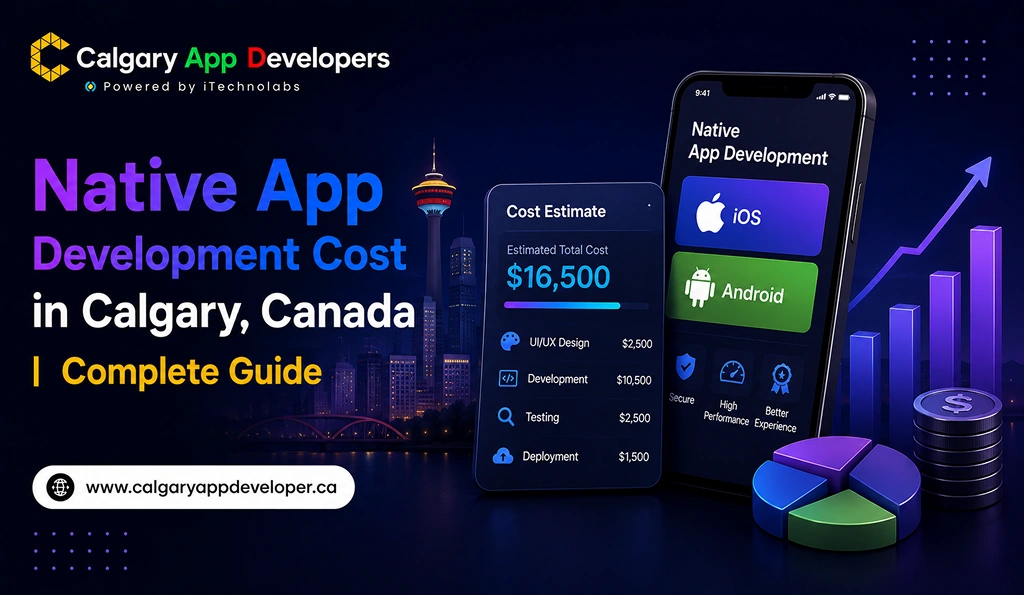
Smartphone application development cost in Canada typically ranges from CAD $25,000 to $200,000+, depending on platform choice, app complexity, feature scope, design standards, backend architecture, and the experience level of the development team. That range reflects genuine variation in project scope. A focused single-platform MVP with core functionality sits at the lower end. A dual-platform enterprise application with real-time data, AI-powered features, complex integrations, and advanced security sits at the higher end.
Here’s a realistic smartphone application development cost breakdown covering the complete development lifecycle.
Total Cost Estimation Table
| Development Stage | Description | Estimated Cost (CAD) |
| Discovery and Planning | Requirements analysis, platform strategy, feature definition, and technical planning | $2,500 to $8,000 |
| UI and UX Design | Wireframes, visual design for target platforms, user flow mapping, interactive prototypes | $5,500 to $20,000 |
| Backend Development | Server logic, APIs, databases, third-party service integrations | $7,500 to $35,000 |
| Smartphone Frontend Development | Platform-specific or cross-platform codebase, UI implementation, and feature development | $10,000 to $55,000 |
| Quality Assurance | Functional testing, device compatibility across iOS and Android, and performance testing | $4,000 to $14,000 |
| Deployment | App Store and Google Play setup, provisioning, and release management | $1,000 to $4,000 |
| Project Management | Sprint coordination, milestone tracking, stakeholder communication | $2,500 to $12,000 |
| Post-Launch Support | Bug fixes, OS compatibility updates, minor enhancements | $4,000 to $20,000 per year |
| Total Estimated Cost | From discovery through post-launch | $25,000 to $200,000+ |
These benchmarks represent realistic smartphone application development cost figures for Canadian projects in 2026, scoped for products optimized for quality and long-term maintainability.
Smartphone Application Development Cost by App Type and Complexity
Smartphone application development cost in Canada varies substantially based on the type of app you’re building and the technical complexity it requires. Feature scope, backend architecture, platform selection, design standards, security requirements, and scalability planning all interact to determine where your project lands in the range.
The table below outlines how complexity affects total investment and development timeline based on our experience across industries and product types.
Estimated Smartphone Application Development Cost by Complexity
| App Complexity | Typical Features | Estimated Cost (CAD) | Estimated Timeline |
| Basic App | Limited screens, simple UI, minimal backend, single platform | $25,000 to $55,000 | 6 to 10 weeks |
| Moderate App | User accounts, API integrations, dashboards, notifications, dual platform | $55,000 to $110,000 | 3 to 6 months |
| Complex App | Real-time features, AI integration, custom backend, enterprise scale, dual platform | $110,000 to $200,000+ | 6 to 12 months |
These estimates include design, development, testing, and deployment. Platform choice affects where within each tier your project lands.
- Basic Smartphone Applications
Basic smartphone apps typically cost between CAD $25,000 and $55,000 and are well-suited for startups validating an early-stage idea, businesses launching a focused internal tool, or products with a clearly defined single-platform user base.
Key Features
- Static or semi-dynamic content screens.
- Simple platform-native navigation structure.
- Basic user authentication with email or social login.
- Minimal third-party integrations.
- Standard iOS or Android UI component library implementations.
- Limited backend logic with straightforward data storage.
- Single user role with simple interaction flows.
- Basic push notification support.
- Single-platform deployment to iOS or Android.
The smartphone app development cost at this tier reflects the focused scope and reduced infrastructure needs. It’s the right starting point when you need to validate demand before committing to dual-platform development or advanced feature investment.
- Moderate Complexity Smartphone Applications
Moderate complexity smartphone apps typically fall in the CAD $55,000 to $110,000 range and serve growing businesses that need data-driven features, external service integrations, a polished user experience, and deployment across both iOS and Android.
Key Features
- User registration, profiles, and account management.
- Payment gateway integration with subscription support.
- Push notifications and in-app messaging.
- Third-party API integrations with external platforms and services.
- Admin or management dashboard for internal team use.
- Cloud-based backend with structured data models and access controls.
- Analytics, usage reporting, and event tracking.
- Multi-screen navigation with platform-appropriate UI patterns.
- Offline access with local data storage and sync on reconnect.
- Role-based access for multiple user types.
- Performance optimization for a range of iOS and Android device types.
Architecture decisions matter significantly at this tier. State management, backend structure, and third-party integration stability all need deliberate planning. Smartphone application development cost increases here because the technical scope is genuinely broader, not because of padding.
- Complex and Enterprise-Level Smartphone Applications
Complex smartphone apps typically start at CAD $110,000 and regularly exceed $200,000, requiring custom engineering, advanced infrastructure design, and long-term scalability planning. This tier covers enterprise platforms, fintech products, healthcare systems, on-demand service networks, and large-scale marketplaces.
Key Features
- Real-time data synchronization across users and connected devices.
- On-device AI and machine learning features using Core ML (iOS) or ML Kit (Android).
- Custom backend architecture built for high availability and scale.
- Advanced security standards and compliance requirements, including PIPEDA.
- Multi-role user access with granular permission systems and audit logging.
- High-volume transaction handling with reliable performance under concurrent load.
- Foldable device and large-screen layout support for enterprise user bases.
- 5G-optimized architecture for low-latency real-time interactions.
- Bilingual UI support for English and French for the national Canadian market.
- Integration with enterprise systems, including ERPs, CRMs, and data platforms.
- Comprehensive monitoring, alerting, and incident response infrastructure.
- Deep hardware integration, including Bluetooth LE, NFC, camera, and sensors.
At this level, smartphone application development cost reflects specialized expertise, extended timelines, larger team composition, and ongoing infrastructure investment. Defining the right complexity tier before development starts is one of the most reliable ways to control cost and prevent scope misalignment from surfacing mid-project.
Key Factors That Impact Smartphone Application Development Cost
Smartphone application development cost is shaped by interacting decisions across platform strategy, feature scope, architecture, team structure, compliance requirements, and long-term maintenance planning. Here’s where the real cost levers sit.
- Developer Location in Canada
Where your development team is based has a direct and measurable effect on hourly rates and total project investment. Smartphone developer rates vary across Canadian cities based on market demand, local cost of living, and talent availability.
Average Smartphone Developer Hourly Rates by Canadian City
| City | Average Hourly Rate (CAD) |
| Toronto | $95 to $155 |
| Vancouver | $90 to $145 |
| Calgary | $65 to $110 |
| Ottawa | $75 to $125 |
| Montreal | $70 to $118 |
Calgary consistently offers one of the most cost-effective smartphone development markets in Canada while maintaining strong technical depth across both iOS and Android specializations. For businesses that want experienced Canadian developers without paying Toronto or Vancouver market premiums, Calgary is the practical choice that doesn’t require the offshore accountability trade-off.
- Platform Choice: iOS, Android, or Both
Platform selection is the single most consequential cost decision in smartphone application development planning. It affects development hours, design effort, testing scope, App Store management, and ongoing maintenance investment simultaneously.
Building for iOS only or Android only at launch reduces frontend development cost by roughly 40 to 50 percent compared to a dual-platform build from day one. The backend can be shared regardless of platform choice, but each platform requires its own UI implementation, platform-specific design adaptation, and dedicated QA validation cycle. Launching on one platform first and expanding to the second three to six months later is a proven cost-control strategy that works well when your highest-value users are concentrated on one platform at launch.
- App Features and Functional Scope
Feature scope drives smartphone application development cost more directly than any other product-side variable. Every feature adds design time, development effort, testing cycles, and long-term maintenance work. Scope elements that carry the most cost weight include real-time messaging or location tracking, payment and subscription management, multi-role access with permission logic, data-heavy dashboards, advanced search and filtering, offline access with background sync, deep linking, push notification logic, and complex third-party integrations. Defining a clear MVP before development begins is the most reliable way to control initial smartphone application development cost and prevent scope expansion that inflates the budget without delivering proportional user value.
- Development Approach: Native vs Cross-Platform
The technical approach you choose for smartphone app development directly affects cost, performance, and long-term maintenance overhead. Native development in Swift (iOS) and Kotlin (Android) delivers the highest performance ceiling and deepest hardware access at the cost of two separate codebases. Cross-platform frameworks like Flutter and React Native share most code across both platforms, which reduces frontend development cost meaningfully for standard mobile products. The right choice depends on your product’s specific hardware requirements, performance standards, and your team’s existing skills.
- Technology Stack and Backend Architecture
Backend decisions shape both initial development cost and long-term infrastructure investment. The smartphone frontend connects to any backend, but backend complexity varies significantly based on data requirements, scalability needs, and integration depth.
Common Smartphone App Technology Stack and Cost Impact
| Technology Component | Options | Cost Influence |
| Frontend Approach | Native Swift/Kotlin, Flutter, React Native | Cross-platform reduces frontend cost; native raises it |
| State Management | BLoC, Riverpod, Redux, Context API, ViewModel | Complex patterns add to the architecture planning time |
| Backend | Node.js, Django, .NET, Firebase, Supabase | Custom backends raise cost vs. BaaS options |
| Database | Firebase, PostgreSQL, MongoDB, Supabase, Core Data | Data modeling complexity affects setup effort |
| Cloud Hosting | AWS, Google Cloud, Azure | Advanced configuration increases infrastructure cost |
| Integrations | Payments, maps, analytics, auth, notifications | Each adds development, testing, and maintenance time |
Advanced stack choices may increase initial smartphone application development cost, but typically reduce long-term technical debt and future rework.
- UI and UX Design Complexity
Design quality has a direct effect on user adoption, retention, and App Store ratings. Higher design standards require more specialist involvement and more time, which measurably raises smartphone application development cost. Design cost drivers include custom component builds outside standard platform libraries, branded animation systems and micro-interactions, interactive prototype development for stakeholder review, accessibility compliance for both VoiceOver (iOS) and TalkBack (Android), and multi-device layout optimization across phone sizes, tablets, and foldable devices. Strong design pays back through lower churn and better review scores, but it needs to be sized appropriately for your product’s current stage.
- Backend Infrastructure and Scalability Planning
Smartphone apps that gain traction require stronger backend infrastructure than the initial build was sized for. Infrastructure cost drivers include custom API development with complex data models, scalable cloud architecture with load balancing, database query optimization under high volume, real-time data synchronization across connected users, and monitoring and alerting infrastructure that surfaces issues before they affect users. Planning for scale from the initial architecture conversation is always cheaper than retrofitting it after a traffic spike reveals the limits of the initial design.
- PIPEDA Compliance and Security Engineering
For any smartphone app serving Canadian users and collecting personal information, PIPEDA compliance is a legal requirement that shapes architecture from the start. Building it in correctly is significantly cheaper than retrofitting it post-launch. PIPEDA-related engineering costs include explicit consent flow design and implementation on both iOS and Android, data use disclosure mechanisms embedded in the user experience, user data access and deletion request handling, encrypted storage using platform-native security frameworks, and secure data transmission practices. For healthcare, fintech, and any product handling sensitive personal data, additional provincial requirements may also apply on top of the PIPEDA baseline.
- Development Team Structure and Experience Level
Team composition affects delivery speed, architecture quality, and long-term product stability. Senior smartphone developers command higher rates but consistently deliver cleaner codebases, better architecture decisions, and fewer post-launch issues that require expensive emergency fixes. Team-related cost variables include the ratio of senior to mid-level developers, dedicated QA involvement throughout development rather than only at the end, project management depth and milestone cadence, DevOps and CI/CD pipeline setup, and ongoing maintenance planning from the initial engagement. Experienced teams that get the architecture right the first time reduce total smartphone application development cost over the product’s lifetime, even when their initial rates are higher.
Hidden Smartphone Application Development Costs You Should Plan For
Smartphone application development cost is consistently underestimated because many real expenses don’t appear in an initial proposal or scope document. These costs surface during development or after launch, and they catch businesses off guard when they haven’t been planned for early. Here are the hidden cost areas that matter most for Canadian smartphone app projects.
- Third-Party Services and Licensing Fees
Most smartphone apps depend on external services that operate on recurring pricing models, not one-time fees. Their cost grows as your user base scales. Common hidden expenses include payment gateway transaction fees applied to every processed payment, mapping and location API calls priced by usage volume, push notification platforms that charge by message volume at scale, analytics and crash reporting subscriptions, and communication platforms for SMS, email, or in-app messaging. These feel negligible early and can become high monthly operational costs as adoption grows. Budget for them as recurring line items from day one.
- Device Testing Across iOS and Android Hardware Range
Smartphone apps need to be validated across a meaningful range of physical hardware on both platforms. Cost drivers include testing across multiple iOS versions on different iPhone and iPad models, testing across Android’s wide device matrix covering different manufacturers, screen sizes, and OS versions, performance validation on lower-end Android devices where memory and processing constraints are real, and compatibility fixes triggered by new iOS and Android annual releases that change system behavior. Skipping thorough physical device testing is one of the fastest ways to generate negative App Store reviews that are hard to recover from post-launch.
- Dual App Store Management and Compliance Changes
Building for both iOS and Android means managing two separate submission processes, two sets of review guidelines, and two compliance ecosystems on independent update timelines. Hidden dual App Store costs include policy-related code changes triggered by Apple and Google updating their guidelines separately, privacy permission declaration reviews and updates on both platforms, security patch implementation for flagged vulnerabilities, and resubmission efforts after rejections or policy revisions. Apple and Google update their review guidelines on their own timelines, which means compliance work happens on two calendars rather than one.
- Smartphone OS Version Fragmentation
Unlike web applications, smartphone apps need to maintain compatibility across multiple active OS versions simultaneously. Android’s fragmentation is particularly significant: a meaningful portion of active Android users run OS versions that are several releases behind current. Cost drivers include testing and compatibility validation across a defined range of iOS and Android versions, fixing OS-specific rendering or behavior issues that surface on older versions, and engineering decisions that balance modern API usage against backwards compatibility requirements. Planning the supported OS version range before development begins directly affects how much compatibility overhead you carry.
- Post-Launch Maintenance and Support
Launching is the beginning of the investment, not the end. Maintenance is a recurring cost that most initial budget discussions significantly undervalue. Post-launch cost considerations include bug fixes surfaced by real user behavior that testing didn’t catch, performance tuning under live traffic conditions, iOS and Android annual OS releases that require compatibility work on both platforms, minor feature enhancements driven by user feedback, and infrastructure monitoring and incident response. A reasonable annual baseline for smartphone app maintenance is 15 to 20 percent of the original development investment. Plan for it from the start rather than treating it as an unexpected expense after launch.
- PIPEDA Compliance and Privacy Engineering
For Canadian smartphone apps handling personal information, PIPEDA compliance carries real implementation costs that aren’t always included in initial proposals. PIPEDA-related costs include building explicit consent flows before any personal data collection on both iOS and Android, implementing user data access and deletion request handling, ensuring encrypted local storage using platform-native security frameworks, secure data transmission practices across all API calls, and reviewing and updating privacy documentation as the app evolves. For apps in healthcare, fintech, or any sector where sensitive data is core to the product, additional provincial requirements may also apply. These belong in your budget from day one.
- Bilingual App Support for National Market Reach
Canadian businesses targeting a national audience need English and French language support in consumer-facing smartphone apps. Adding bilingual support after launch is significantly more expensive than building it in from the start, and it requires implementation on both iOS and Android separately. Bilingual engineering costs include implementing iOS localization using Localizable. strings and Xcode’s localization workflow, implementing Android localization using string resource files, translating all in-app content and error messages accurately, testing layout integrity across both language variants since French strings are typically longer than English equivalents, and maintaining bilingual parity through every future feature release. If national reach is on your product roadmap, this cost belongs in your initial scope.
- On-Device AI and 5G Feature Complexity
In 2026, user expectations for intelligent personalization, real-time responsiveness, and predictive features are higher than they were two years ago. Adding on-device AI inference through Core ML or ML Kit, implementing 5G-optimized streaming or real-time sync, or supporting foldable device layouts all carry engineering costs that aren’t always visible in initial project scoping. These aren’t edge case requirements anymore, particularly for consumer apps in healthcare, fitness, fintech, and e-commerce. Plan for them explicitly if your product’s competitive positioning depends on these capabilities.
- Scalability and Infrastructure Growth
Smartphone apps that gain traction require stronger infrastructure than the initial build was sized for. Infrastructure-related hidden costs include increased cloud server capacity as concurrent user volume grows, database scaling and query optimization under production load conditions, load balancing and uptime monitoring configuration, CDN setup for faster content and asset delivery, and emergency engineering work when infrastructure limits are hit unexpectedly. Designing for scale from the initial backend architecture discussion reduces this risk, but doesn’t eliminate the ongoing operational cost of managing infrastructure as the product grows.
Native vs Cross-Platform vs PWA: Smartphone App Cost Comparison
The development approach decision is one of the most consequential choices in smartphone application development planning, and it’s worth being honest about what each option actually delivers at what cost. Here’s how the approaches compare on the factors that most directly affect total investment and product outcomes.
| Factor | Native (iOS + Android) | Cross-Platform (Flutter/RN) | Progressive Web App |
| Codebase | Separate Swift and Kotlin codebases | Single shared codebase for iOS and Android | Single web codebase; no App Store required |
| Development Cost (CAD) | $40,000 to $200,000+ | $25,000 to $170,000+ | $15,000 to $60,000 |
| Timeline | Longest: two parallel development tracks | Moderate; one build covers both platforms | Fastest; web-based delivery |
| Performance | Highest; direct platform API access | High to very high; varies by framework | Moderate; limited by browser APIs |
| Hardware Access | Full depth; all iOS and Android APIs | Partia, complex features need native modules | Limited; restricted to browser-exposed APIs |
| App Store Distribution | Full iOS and Android distribution | Full iOS and Android distribution | No App Store listing; browser-based access |
| Best For | Deep hardware integration, maximum performance, platform-exclusive features | Multi-platform reach, cost efficiency, standard mobile products | Content-first products, marketing tools, limited-scope web apps |
Native smartphone development is worth the premium when your product’s core value depends on hardware capabilities, platform-exclusive security integrations, or performance requirements that cross-platform frameworks can’t meet reliably. Cross-platform is the better cost choice for most standard consumer and enterprise smartphone apps, where Flutter or React Native can deliver an equivalent user experience at a meaningfully lower total cost. PWA makes sense for content-first products or marketing tools where App Store distribution isn’t a requirement and development speed matters more than native capabilities.
Smart Ways to Reduce Smartphone Application Development Cost Without Sacrificing Quality
Managing smartphone application development cost effectively means making better decisions earlier in the process, not cutting scope that users actually need. Here’s what genuinely works based on direct project experience.
1. Define the Scope:
Every scope change mid-project adds rework, retesting, and team coordination overhead that compounds across the remaining timeline. Investing time in thorough requirements documentation and feature prioritization before development begins directly reduces total smartphone application development cost. This is proportionally more valuable on dual-platform projects because every late addition affects both iOS and Android simultaneously.
2. Build an MVP First:
A focused MVP with essential features lets you test demand with real users before committing to full-scale development. Launching on a single platform first reduces initial cost while still giving you a real market signal. Use what you learn from the MVP to guide the second platform build and the first major feature expansion, not pre-launch assumptions.
3. Choose the Right Development Approach:
Cross-platform frameworks like Flutter and React Native deliver an equivalent user experience to native for most standard smartphone products at a meaningfully lower cost. Native development’s premium is justified when your product needs deep hardware integration, platform-exclusive features, or the highest possible performance ceiling. Getting this decision right before development starts is one of the largest single cost levers available in smartphone app planning.
4. Share the Backend Across:
Whether you’re building native iOS and Android separately or using a cross-platform framework, a well-designed shared backend serves all platforms from a single API layer. That eliminates backend duplication and ensures every dollar invested in server infrastructure and business logic pays back across all platforms simultaneously.
5. Leverage Platform Libraries:
Both iOS and Android provide extensive first-party libraries for common needs. Apple’s AVFoundation, MapKit, AuthenticationServices, and StoreKit are production-grade frameworks. Android’s equivalent Jetpack components serve the same role. For cross-platform builds, Flutter’s pub.dev and React Native’s npm ecosystem both have well-maintained packages for payments, authentication, maps, notifications, and analytics. Using proven solutions instead of custom builds reduces development hours, testing effort, and long-term maintenance costs.
6. Plan Scalable Backend Architecture:
Backend systems that aren’t designed for growth require expensive structural changes when user demand scales faster than expected. Building scalability into the initial architecture discussion is always cheaper than retrofitting it under pressure. For smartphone apps targeting meaningful user volume, this is an investment that pays back reliably.
7. Phase Platform Delivery:
Building iOS first and launching Android three to six months later, or vice versa, allows you to validate demand on one platform before committing to the full dual-platform investment. The second platform builds benefits from the architecture and design decisions already established on the first. That efficiency reduces total smartphone application development cost compared to true parallel dual-platform development from day one.
8. Invest in Testing Throughout:
Teams that treat QA as a final-phase activity consistently spend more fixing late-discovered issues than they would have spent catching them early. Automated testing, continuous device testing across both platforms, and structured QA involvement throughout development reduce post-launch bug fix costs and protect App Store ratings from avoidable launch-day defects.
9. Explore Canadian Government Funding Programs:
Canadian businesses investing in smartphone application development may qualify for SR&ED (Scientific Research and Experimental Development) tax credits if the project involves genuine technical innovation. CDAP (Canada Digital Adoption Program) grants are designed to help small and medium-sized Canadian businesses adopt digital technology tools. Both programs can meaningfully offset smartphone application development costs and are worth discussing with your accountant or a funding specialist before finalizing your development budget.
Our Proven Expertise in Smartphone App Development
Building a successful smartphone application is not just about writing code. It requires understanding how users behave in real environments, how systems perform under pressure, and how every interaction affects retention, trust, and long-term growth. Our experience delivering smartphone applications across different industries has given us practical insight into what separates functional apps from products users actually rely on every day.
Here are two examples that reflect our hands-on expertise in building scalable, high-performance smartphone applications for real-world use cases.
1. Zefir: Request a Ride
Zefir is an on-demand ride booking application built to make urban transportation faster, simpler, and more transparent. The platform allows users to request rides instantly and get connected with nearby top-rated drivers in real time through a streamlined mobile experience.
The product was designed around one core goal: to reduce friction at every stage of the ride booking process while maintaining reliability under real-time demand conditions.
Core Features Delivered
- One tap ride booking flow optimized for fast user actions
- Real-time driver matching and live ride tracking
- Upfront fare visibility before ride confirmation
- Ride history, booking management, and digital receipts
- Driver ratings and passenger feedback system
- Integrated secure payment processing within the app
- Real-time trip updates and notification handling
Technical Highlights
- Real-time location tracking integrated with advanced mapping services
- Optimized driver assignment logic for faster pickup matching during peak traffic periods
- Shared API architecture supporting both iOS and Android applications efficiently
- Secure fare calculation and payment infrastructure
- Scalable backend capable of handling simultaneous ride requests and live tracking events
Zefir demonstrates our ability to build location-based smartphone applications where speed, reliability, and real-time synchronization directly influence user trust. These are the types of products where even small performance delays affect retention, and the platform consistently delivered a smooth user experience under demanding operational conditions.
2. Hive: Personal Safety App
Hive is a personal safety smartphone application designed to help combat violence against women and girls through community-driven protection and emergency communication tools. The app enables users to build a trusted safety network and instantly connect with people who can respond during unsafe situations.
The platform focuses on immediate communication, location visibility, and fast emergency escalation when users need help most.
Core Features Delivered
- Real-time location sharing with trusted contacts
- Emergency alert system for rapid distress communication
- Instant messaging and safety check-in functionality
- Trusted community network creation and management
- Live status updates during emergencies
- Push notification system for urgent safety alerts
- Secure user authentication and privacy protection controls
Technical Highlights
- Real-time communication infrastructure designed for low-latency emergency responses
- Secure location sharing system with controlled user permissions
- Cross-platform smartphone application delivery for both Android and iOS
- Scalable backend architecture supporting live communication events
- High availability notification system for critical emergency alerts
Hive reflects our experience building smartphone applications where reliability is tied directly to user safety and trust. Applications like this require more than clean UI design. They demand stable architecture, dependable real-time communication systems, strong privacy controls, and consistent performance during high urgency situations.
These projects highlight the breadth of our smartphone app development expertise across transportation, safety, real-time communication, and location-based technologies. More importantly, they show our ability to build applications that solve practical user problems while maintaining the scalability and performance businesses need for long-term growth.
Why Businesses Choose Us for Smartphone App Development in Canada
Businesses across Canada choose Calgary App Developer because we combine real smartphone engineering expertise with transparent delivery practices and genuine accountability for outcomes, not just code output.
1. AI-Powered Development Where It Adds Measurable Value:
We integrate AI capabilities into smartphone apps where they genuinely improve user experience or business performance. That means on-device inference using Core ML and ML Kit, intelligent personalization, predictive features, and smart automation built on real usage data. We add AI when it makes the product work better for the people using it, not because it looks good in a proposal.
2. Proven Experience Across Platforms, Industries, and Complexity Levels:
Our smartphone development work spans on-demand platforms, engagement apps, enterprise internal tools, and startup MVPs across iOS and Android in multiple industries. We’ve seen what works at each complexity tier and apply that experience to help clients avoid the architectural decisions that look fine at the start and create expensive problems six months later.
3. Transparent Smartphone Application Development Cost:
You’ll know what your project costs before we write a line of code. Detailed cost breakdowns by platform and development stage, realistic timelines, and clear scope documentation are standard parts of every engagement. We don’t give optimistic estimates to win work and manage scope expansions later. We give accurate ones so you can plan and commit with confidence.
4. Scalable Architecture Built for Long-Term Product Growth:
Every smartphone app we build uses a clean, layered architecture designed to grow without requiring expensive rebuilds as user demand scales. Whether you’re launching with 500 users or scaling to 500,000, the codebase and backend infrastructure should be assets, not constraints. We design for scale from the start because retrofitting it later always costs more.
5. Full Accountability Through Every Phase of Delivery:
You work with a dedicated team, not a rotating roster of contractors. Regular milestone reviews, transparent progress reporting, and direct communication with the developers building your product are standard elements of how we work. That accountability structure directly reduces the risk of late-stage surprises and budget overruns.
6. Bilingual Development Capability for National Market Reach:
For Canadian businesses building smartphone products for a national audience, English and French localization is a real requirement. Our team implements full bilingual support on both iOS and Android, which means your app ships bilingual without requiring a separate localization sprint after launch.
7. Free Smartphone App Consultation:
Before you commit any budget, talk to our team. Our free consultation covers platform strategy, technical feasibility, realistic smartphone application development cost estimation, feature prioritization, and growth planning specific to your product. You’ll leave with a clearer view of scope, investment, and the right development approach for your situation.
Conclusion
Understanding smartphone application development cost in Canada is about more than getting a number to put into a business case. It’s about making informed decisions that balance platform strategy, functionality, performance, scalability, and long-term product value from the first planning conversation. Costs vary based on platform choice, app complexity, design standards, team location, and ongoing maintenance commitments, but clarity at the planning stage makes those costs predictable and manageable.
The businesses that get the most from their smartphone app investment are the ones that chose the right platform strategy for their actual user base, defined a clear scope before development started, planned for hidden costs from the beginning, and worked with a development partner that delivered genuine accountability alongside technical execution.
With the right smartphone application development company, cost becomes a strategic advantage rather than an uncertainty. A well-planned smartphone app isn’t just a development expense. It’s a long-term business asset designed to grow, adapt, and deliver measurable returns across its full lifecycle.
Talk to the Calgary App Developer team today and get a clear, honest view of what your smartphone app will cost to build right.
FAQs
1. How much does smartphone application development cost in Canada in 2026?
Smartphone application development cost in Canada typically ranges from $25,000 to $200,000+ CAD, depending on platform choice, app complexity, feature scope, backend architecture, and team location. A focused single-platform MVP with core functionality sits at the lower end. A complex dual-platform enterprise application with real-time data, AI features, and advanced security sits at the higher end. Getting a detailed, scope-based estimate from an experienced smartphone development team is the only reliable way to land an accurate number for your specific product.
2. What’s the biggest factor that affects smartphone application development cost?
Platform choice is the single most consequential cost decision in smartphone app planning. Building for iOS only or Android only at launch reduces frontend development cost by roughly 40 to 50 percent compared to a dual-platform build from day one. Feature scope is the next most significant driver: every feature adds design, development, testing, and ongoing maintenance work. Defining a clear MVP scope and choosing the right platform strategy before development begins have more impact on total smartphone application development cost than any other decision.
3. Is it cheaper to build a cross-platform smartphone app or a native one?
Cross-platform development using Flutter or React Native is meaningfully cheaper than building separate native iOS and Android apps for most standard smartphone products. A shared codebase covers both platforms from one development effort, which reduces frontend hours, testing scope, and long-term maintenance costs. Native development’s higher cost is justified when your product requires deep hardware integration, platform-exclusive features, or performance levels that cross-platform frameworks can’t reliably deliver. For most consumer and enterprise smartphone apps that don’t require those capabilities, cross-platform delivers an equivalent user experience at a lower total cost.
4. How long does smartphone application development take in Canada?
Smartphone application development timelines range from 6 to 10 weeks for a basic single-platform MVP, 3 to 6 months for a moderate complexity dual-platform app with integrations and custom backend, and 6 to 12 months for complex or enterprise-level applications on both platforms. These timelines include design, development, testing, and App Store submission. Projects that compress design or testing phases consistently produce post-launch issues that cost more to fix than the time saved upfront.
5. What hidden costs should I plan for in smartphone app development?
The hidden costs that catch Canadian businesses off guard most often include third-party service fees that grow with user volume, dual App Store compliance management on separate Apple and Google timelines, OS version fragmentation testing across iOS and Android, PIPEDA compliance engineering for apps collecting personal data, bilingual localization for national market reach, post-launch maintenance and OS compatibility updates, on-device AI and 5G feature complexity, and infrastructure scaling costs as user demand grows. All of these are predictable expenses that belong in your initial budget rather than being discovered after launch.
6. How does PIPEDA affect smartphone application development cost in Canada?
PIPEDA requires Canadian smartphone apps collecting personal information to implement explicit consent flows before data collection, clear data use disclosures, user data access and deletion capabilities, encrypted storage practices, and secure data transmission. Building these correctly from the start adds engineering effort to your smartphone application development cost, but it’s significantly cheaper than retrofitting compliance after launch. For healthcare, fintech, and consumer apps handling personal data, PIPEDA-compliant architecture is a baseline legal requirement that belongs in your initial scope and budget, not a future-phase consideration.
7. Why does smartphone application development cost vary across Canadian cities?
Smartphone developer hourly rates reflect local market conditions, cost of living, and demand for specialized platform expertise. Toronto and Vancouver consistently charge the highest rates in Canada. Calgary offers senior-level iOS and Android expertise at rates that are meaningfully more competitive, without the dual-platform coordination risks that offshore development introduces. Offshore options often appear cheaper upfront but regularly accumulate hidden costs through revision cycles, communication friction, and post-launch accountability gaps that erode the initial savings quickly, particularly on complex multi-platform projects.
8. How do I get an accurate smartphone application development cost estimate?
An accurate estimate requires documented user flows, a defined feature set with clear scope boundaries, platform strategy covering iOS, Android, or both, technical requirements around integrations and scalability, security and compliance needs including PIPEDA, and a clear understanding of your target audience and go-to-market timeline. Sharing those inputs with an experienced smartphone development team allows them to give you a realistic, scope-based cost breakdown rather than a broad estimate that may not reflect what you’re actually building. At Calgary App Developer, our free consultation covers platform strategy, technical feasibility, realistic cost estimation, and growth planning so you have the clarity to move forward confidently.


Pankaj Arora is a seasoned technology leader and the Founder of Calgary App Developer, with 10+ years of expertise in crafting high-performance digital solutions. His core competencies include full-stack app development, cloud-native architecture, API integration, and agile product delivery. Under his leadership, Calgary App Developers has empowered startups and enterprises alike with scalable mobile applications, secure web platforms, and AI-driven SaaS products.