








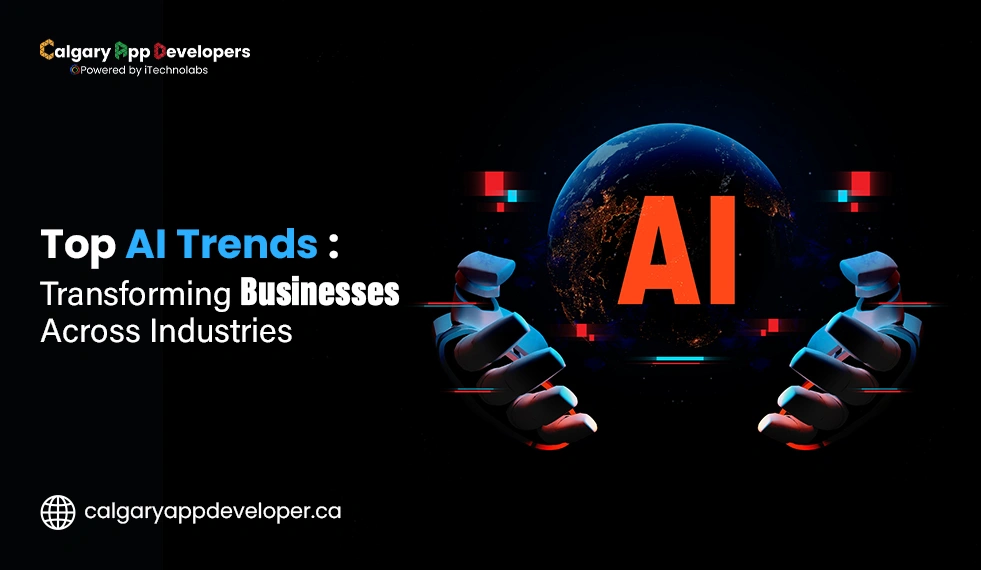
Top AI Trends in 2026: Transforming Businesses Across Industries
Artificial intelligence has transitioned from being a future concept that people studied in boardrooms and research labs to becoming an essential element that businesses use for their operations and their competitive growth. In 2026, organizations across all sectors will stop testing AI technology and start using it as a fundamental component in their daily operations, which includes decision processes and customer interactions, product development, and efficiency improvement activities.
What sets this phase apart is the speed and scale of adoption. Businesses are not just using AI to automate routine tasks. They are leveraging it to uncover insights, predict outcomes, and create more personalized experiences at a level that was not possible before. As a result, AI is becoming a defining factor in how companies differentiate themselves in crowded markets.
At the same time, the AI landscape is evolving rapidly. New capabilities are emerging, existing technologies are maturing, and the integration of AI with other digital innovations is opening up entirely new possibilities. For business leaders, staying informed about these shifts is no longer optional. It is essential for making strategic decisions that remain relevant in a competitive environment.
This blog explores the most important AI trends shaping 2026, how they are transforming industries, and what organizations need to do to stay ahead.
- AI in 2026 has shifted from experimentation to full-scale business integration.
- Enterprises are using AI to drive automation, decision-making, and personalization.
- The real value of AI comes from measurable ROI, not adoption alone.
- Businesses that align strategy, data, and talent with AI will lead their industries.
- Artificial intelligence is becoming a foundational part of business operations, influencing how companies compete, innovate, and grow across industries.
- The global AI market is expanding rapidly, driven by enterprise adoption, large-scale investments, and the growing use of generative and applied AI technologies.
- Businesses are moving beyond pilot projects and deploying AI across core functions such as operations, customer experience, and decision-making systems.
- Agentic AI and intelligent automation are enabling systems to handle complex workflows with minimal human input, improving efficiency and reducing operational costs.
- Generative AI is now a standard capability across departments, helping organizations create content, write code, and enhance communication at scale.
- AI-driven decision intelligence allows companies to move from reactive insights to predictive and prescriptive strategies, improving accuracy and speed in decision-making.
- Hyper-personalization powered by AI is transforming customer engagement by delivering highly relevant experiences based on real-time data and behavior analysis.
- The convergence of AI with cloud, data platforms, IoT, and other technologies is creating integrated ecosystems that accelerate innovation and scalability.
- Responsible AI and governance are becoming critical as businesses address challenges related to data privacy, bias, transparency, and regulatory compliance.
- Industry-specific AI models are improving accuracy and outcomes by tailoring solutions to sector-specific challenges in areas such as healthcare, finance, and manufacturing.
- AI is enhancing workforce productivity by augmenting human capabilities, allowing employees to focus on strategic and creative tasks rather than repetitive work.
- Organizations that succeed with AI prioritize clear business goals, strong data foundations, scalable infrastructure, and continuous performance measurement.
- The future of AI will be defined by deeper integration, more autonomous systems, and increased emphasis on ethical and responsible implementation.
AI in 2026: Market Growth, Adoption, and Key Statistics
Artificial intelligence is entering a phase of accelerated expansion, driven by enterprise adoption, rising investments, and rapid advancements in generative and applied AI. The numbers behind this shift reflect not just growth, but a structural transformation in how businesses operate.
Market Size and Growth Trajectory
- The global AI market is scaling at a pace rarely seen in modern technology cycles. Estimates suggest the market will reach approximately $757 billion in 2026, growing at nearly 19 percent annually.
- Long-term projections are even more aggressive. The market is expected to exceed $3.6 trillion by 2034, driven by sustained enterprise demand and widespread industry-wide integration.
- In parallel, global AI spending is surging. Businesses are projected to invest $2 trillion in AI technologies by 2026, highlighting how AI has moved from experimental budgets to core business expenditure.
Adoption Beyond Enterprises
- AI usage is not limited to organizations. Globally, about one in six people now actively uses generative AI tools, showing how deeply AI is integrating into everyday work and life.
- At the same time, adoption gaps persist across regions and industries, indicating that the growth curve is far from saturated and will continue to expand through the decade.
Taken together, these statistics point to a clear reality. AI in 2026 is not just growing. It is becoming foundational to business strategy, economic growth, and competitive advantage across industries.
Key AI Trends Transforming Businesses in 2026
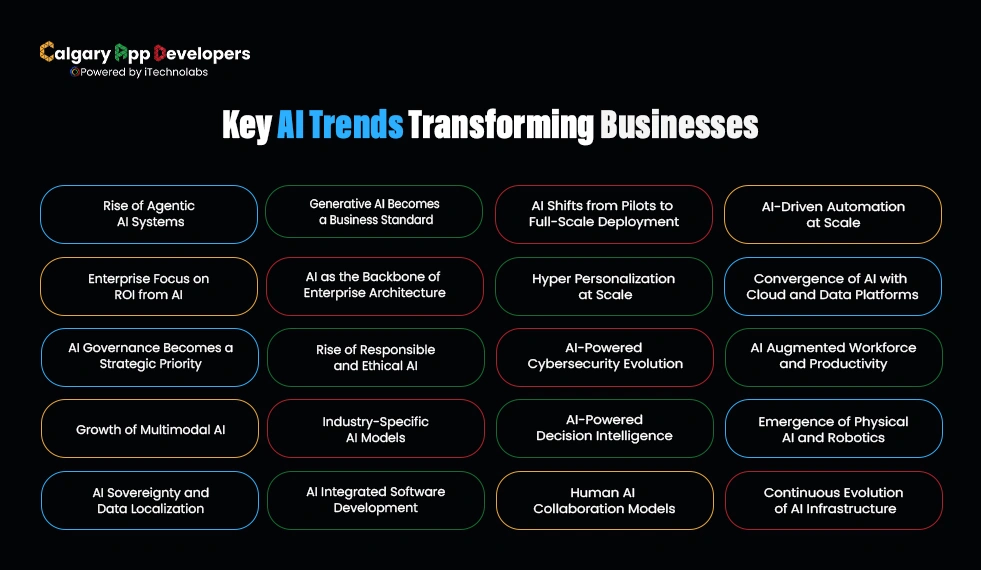
Artificial intelligence in 2026 is defined by maturity, scale, and real business impact. The focus has shifted from experimentation to measurable outcomes, with enterprises integrating AI deeply into their core operations. Below are the 20 most important trends shaping this transformation.
1. Rise of Agentic AI Systems
Agentic AI marks a fundamental shift from reactive tools to autonomous systems that can plan, execute, and optimize tasks with minimal human input. These systems are capable of handling multi-step workflows such as research, decision-making, and task execution across enterprise environments. As a result, businesses are redesigning operations around AI-driven workflows rather than using AI as a support layer.
Adoption is accelerating rapidly. Around 79 percent of organizations already report some level of agentic AI adoption, with most planning to expand usage further.
At the same time, Gartner predicts that 40 percent of enterprise applications will include AI agents by 2026, highlighting how quickly these systems are becoming embedded in core business software.
2. Generative AI Becomes a Business Standard
Generative AI has moved beyond experimentation and is now a standard capability across business functions. Organizations are using it to generate content, write code, design products, and automate communication at scale. What began as a productivity tool is now a key driver of innovation and speed.
In 2026, generative AI will no longer be limited to creative tasks. It is being integrated into enterprise systems to automate documentation, enhance customer interactions, and support decision-making. Its ability to process natural language and generate contextual outputs is making it accessible across departments, including non-technical teams.
The real impact lies in its scalability. Businesses can now produce high-quality outputs faster and at lower cost, which directly improves efficiency and competitive positioning.
Also Check: Top App Development Trends in North America
3. AI Shifts from Pilots to Full-Scale Deployment
Organizations are moving past proof-of-concept stages and deploying AI across entire business units. This shift reflects growing confidence in AI’s ability to deliver measurable value rather than just experimental insights.
Enterprises are embedding AI into core systems such as supply chain management, customer service platforms, and financial operations. This transition also signals a change in mindset. AI is no longer treated as an innovation initiative but as a core business capability.
The gap between adopters and leaders is becoming more visible. While many companies use AI in isolated functions, only a smaller group has successfully scaled it across operations. These organizations are seeing stronger returns through integrated and enterprise-wide AI strategies.
4. AI-Driven Automation at Scale
Automation in 2026 is no longer limited to repetitive tasks. AI is enabling intelligent automation that can handle complex, decision-based processes across industries. This includes areas such as fraud detection, demand forecasting, and workflow orchestration.
Businesses are using AI to automate entire processes rather than individual tasks. For example, in customer service, AI systems can handle inquiries, escalate issues, and generate responses without human intervention. In operations, AI can monitor systems, predict failures, and trigger corrective actions.
This shift is driving significant efficiency gains. Organizations can reduce operational costs while improving speed and accuracy. More importantly, employees are freed from routine work and can focus on higher-value activities that require human judgment.
5. Enterprise Focus on ROI from AI
As AI investments grow, businesses are increasingly focused on measurable returns rather than experimentation. Leaders now expect clear outcomes such as revenue growth, cost reduction, and productivity improvement. In fact, research shows that while AI adoption is widespread, only about 39 percent of organizations report any measurable enterprise-level financial impact from AI, highlighting the growing pressure to prove real value.
This trend is pushing organizations to prioritize high-impact use cases and align AI initiatives with business goals. Instead of adopting AI for the sake of innovation, companies are building strategies that deliver tangible value.
The pressure to demonstrate ROI is also influencing how AI projects are evaluated and scaled. Businesses are investing more in data quality, infrastructure, and talent to ensure successful implementation. This results-driven approach is turning AI into a strategic asset rather than a speculative investment.
6. AI as the Backbone of Enterprise Architecture
AI is becoming a foundational layer within enterprise systems rather than an add-on capability. Organizations are embedding AI into core architecture, including data platforms, cloud infrastructure, and business applications. This shift allows companies to build systems that are inherently intelligent, capable of learning, adapting, and optimizing in real time.
Instead of isolated AI tools, businesses are creating interconnected ecosystems where AI supports everything from operations to customer experience. This approach improves scalability, reduces fragmentation, and enables faster innovation.
As enterprises modernize their tech stacks, AI is increasingly shaping how systems are designed, integrated, and maintained across the organization.
Read Also: Digital Product Development Trends for 2026 & Beyond
7. Hyper Personalization at Scale
Personalization has evolved into a real-time, data-driven strategy powered by AI. Businesses can now analyze large volumes of customer data to deliver highly relevant content, recommendations, and experiences across multiple touchpoints. This level of personalization was not feasible with traditional systems.
AI enables companies to understand user behavior, preferences, and intent with greater precision. As a result, organizations can tailor interactions in ways that improve engagement, loyalty, and conversion rates.
Recent data shows that 71 percent of consumers now expect personalized interactions, while 76 percent feel frustrated when brands fail to deliver them, highlighting how critical personalization has become for modern businesses.
In addition, 77 percent of consumers are more likely to purchase from brands that offer relevant, personalized experiences, making hyper-personalization a direct driver of revenue growth and customer retention.
8. Convergence of AI with Cloud and Data Platforms
AI is tightly integrated with cloud computing and advanced data platforms, enabling businesses to process and analyze data at scale. Cloud infrastructure provides the computational power needed to train and deploy AI models efficiently, while modern data platforms ensure seamless access to high-quality data.
This convergence allows organizations to move faster, reduce infrastructure costs, and scale AI initiatives without heavy upfront investments. It also supports real-time analytics, enabling businesses to make faster and more informed decisions.
As a result, companies are shifting toward unified ecosystems where AI, cloud, and data work together to drive innovation and operational efficiency.
9. AI Governance Becomes a Strategic Priority
As AI adoption grows, governance is becoming essential for managing risks and ensuring responsible use. Organizations are developing frameworks to address issues such as data privacy, model bias, regulatory compliance, and transparency.
This trend reflects a broader shift toward accountability in AI deployment. Businesses are no longer focused only on performance but also on how AI systems make decisions and impact stakeholders.
Recent data highlights how critical governance has become. Around 72 percent of S&P 500 companies disclosed at least one material AI-related risk in 2025, up sharply from just 12 percent in 2023, showing how rapidly AI governance has moved to the top of enterprise priorities.
Strong governance not only reduces risk but also supports long-term scalability and sustainability of AI initiatives. Businesses that invest in governance frameworks are better positioned to build trust, meet regulatory requirements, and scale AI responsibly.
10. Rise of Responsible and Ethical AI
Responsible AI is gaining importance as businesses recognize the social and ethical implications of AI systems. Companies are focusing on fairness, transparency, and accountability to ensure that AI outcomes are unbiased and trustworthy.
This involves implementing practices such as explainable AI, bias detection, and ethical review processes. Organizations are also aligning AI strategies with regulatory requirements and societal expectations.
Ethical AI is no longer optional. It directly impacts brand reputation, customer trust, and regulatory compliance. Businesses that prioritize responsible AI are better positioned to scale their solutions while maintaining credibility and minimizing potential risks.
Also Read: Top Mobile App Development Trends to Follow in 2026
11. AI-Powered Cybersecurity Evolution
Cybersecurity is becoming increasingly complex as digital ecosystems expand, and AI is playing a central role in strengthening defenses. AI-powered systems can detect anomalies, identify threats, and respond to attacks in real time with far greater speed than traditional methods. This proactive approach allows organizations to prevent breaches rather than just react to them.
AI is also being used to analyze vast volumes of security data, uncover hidden patterns, and predict potential vulnerabilities. As cyber threats grow more sophisticated, businesses are relying on AI to stay ahead. This shift is turning cybersecurity into an intelligent, adaptive system that evolves continuously with emerging risks.
12. AI Augmented Workforce and Productivity
The artificial intelligence system brings a new approach to work because it improves human capabilities without replacing workers. Employees use AI tools to handle repetitive work, which enables them to create insights and make better decisions. This approach enables teams to dedicate their efforts towards activities that create business value through strategic and creative work.
AI-powered assistants, copilots, and automation tools are becoming part of everyday workflows across functions such as marketing, finance, and operations. This integration is improving efficiency, reducing errors, and accelerating output.
Organizations that embrace AI augmentation are seeing stronger productivity gains and better employee satisfaction, as individuals can work more effectively while focusing on higher-impact responsibilities.
13. Growth of Multimodal AI
Multimodal AI represents a significant advancement in how machines understand and process information. These systems can analyze and combine different types of data, such as text, images, audio, and video, enabling more comprehensive and context-aware outputs.
This capability is unlocking new use cases across industries. For example, businesses can analyze customer interactions across voice and text channels or use visual data alongside written inputs to improve decision-making.
Multimodal AI also enhances user experiences by enabling more natural and intuitive interactions. As this technology matures, it is expected to drive more sophisticated applications that closely mimic human understanding and communication.
14. Industry-Specific AI Models
Businesses are increasingly adopting AI models tailored to specific industries and use cases. Unlike general-purpose AI, these models are trained on domain-specific data, making them more accurate and relevant for particular applications.
In healthcare, AI models assist in diagnostics and patient care. In finance, they support risk analysis and fraud detection. In manufacturing, they optimize production processes and predict equipment failures.
This trend reflects a move toward precision and specialization in AI deployment. By leveraging industry-specific models, organizations can achieve better outcomes, reduce errors, and create solutions that align closely with their unique operational needs.
15. AI-Powered Decision Intelligence
Decision intelligence combines AI, data analytics, and business logic to support smarter and faster decision-making. Instead of relying solely on historical data, organizations are using AI to generate predictive and prescriptive insights.
These systems can analyze complex datasets, identify trends, and recommend optimal actions in real time. This is particularly valuable in areas such as supply chain management, financial planning, and customer experience optimization.
By integrating AI into decision processes, businesses can reduce uncertainty and improve accuracy. This leads to better strategic outcomes and a stronger ability to respond to changing market conditions.
Read Also: Augmented Reality Mobile App Development: Trends & Insights
16. Emergence of Physical AI and Robotics
AI is expanding beyond software into the physical world through robotics and intelligent machines. These systems are being used in manufacturing, logistics, healthcare, and retail to automate tasks that require precision, speed, and consistency.
Modern robots powered by AI can adapt to changing environments, learn from data, and perform complex operations with minimal human supervision. This is improving efficiency, reducing operational costs, and enhancing safety in high-risk environments.
The integration of AI with robotics is also enabling new business models, such as automated warehouses and autonomous delivery systems, transforming how physical operations are managed across industries.
17. AI Sovereignty and Data Localization
As AI adoption grows, concerns around data control and regulatory compliance are becoming more prominent. AI sovereignty refers to the ability of organizations and governments to manage their own data, infrastructure, and AI systems within defined jurisdictions.
Businesses are increasingly prioritizing local data storage, compliance with regional regulations, and secure AI infrastructure. This is particularly important in sectors that handle sensitive information, such as finance and healthcare.
The focus on sovereignty is shaping how AI systems are designed and deployed, with an emphasis on transparency, security, and regulatory alignment across global markets.
18. AI Integrated Software Development
AI is transforming the way software is built, tested, and deployed. Developers are using AI-powered tools to write code, identify bugs, generate test cases, and optimize performance. This is significantly reducing development time and improving code quality.
AI integration is also enabling more collaborative and efficient workflows within development teams. With intelligent assistance, developers can focus on solving complex problems rather than handling repetitive tasks.
As a result, organizations can accelerate product releases, reduce costs, and maintain higher standards of quality. AI is quickly becoming an essential component of modern software development practices.
19. Human AI Collaboration Models
The future of work is being shaped by collaboration between humans and AI systems. Instead of replacing human roles, AI is augmenting capabilities, allowing individuals to work more efficiently and make better decisions.
In collaborative environments, AI handles data analysis, automation, and routine processes, while humans focus on creativity, strategy, and critical thinking. This partnership leads to improved productivity and more innovative outcomes.
Organizations are redesigning workflows and roles to maximize this collaboration. Success increasingly depends on how effectively businesses integrate human expertise with AI-driven insights and capabilities.
20. Continuous Evolution of AI Infrastructure
AI infrastructure is advancing rapidly to support the growing demands of modern applications. Improvements in computing power, specialized hardware, and model efficiency are enabling faster training and deployment of AI systems.
Cloud providers and technology companies are investing heavily in AI-optimized infrastructure, making advanced capabilities more accessible to businesses of all sizes. This reduces barriers to adoption and allows organizations to scale AI initiatives more effectively.
At the same time, innovations in model optimization and energy efficiency are addressing cost and sustainability concerns. This ongoing evolution is ensuring that AI remains scalable, efficient, and ready to support future business needs.
Also Read: Top AI Companies in Canada to Know in 2026
How AI is Converging with Other Emerging Technologies
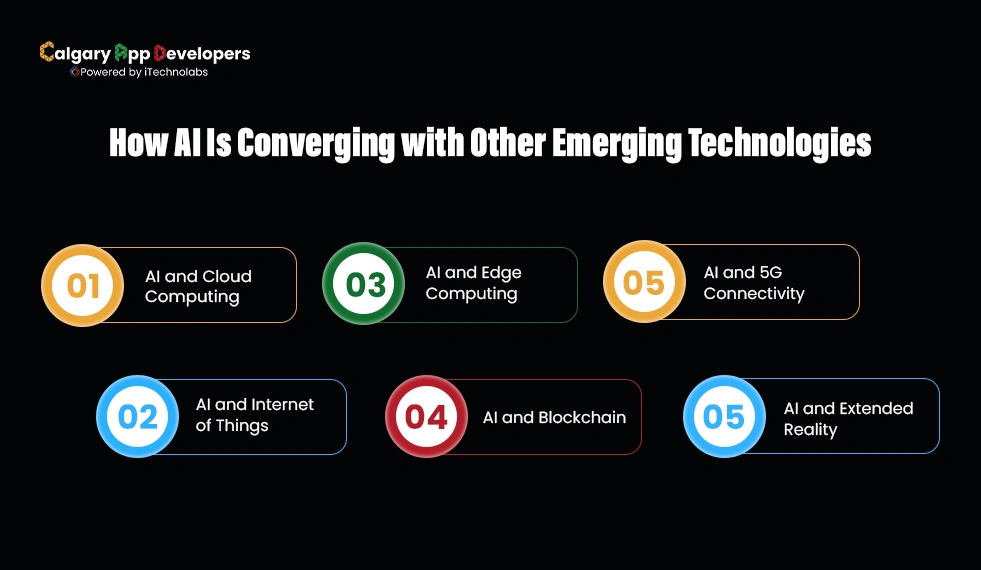
Artificial intelligence is no longer evolving in isolation. Its real impact is emerging through convergence with other advanced technologies, creating powerful ecosystems that drive innovation, efficiency, and entirely new business models. This integration is redefining how organizations build, operate, and scale in 2026.
1. AI and Cloud Computing
Cloud platforms provide the computational power and scalability required to train and deploy AI models at scale. In return, AI enhances cloud environments by enabling intelligent resource management, predictive maintenance, and automated operations.
This synergy allows businesses to access advanced AI capabilities without heavy infrastructure investments. It also accelerates experimentation and deployment, making innovation more accessible across organizations of all sizes.
2. AI and Internet of Things
The combination of AI and the Internet of Things is turning connected devices into intelligent systems. IoT devices generate massive volumes of data, and AI processes this data to deliver real-time insights and automated responses.
In industries like manufacturing and logistics, this convergence enables predictive maintenance, smart asset tracking, and optimized operations. It transforms raw data into actionable intelligence, improving efficiency and reducing downtime.
3. AI and Edge Computing
Edge computing brings data processing closer to where it is generated, reducing latency and enabling faster decision-making. When combined with AI, it allows real-time analysis in environments where speed is critical, such as autonomous vehicles, healthcare monitoring, and industrial automation.
This convergence also enhances data privacy by minimizing the need to transfer sensitive data to centralized systems. Businesses can process and act on data locally while maintaining performance and security.
4. AI and Blockchain
AI and blockchain together create systems that are both intelligent and trustworthy. While AI enables data analysis and automation, blockchain ensures transparency, security, and immutability of data.
This combination is particularly valuable in sectors like finance, supply chain, and healthcare, where trust and traceability are essential. It helps organizations build systems that are not only efficient but also verifiable and secure.
5. AI and 5G Connectivity
The rollout of 5G is amplifying the capabilities of AI by enabling faster data transmission and lower latency. This is critical for applications that require real-time processing, such as smart cities, remote healthcare, and autonomous systems.
With 5G, AI systems can operate more efficiently across distributed environments, supporting high-speed communication between devices, platforms, and users.
6. AI and Extended Reality
The integration of AI with augmented and virtual reality is creating more immersive and interactive digital experiences. AI enhances these environments by enabling real-time object recognition, natural language interaction, and personalized user experiences.
This convergence is being used in training, retail, and entertainment to create dynamic and engaging experiences that adapt to user behavior and preferences.
The convergence of AI with these technologies is not just enhancing existing capabilities. It is creating entirely new possibilities for innovation. Businesses that understand and adopt these integrated ecosystems are better positioned to lead in an increasingly technology-driven world.
Read Also: Best AI Business Solutions Driving Business Growth
Industry-Wise Applications of Enterprise AI
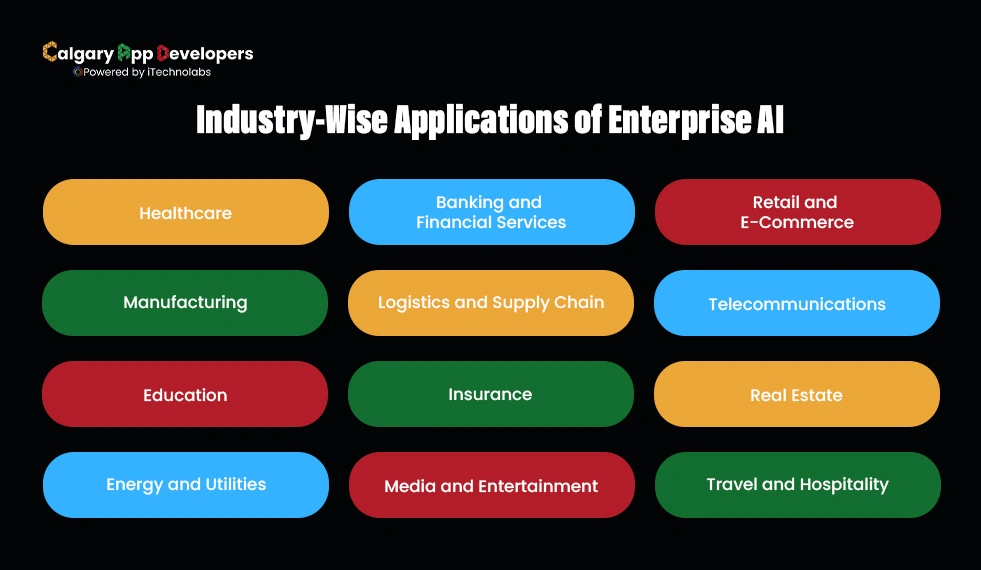
Artificial intelligence is no longer confined to a single function or sector. Its real value is visible in how it adapts to industry-specific challenges and unlocks efficiency, accuracy, and innovation.
Here are 12 key industries where enterprise AI is driving measurable impact.
-
Healthcare
AI is transforming healthcare by improving accuracy, speed, and patient outcomes. It supports doctors in diagnosing diseases, analyzing medical images, and predicting health risks based on patient data. Hospitals are also using AI to streamline operations, reduce administrative workload, and enhance patient care delivery.
- AI-powered diagnostics improve early disease detection.
- Predictive analytics helps identify high-risk patients.
- Virtual assistants support patient engagement and follow-ups.
- Automation reduces administrative burden in hospitals.
-
Banking and Financial Services
In financial services, AI is strengthening security, improving decision-making, and enhancing customer experience. Banks are using AI to detect fraud in real time, assess creditworthiness, and automate routine processes. It also enables more personalized financial services.
- Real-time fraud detection minimizes financial risks.
- AI-driven credit scoring improves lending decisions.
- Chatbots and virtual assistants enhance customer support.
- Automation reduces operational costs and errors.
-
Retail and E-Commerce
AI is helping retailers deliver personalized shopping experiences while optimizing backend operations. From product recommendations to inventory management, AI enables businesses to respond quickly to customer demand and market trends.
- Personalized recommendations increase conversions.
- Demand forecasting improves inventory planning.
- Dynamic pricing adjusts based on market conditions.
- AI-driven insights enhance customer experience.
-
Manufacturing
Manufacturing is becoming more efficient and intelligent with AI-driven systems. Companies are using AI to monitor equipment, predict failures, and maintain consistent product quality. This reduces downtime and improves overall productivity.
- Predictive maintenance prevents equipment failures.
- AI-based quality control reduces defects.
- Production processes become more efficient and automated.
- Real-time monitoring improves operational visibility.
-
Logistics and Supply Chain
AI is optimizing supply chains by improving visibility, forecasting demand, and streamlining logistics operations. Businesses can now make faster decisions and reduce inefficiencies across the supply chain.
- Route optimization reduces delivery time and costs.
- Demand forecasting improves supply planning.
- Warehouse automation increases efficiency.
- Real-time tracking enhances transparency.
-
Telecommunications
Telecom companies are using AI to manage complex networks and deliver better customer experiences. AI helps optimize network performance, predict outages, and handle large volumes of data efficiently.
- Network optimization improves performance and reliability.
- Predictive maintenance reduces service disruptions.
- AI-driven analytics manages high data traffic.
- Customer experience improves through intelligent support systems.
Also Read: Best AI Cloud Business Tools for Smarter Management
-
Education
AI is reshaping education by making learning more personalized, accessible, and data-driven. It enables institutions to tailor content based on individual student needs, improving engagement and outcomes. Educators can also use AI to track performance and identify learning gaps early.
- Personalized learning paths based on student performance.
- AI tutors provide real-time guidance and support.
- Automated grading saves time for educators.
- Learning analytics help improve course effectiveness.
-
Insurance
AI is streamlining insurance operations by improving accuracy, speed, and risk assessment. From underwriting to claims processing, AI reduces manual effort and enhances decision-making. It also helps insurers detect fraud and provide faster customer service.
- Automated claims processing speeds up settlements.
- AI-driven risk assessment improves underwriting accuracy.
- Fraud detection systems reduce financial losses.
- Chatbots enhance customer support and engagement.
-
Real Estate
AI is bringing data-driven insights into real estate, helping buyers, sellers, and investors make informed decisions. It analyzes market trends, property values, and customer preferences to improve efficiency in transactions.
- AI-based property valuation improves pricing accuracy.
- Market analysis helps identify investment opportunities.
- Smart matching connects buyers with suitable properties.
- Predictive insights guide real estate decisions.
-
Energy and Utilities
AI serves as a fundamental technology which enables organizations to achieve energy efficiency and sustainable development. The system enables organizations to monitor their energy usage and anticipate equipment breakdowns while optimizing their energy distribution processes.
- Smart grids optimize energy distribution in real time.
- Predictive maintenance reduces equipment downtime.
- AI analyzes consumption patterns for better efficiency.
- Supports renewable energy integration and sustainability goals.
-
Media and Entertainment
AI is transforming how content is created, distributed, and consumed. It enables platforms to understand user preferences and deliver highly personalized experiences while improving production efficiency.
- Content recommendation engines increase user engagement.
- AI-driven analytics provide audience insights.
- Automated content creation speeds up production.
- Personalization enhances user experience across platforms.
-
Travel and Hospitality
AI is enhancing customer experience and operational efficiency in the travel and hospitality sector. It helps businesses deliver personalized services while optimizing pricing and resource management.
- Personalized travel recommendations improve customer satisfaction.
- Dynamic pricing adjusts based on demand and trends.
- AI chatbots handle bookings and customer queries.
- Predictive analytics helps manage demand and capacity.
These applications highlight a clear pattern. AI is not just improving processes. It is reshaping how industries operate, compete, and deliver value to their customers.
Real World Examples of AI in Action
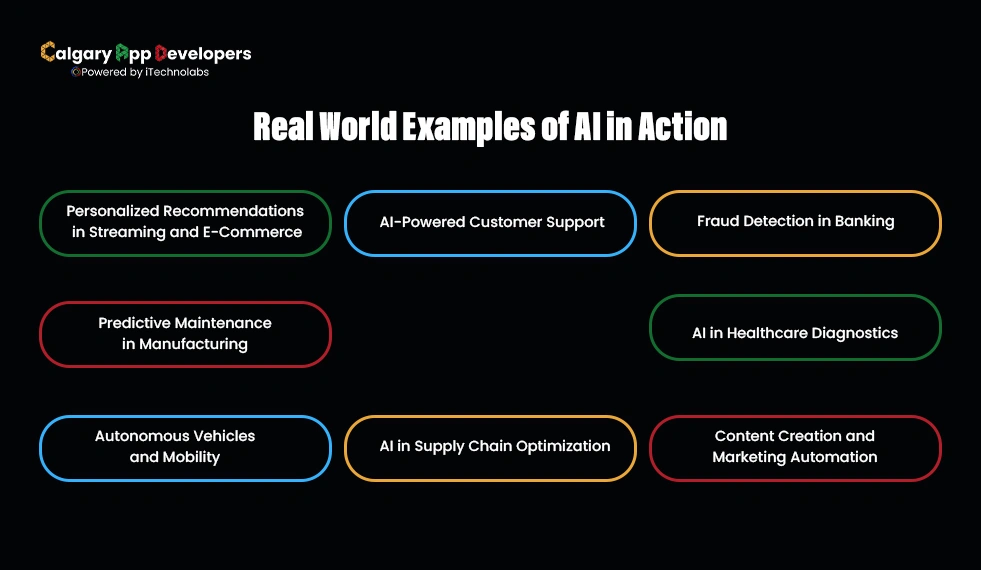
Artificial intelligence is delivering measurable impact across industries, moving beyond theory into everyday business operations. Companies are using AI to solve real problems, improve efficiency, and create better customer experiences. Below are some practical examples that show how AI is being applied at scale.
1. Personalized Recommendations in Streaming and E-Commerce
Platforms like Netflix and Amazon use AI to analyze user behavior and deliver highly personalized recommendations. These systems process viewing history, search patterns, and preferences to suggest relevant content or products.
This approach increases engagement, improves customer satisfaction, and drives higher conversion rates by showing users exactly what they are likely to interact with.
2. AI-Powered Customer Support
Companies such as H&M and Sephora use AI-driven chatbots and virtual assistants to handle customer queries. These systems provide instant responses, assist with product selection, and resolve common issues without human intervention.
This reduces response time, lowers support costs, and ensures customers receive consistent service across channels.
3. Fraud Detection in Banking
Financial institutions like PayPal rely on AI to detect fraudulent transactions in real time. AI models analyze transaction patterns, user behavior, and anomalies to flag suspicious activities instantly.
This helps prevent financial losses, strengthens security, and builds trust among users by ensuring safer digital transactions.
4. Predictive Maintenance in Manufacturing
Companies such as General Electric use AI to monitor equipment performance and predict potential failures before they occur. Sensors collect real-time data, which AI systems analyze to identify early warning signs.
This reduces downtime, lowers maintenance costs, and improves operational efficiency by preventing unexpected breakdowns.
5. AI in Healthcare Diagnostics
Organizations like IBM Watson Health have used AI to assist doctors in diagnosing diseases and recommending treatments. AI systems analyze medical records, research data, and imaging results to support clinical decisions.
This improves diagnostic accuracy, speeds up treatment planning, and enhances patient outcomes.
6. Autonomous Vehicles and Mobility
Companies such as Tesla are leveraging AI to power autonomous driving systems. AI processes data from sensors, cameras, and radar to make real-time driving decisions.
This technology is redefining mobility by improving safety, reducing human error, and enabling the development of self-driving transportation systems.
7. AI in Supply Chain Optimization
Global logistics companies like DHL use AI to optimize routes, forecast demand, and manage inventory. AI helps identify the most efficient delivery paths and predict delays before they happen.
This leads to faster deliveries, reduced operational costs, and improved supply chain visibility.
8. Content Creation and Marketing Automation
Brands and platforms such as HubSpot use AI to generate content, analyze campaign performance, and optimize marketing strategies. AI tools can create emails, blogs, and social media content based on audience insights.
This enables businesses to scale content production while maintaining relevance and engagement.
These examples highlight a clear pattern. AI is no longer experimental. It is actively shaping how businesses operate, compete, and deliver value across industries.
Also Check: Best Artificial Intelligence Apps in 2026
How Businesses Can Prepare for AI in 2026
AI adoption is no longer about keeping up with trends. It is about building the right foundation to compete in a technology-driven market. Businesses that prepare strategically will be in a stronger position to scale AI and unlock long-term value. The focus should be on clarity, capability, and execution.
1. Define Clear Business Objectives
AI initiatives should start with well-defined goals. Instead of adopting AI for experimentation, organizations need to identify specific problems they want to solve, such as improving efficiency, reducing costs, or enhancing customer experience. Clear objectives ensure that AI investments are aligned with measurable outcomes.
- Identify high-impact use cases aligned with business goals.
- Focus on problems where AI can deliver measurable value.
- Avoid isolated experiments without a strategic direction.
2. Build a Strong Data Foundation
AI systems rely on high-quality data to perform effectively. Businesses must invest in data collection, management, and governance to ensure accuracy and consistency. Without a solid data foundation, even the most advanced AI models will fail to deliver results.
- Ensure data accuracy, accessibility, and security.
- Break down data silos across departments.
- Implement strong data governance practices.
3. Invest in the Right Technology Stack
Choosing the right infrastructure is critical for scaling AI. This includes cloud platforms, data pipelines, and AI tools that support development and deployment. A flexible and scalable tech stack enables faster innovation and easier integration.
- Adopt scalable cloud and AI platforms.
- Integrate AI with existing systems and workflows.
- Prioritize tools that support long-term growth.
4. Develop AI Talent and Skills
Successful AI adoption depends on people as much as technology. Businesses need skilled professionals who can build, manage, and interpret AI systems. At the same time, non-technical teams should be trained to work effectively with AI tools.
- Hire or upskill talent in AI and data science.
- Train teams to use AI in daily workflows.
- Encourage cross-functional collaboration.
5. Start Small and Scale Strategically
Instead of large-scale deployments from the start, businesses should begin with focused projects and expand based on results. This approach reduces risk and allows organizations to learn and refine their strategy over time.
- Launch pilot projects with clear success metrics.
- Measure outcomes and optimize continuously.
- Scale successful use cases across the organization.
6. Establish Governance and Ethical Practices
As AI becomes more integrated into operations, governance is essential to ensure responsible use. Businesses must address issues such as data privacy, bias, and transparency to build trust and comply with regulations.
- Implement clear AI governance frameworks.
- Ensure transparency in AI decision-making.
- Monitor systems for bias and ethical risks.
7. Focus on Change Management
AI adoption often requires changes in processes, roles, and culture. Organizations need to prepare their teams for this shift by communicating clearly and supporting employees through the transition.
- Align leadership and teams on AI strategy.
- Communicate benefits and expectations clearly.
- Support employees with training and resources.
8. Measure ROI and Continuously Improve
AI should deliver measurable business value. Organizations must track performance, evaluate outcomes, and refine their approach to ensure long-term success.
- Define key performance indicators for AI initiatives.
- Monitor impact on cost, efficiency, and revenue.
- Continuously optimize models and processes.
Preparing for AI in 2026 requires more than adopting new tools. It involves building a strong foundation, aligning strategy with execution, and creating a culture that embraces intelligent technologies. Businesses that take a structured approach will be better equipped to turn AI into a lasting competitive advantage.
What the Future Holds for Artificial Intelligence
Artificial intelligence is entering a phase where its influence will extend far beyond automation and efficiency. The next wave of AI will shape how businesses innovate, how economies grow, and how people interact with technology daily. The focus is shifting from capability to impact.
- From Tools to Autonomous Systems: AI is evolving into systems that can operate with minimal human input. Future AI will not just assist with tasks but manage workflows, make decisions, and adapt in real time. This will redefine how organizations structure operations and allocate human effort.
- Deeper Integration Across Industries: AI will become deeply embedded in every industry, from healthcare and finance to manufacturing and education. Instead of being a separate layer, it will function as a core component of business processes, influencing everything from strategy to execution.
- More Human-Like Interactions: Advancements in natural language processing and multimodal AI will make interactions more intuitive and context-aware. AI systems will understand not just commands but intent, tone, and context, leading to more natural communication between humans and machines.
- Rise of Specialized and Efficient Models: Future AI models will become more focused, efficient, and tailored to specific industries and use cases. This shift will reduce costs, improve accuracy, and make AI more accessible to businesses of all sizes.
- Stronger Focus on Regulation and Ethics: As AI becomes more powerful, regulatory frameworks will continue to evolve. Governments and organizations will place greater emphasis on transparency, accountability, and responsible use. Ethical AI will become a requirement rather than a choice.
- AI as a Driver of Economic Growth: AI is expected to play a major role in global economic expansion by improving productivity, creating new business models, and unlocking innovation. Companies that adopt AI effectively will gain a significant competitive advantage in the coming years.
The future of artificial intelligence is not defined by a single breakthrough but by continuous evolution. Businesses that stay informed, invest strategically, and adapt quickly will be best positioned to lead in an AI-driven world.
Conclusion
Artificial intelligence in 2026 is no longer a competitive advantage reserved for early adopters. It is becoming a fundamental part of how modern businesses operate, innovate, and grow. From autonomous systems and intelligent automation to industry-specific applications and real-world use cases, AI is reshaping every layer of the enterprise.
The trends explored in this blog reflect a clear shift. Businesses are moving from experimentation to execution, from isolated tools to integrated ecosystems, and from short-term gains to long-term strategic value. At the same time, the convergence of AI with other technologies is unlocking new possibilities that were not achievable just a few years ago.
For organizations, the path forward is not just about adopting AI but about adopting it with purpose. Success will depend on a clear strategy, strong data foundations, skilled talent, and a commitment to responsible implementation.
As AI continues to evolve, the gap between leaders and laggards will only widen. Businesses that act now, invest wisely, and scale thoughtfully will be the ones that define the future of their industries.
FAQs
1. What are the most important AI trends businesses should watch in 2026?
The most impactful trends include agentic AI systems, generative AI adoption, and intelligent automation at scale. Businesses are also focusing on AI-driven decision intelligence, hyper-personalization, and industry-specific AI models. Alongside this, responsible AI and governance are becoming critical. These trends reflect a shift from experimentation to real business integration and measurable outcomes across industries.
2. What recent AI developments are shaping the technology landscape?
Recent developments include rapid advancements in multimodal AI, autonomous agents, and AI-integrated software development. Major tech companies are investing heavily in AI infrastructure, cloud integration, and large-scale models. There is also strong momentum around open source AI and enterprise-ready solutions, making advanced capabilities more accessible to businesses across sectors.
3. How is AI changing search, and what should businesses prepare for?
AI is transforming search into a more conversational and intent-driven experience. Instead of keyword-based results, users now expect direct, contextual answers powered by generative AI. Businesses need to optimize for AI-driven discovery by focusing on high-quality, structured content and authority. Visibility will increasingly depend on how well content aligns with user intent and AI interpretation.
4. What are the latest advancements in AI for analytics and decision-making?
AI is enabling predictive and prescriptive analytics, allowing businesses to move beyond historical insights. Advanced models can analyze complex datasets, identify patterns, and recommend actions in real time. Decision intelligence platforms are helping organizations improve accuracy, reduce risk, and respond faster to market changes. This is making data-driven strategies more effective and actionable.
5. How are ChatGPT and generative AI evolving for future applications?
Tools like ChatGPT are evolving into more advanced, multimodal systems capable of handling text, images, and voice. They are being integrated into enterprise workflows for customer support, content creation, and internal operations. Future developments will focus on greater accuracy, deeper context understanding, and seamless integration across business systems.
6. How does Calgary App Developer use AI trends to drive business growth?
Calgary App Developer leverages AI by aligning it with business objectives and real use cases. The focus is on building scalable solutions, integrating AI into existing systems, and ensuring measurable outcomes. By combining strategy, technology, and domain expertise, Calgary App Developer helps businesses improve efficiency, enhance customer experience, and unlock new growth opportunities through AI.


Pankaj Arora is a seasoned technology leader and the Founder of Calgary App Developer, with 10+ years of expertise in crafting high-performance digital solutions. His core competencies include full-stack app development, cloud-native architecture, API integration, and agile product delivery. Under his leadership, Calgary App Developers has empowered startups and enterprises alike with scalable mobile applications, secure web platforms, and AI-driven SaaS products.