









Augmented Reality Mobile App Development: Trends & Insights
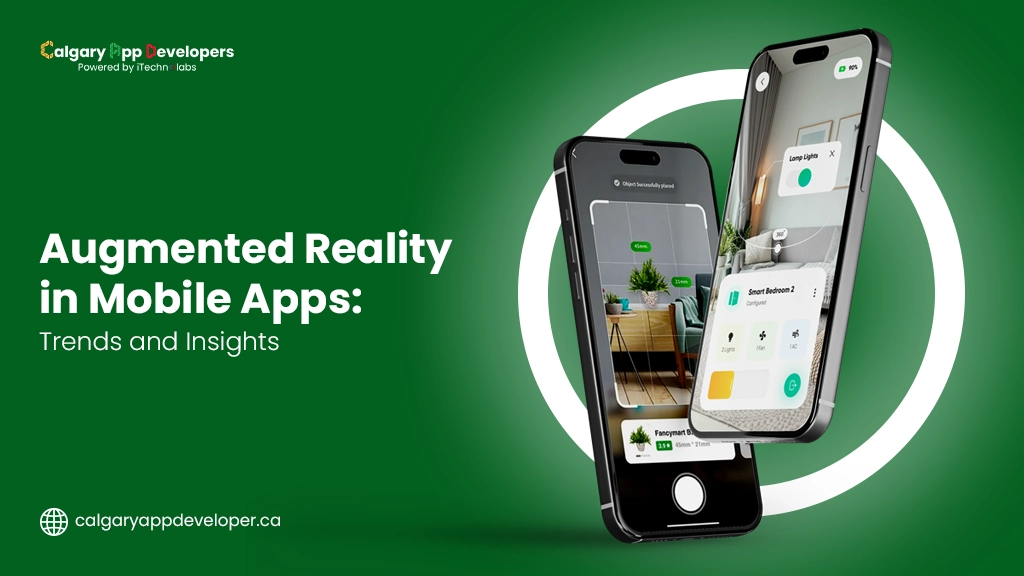
Augmented reality has quietly moved from novelty to utility. What once felt experimental is now built into the apps people use every day. Mobile AR lets users preview products in their own space, follow interactive directions, learn through visual overlays, and make faster decisions without leaving the screen. It removes friction by blending digital information directly into the real world.
The business momentum behind this shift is just as strong. The AR market is valued at over $32 billion in 2024, and growth is accelerating. By 2028, total revenue from the AR and VR space is expected to nearly double, pushing the market past the $50 billion mark to approximately $58.1 billion.
This growth reflects a clear change in how users want to interact with products, services, and information.
In this blog, we break down what augmented reality actually is, how it is being used in mobile apps today, and why businesses across industries are investing in it.
We also explore the practical value AR delivers, not in theory, but in real user engagement, better decision making, and measurable business outcomes.
- Augmented reality is transforming mobile apps by blending digital content with real-world experiences.
- Businesses are adopting AR to improve engagement, decision-making, and conversion rates.
- AR is already delivering practical value across industries, not just experimental experiences.
- Rapid market growth signals that AR will become a standard mobile capability.
- Augmented reality enhances mobile apps by overlaying interactive digital elements onto physical environments in real time.
- Retail, education, healthcare, real estate, gaming, and navigation apps use AR to improve usability and user confidence.
- AR-driven experiences help businesses reduce friction, increase engagement, and differentiate in competitive markets.
- Successful AR adoption requires thoughtful design, device compatibility planning, and clear user guidance.
- Continued investment in AR reflects its shift from novelty to a core technology in modern mobile applications.
Understanding Augmented Reality
At its core, Augmented Reality (AR) is a technology that blends the digital world with the real one. It overlays computer-generated images, sounds, or other data onto your physical environment—usually through a smartphone camera or AR-enabled glasses—creating an interactive experience in real time.
Unlike Virtual Reality (VR), which immerses users in a fully digital environment, AR enhances the real world rather than replacing it. For example, when you open an app and see a 3D object appear on your desk through your phone’s screen—that’s AR in action.
How AR Works: The Basics
AR relies on a few key components:
- Sensors and Cameras: These capture the user’s environment and feed data into the app.
- Processing Unit: Your smartphone or tablet processes this information in real time.
- Projection and Display: AR elements (like text, images, or animations) are rendered and projected onto your screen in alignment with the physical space.
- Interaction: Many AR apps allow users to interact with digital content—rotate objects, move them around, or even trigger animations with gestures.
AR can be delivered through various methods, including:
- Marker-based AR: Recognizes specific patterns (like QR codes or images) to trigger AR content.
- Markerless AR (Location-based): Uses GPS, accelerometers, and compasses to display AR content based on the user’s location.
- SLAM (Simultaneous Localization and Mapping): Helps apps understand and map physical environments in real time for more precise AR experiences.
Real-World Examples You Might Know
- Snapchat or Instagram filters that add effects to your face
- Google Lens, which identifies objects or text in your surroundings
- IKEA Place, an app that lets you “drop” furniture into your room virtually
In short, AR makes your phone more than a tool—it turns it into a window between the digital and physical worlds. And as mobile hardware gets better and developers continue pushing boundaries, AR’s presence in our everyday lives will only grow.
Also Read: Top 10 Business Mobile App Features to Scale Your Business
Key Use Cases of AR in Mobile Applications
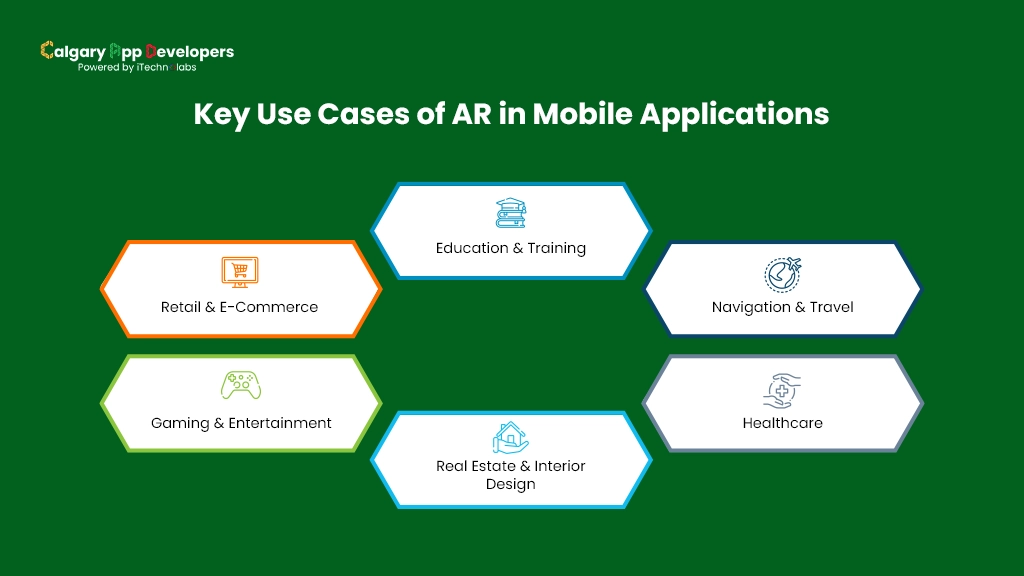
Augmented Reality is changing the experience of mobile app interaction by bringing virtual data into physical environments. From online shopping to learning, AR can potentially enhance the experience by visualizing, interactivizing, and personalizing it. Let us explore some of the most interesting applications of AR in mobile apps today:
- Retail & E-Commerce: Try Before You Buy
AR has revolutionized e-commerce. It enables customers to see products where they should be naturally positioned prior to buying them, hugely enhancing confidence and lowering return rates.
- Example: A consumer browsing through a furniture app can tap on their phone to set a 3D image of a sofa within their home to check fit, size, and color. Beauty firms apply AR to enable users to try makeup virtually, and spectacle producers offer virtual trials using the front camera.
Not only does it enhance customer satisfaction but also boosts conversion and removes the uncertainty of shopping online.
- Gaming & Entertainment: Immersive Play in the Real World
AR has transformed mobile gaming by mixing up the virtual world of the game with the player’s real world. It facilitates interaction between players and virtual objects or characters as if they were part of their real world.
- Example: The success of Pokémon GO proved the gaming potential of AR. Players move about actual locations to encounter and catch virtual animals that appear on their screens, overlaid on what they can see around them.
AR introduces movement and reality into games, which results in exercise, discovery, and increased engagement.
- Education & Training: Learning That Comes to Life
AR transforms passive learning into active discovery by adding visual layers and interactive elements to educational content. It caters to different learning styles by combining text, images, audio, and 3D models.
- Example: A biology app can let students examine a 3D model of the human heart that beats and reacts to user interactions. In technical training, AR can provide real-time, step-by-step guidance for assembling machinery or performing complex procedures.
AR is more interactive and enjoyable to apply, especially to subjects assisted by spatial or visual understanding. It also reduces learning curves in workplace training.
- Real Estate & Interior Design: Visualizing Spaces Before Building
In industries where visualization is key, AR enables users to preview architectural designs, interior layouts, and furniture arrangements within their actual spaces.
- Example: A real estate app can offer AR-based virtual tours, allowing potential buyers or renters to walk through properties using their phones. Interior design apps let users drag and drop furniture pieces into a live camera view of their room.
This saves time, enhances decision-making, and helps users better understand scale, layout, and aesthetics before making costly commitments.
- Navigation & Travel: Smarter Wayfinding
AR is making travel and navigation easier by overlaying directions and points of interest directly onto a live camera feed, providing real-time visual guidance.
- Example: Google Maps’ Live View feature uses AR to show arrows and street names over the live view of your surroundings, helping pedestrians navigate urban environments with ease.
It reduces confusion in unfamiliar places and enhances accessibility for people who struggle with traditional map reading or navigation.
- Healthcare: Visualizing Complex Medical Data
AR in medical apps is used in education, diagnosis, and treatment. Practitioners and patients both benefit from better visualizations of conditions and treatments.
- Example: A physical therapy application may use AR to guide patients through exercises with overlays on their own bodies. Some education software has animated organ systems to explain conditions or procedures.
As a developer, entrepreneur, or consumer, it’s obvious that AR is more than a fad—it’s a revolutionary tool. In markets investigating emerging technologies—such as the expanding augmented reality Calgary business ecosystem—these applications are quickly becoming standard mobile app development features.
Read Also: Top Mobile App Trends Shaping the Future of Technology
Why Augmented Reality is a Game Changer for Calgary-Based Businesses
Calgary has long been known for its energy sector and entrepreneurial spirit, but in recent years, it’s also emerging as a hub for digital innovation. As more businesses look to future-proof their operations, augmented reality in Calgary is becoming a key differentiator—transforming traditional industries and customer experiences alike.
Whether you’re in retail, real estate, healthcare, or tourism, AR is helping local businesses unlock new levels of engagement, personalization, and operational efficiency.
- Standing Out in a Competitive Market
Calgary’s business landscape is evolving rapidly, and companies that integrate AR into their mobile strategies gain a serious edge. AR-powered product demos, virtual try-ons, and immersive storytelling allows brands to capture attention in ways that static content simply can’t.
Example:
A Calgary fashion boutique can use an AR app to let users virtually try on outfits at home. This not only elevates the shopping experience but also reduces returns and boosts online sales.
- Revolutionizing Real Estate and Construction
In a real estate and construction-based city, AR is reshaping the planning, presentation, and sale of property. Virtual home tours, interactive floor plans, and field-level real-time overlays enhance clarity for customers and contractors alike.
Example:
An AR app created by a Calgary real estate firm can enable prospective homebuyers to stroll through 3D house models on their phone—even before one brick is laid.
- Enhancing Local Tourism and Events
Calgary’s rich cultural and natural attractions—from the Stampede to the Rockies—offer massive potential for AR-driven experiences. AR can enhance tours, events, and exhibits by layering digital content onto real-world locations, giving both locals and tourists interactive insights and gamified experiences.
Example:
A tourism app could allow users to point their phones at landmarks to reveal historical facts, hidden stories, or interactive games tied to Calgary’s history.
- Streamlining Industrial Training and Maintenance
Since so many Calgary businesses have activities in energy, manufacturing, and logistics, AR can greatly improve team training and equipment maintenance. AR instructions can be projected directly on actual equipment to reduce downtime and the potential for human mistake.
Example:
An oilfield service company can use a custom-built AR app to guide technicians step by step through maintenance procedures on complex equipment, increasing safety and productivity.
- Boosting Customer Engagement and Retention
Whether you’re running a local coffee shop or a fitness studio, customer experience matters. AR can turn everyday interactions into memorable moments, helping businesses connect with users on a deeper level.
Example:
A Calgary café could use an AR loyalty app that rewards users with fun animations or digital collectibles for each visit, driving repeat business.
As AR app development in Calgary continues to grow, businesses that adopt this technology early stand to gain the most. It’s not just about novelty—it’s about creating smarter, more interactive experiences that resonate with modern consumers.
Also Check: How Mobile App Development Is Evolving in Calgary
Top Business Benefits of Integrating AR into Mobile Apps
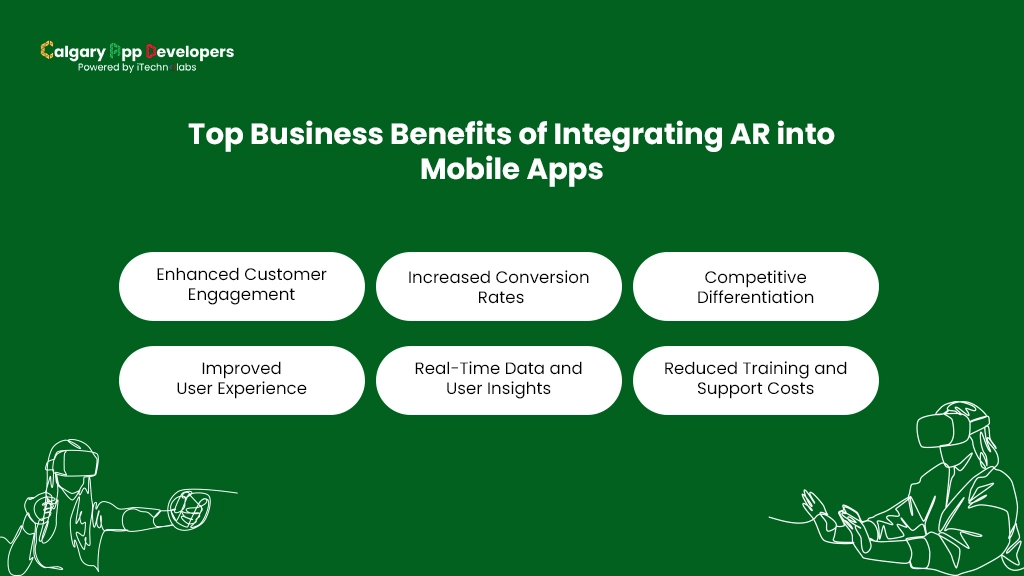
Augmented Reality is not just a novelty fad—it’s a business opportunity in the making. If you’re looking for new customers, need to optimize processes, or are trying to stand out in a cacophonous marketplace, AR offers a whole lot more than fun and games. Here are some ways that business is turning AR into bottom-line value:
- Enhanced Customer Engagement
AR invites users to interact actively with your app rather than scroll passively. From trying on things virtually, interacting with 3D tutorials, to finding immersive experiences, AR cultivates deeper, more meaningful interaction.
Activated users are more probable to convert, be loyal, and endorse your brand. AR makes things memorable—and memorable is marketable.
- Increased Conversion Rates
By reducing uncertainty and helping users visualize products or services in their own environment, AR can accelerate purchase decisions. When users can “try before they buy” or see real-time product customization, they’re more confident and less likely to abandon their cart.
Fewer returns, faster buying decisions, and higher customer satisfaction all contribute directly to your bottom line.
- Competitive Differentiation
In saturated app marketplaces, standing out is everything. AR provides an exceptional, cutting-edge feature set that few competitors are going to be providing—especially if you’re in an area where innovation is difficult to come by or resistant to adopting.
It takes trust and brand recognition to be perceived as a technology leader. AR can be the differentiating feature that makes your app stand out.
- Improved User Experience
AR can simplify challenging interactions, tailor content in real time, and create beautiful visual guidance. Onboarding, support, or navigation—AR makes digital interactions more natural and intuitive.
A smoother, more delightful user experience brings users back and prevents churn. AR takes you where the users are—literally and figuratively.
- Real-Time Data and User Insights
AR apps can capture valuable behavioral data—where individuals engage with virtual objects, how they move their eyes, and how long they maintain attention. This data can inform wiser business decisions and make marketing more effective.
Understanding customer behavior in augmented environments can help you better shape your digital content and your physical product lines.
- Reduced Training and Support Costs
In internal business apps, AR can be used to train employees or provide ongoing assistance. Interactive, visual learning helps employees learn faster and retain longer.
You save time, reduce errors, and speed onboarding without paying for expensive training classes or published guides.
Must Read: How Much Does it Cost to Build an App in Calgary, Canada?
Challenges and Considerations in AR App Development
While Augmented Reality offers intriguing possibilities for mobile apps, crafting a successful AR experience has its own challenges. From technical acumen to reach and engagement of users, organizations must approach their AR app development with caution in order to offer real value. Take the following key challenges and things to be careful about into consideration:
- Hardware Limitations
Not all smartphones are created equal. While newer devices are often AR-ready, many users still operate older phones without the necessary sensors, processing power, or camera quality to deliver a smooth AR experience.
What to consider:
Ensure your app offers graceful degradation or fallback experiences for customers with incompatible hardware and test on a wide range of hardware.
- High Development Costs
AR app development typically requires more time, resources, and specialized skills compared to traditional apps. 3D modeling, real-time rendering, and integration with AR SDKs (like ARKit or ARCore) add to the overall complexity.
What to consider:
Start with a minimum viable product (MVP) and iterate based on user feedback. Partnering with experienced AR developers can reduce risk and improve efficiency.
- UX and Usability Challenges
Designing intuitive AR experiences is harder than it looks. If users don’t understand how to interact with AR elements, or if the experience is clunky or inconsistent, engagement will drop.
What to consider:
Keep the interface simple and provide clear instructions. Use subtle visual cues, like animations or guided prompts, to lead users through AR interactions.
- Environmental Dependencies
AR apps rely on the user’s physical surroundings—lighting, surfaces, textures, and even internet connectivity can impact how well the app performs. Poor conditions can lead to tracking errors, lag, or broken interactions.
What to consider:
Design AR features to be resilient. Provide fallback options or instructions for adjusting the environment (e.g., “move to better lighting” or “point at a flat surface”).
- Data Privacy and Security
AR apps often collect and process camera, location, and real-world interaction data. This raises concerns about user privacy and how that data is stored or shared.
What to consider:
Be transparent with users about data usage. Implement robust security protocols and ensure compliance with data protection regulations like GDPR or CCPA.
Suggested: Why Your Business Needs a Custom Mobile App
Future Outlook
The future of Augmented Reality in mobile apps is bright—and rapidly evolving. As smartphones become more powerful and AR development tools continue to advance, the technology is expected to become more seamless, accessible, and embedded in everyday life.
AR is no longer just a novelty; it’s becoming a core feature in how users interact with digital content. In the coming years, we can expect AR to:
- Integrate more deeply with AI, allowing apps to understand user behavior and context for hyper-personalized experiences.
- Support persistent AR, where digital content can “stay” in the physical world across sessions and devices—turning physical spaces into interactive canvases.
- Bridge online and offline, enabling retailers to merge e-commerce with in-store experiences more fluidly.
- Expand into wearables, with smart glasses and headsets poised to bring hands-free AR to mainstream users.
For businesses, this means that investing in AR today is not just a trend—it’s a forward-thinking move that can future-proof customer engagement and unlock new revenue streams.
Local innovation is playing a big role too. As demand rises, AR app development in Calgary is gaining momentum, with startups, agencies, and enterprises embracing the technology to stand out and scale smarter. This ecosystem of talent and ambition signals a promising future for AR-driven mobile experiences in both local and global markets.
Conclusion:
Augmented Reality is no longer a futuristic concept—it’s a present-day game changer that’s redefining how mobile apps are built, experienced, and valued. From retail and education to real estate and healthcare, AR is creating immersive, intuitive, and personalized experiences that engage users like never before.
For businesses and developers, embracing AR is not just about keeping up with trends—it’s about staying ahead of them. As mobile technology continues to evolve, those who invest early in AR stand to gain a clear competitive advantage.
With growing interest in augmented reality Calgary and a vibrant tech scene to support it, now is the perfect time for forward-thinking businesses to explore what’s possible. Whether you’re enhancing customer engagement, streamlining training, or launching something entirely new, AR has the power to bring your vision to life—layer by interactive layer.
FAQ’s About Augmented Reality Mobile App Development
1. What is augmented reality in mobile apps?
Augmented reality in mobile apps overlays digital elements like images, text, or 3D models onto the real world through a smartphone camera. It enhances real environments instead of replacing them, helping users visualize products, learn interactively, or navigate spaces more intuitively within a mobile app experience.
2. How do businesses benefit from using AR in mobile apps?
Businesses use AR to increase user engagement, improve conversion rates, and reduce uncertainty during decision-making. Features like virtual try-ons, interactive demos, and visual guidance build trust and confidence, leading to higher sales, fewer returns, and stronger customer retention across industries.
3. Which industries use AR the most in mobile applications?
AR is widely used in retail, e-commerce, gaming, education, real estate, healthcare, navigation, fitness, and tourism. Any industry that benefits from visualization, spatial understanding, or interactive guidance can use AR to enhance user experience and deliver more value through mobile apps.
4. Is augmented reality expensive to implement in a mobile app?
AR development can be more expensive than standard app features due to 3D assets, real-time rendering, and specialized development skills. However, starting with a focused AR feature or MVP helps control costs. Long term, AR often delivers strong ROI through higher engagement and improved conversions.
5. Do users need special devices to use AR apps?
Most mobile AR experiences work on modern smartphones that support AR frameworks like ARKit or ARCore. No special headsets are required. However, performance depends on camera quality, sensors, and processing power, so apps should be designed to handle a wide range of devices.
6. Is augmented reality just a trend or a long-term technology?
Augmented reality is a long-term technology. With rapid growth in the AR and VR market and deeper integration into mobile platforms, AR is becoming a standard interaction layer rather than a novelty. Businesses adopting AR now are positioning themselves for future user expectations and digital experiences.


Pankaj Arora is a seasoned technology leader and the Founder of Calgary App Developer, with 10+ years of expertise in crafting high-performance digital solutions. His core competencies include full-stack app development, cloud-native architecture, API integration, and agile product delivery. Under his leadership, Calgary App Developers has empowered startups and enterprises alike with scalable mobile applications, secure web platforms, and AI-driven SaaS products.