









White Label App Development Guide 2026

Most successful businesses today are not reinventing the wheel. They are building faster by adapting proven products to their own brand and audience. That is exactly why white label app development has moved from a niche option to a mainstream strategy.
Mobile apps are now a baseline expectation. Customers want quick access, smooth performance, and consistent experiences across industries like fitness, food delivery, fintech, education, and on-demand services. Building a custom app from scratch can take months and require significant engineering investment. For many growing businesses, that timeline simply does not work.
White label app development offers a smarter alternative. You start with a production-ready application framework, customize branding and features, and launch under your own identity. This approach cuts development time dramatically while keeping costs predictable and quality high.
The global mobile application market is projected to grow substantially from 2025 to 2031, with Mordor Intelligence forecasting it to reach around USD 864.5 billion by 2031, reflecting strong expansion in app usage and digital engagement worldwide.
This guide explains how white label app development works, when it makes sense, and how businesses use it to scale without sacrificing control. The insights here are based on our hands-on experience building and scaling web applications where speed, reliability, and long-term flexibility matter more than starting from zero.
- White label app development lets businesses launch branded mobile apps fast without building from scratch.
- It reduces cost, risk, and time to market while keeping quality high.
- Best suited for startups, agencies, and growing businesses needing proven features.
- Long-term success depends on choosing the right provider and understanding limitations.
- White label app development uses a pre-built, production-ready app framework that businesses can brand, customize, and launch under their own identity.
- This approach significantly shortens development timelines and lowers costs compared to custom app development, making it ideal for fast-moving markets.
- Common use cases include e-commerce, fitness, food delivery, education, fintech, and on-demand services where standard features meet business needs.
- White label apps offer professional quality, tested reliability, and ongoing maintenance support from the provider.
- Limitations include restricted customization, dependency on the provider, and potential scalability constraints for highly complex or unique products.
- Businesses should choose white label solutions when speed, budget control, and predictable outcomes matter more than full backend ownership.
- Selecting an experienced development partner is critical to ensure security, scalability, compliance, and long-term flexibility.
What is White Label App Development?
White label application development is a business strategy in which an app development company creates a finished, ready-to-go mobile app that another business firm can rebrand and sell under its own name. The technical work is undertaken by one firm and another firm adds its own name, logo, color scheme, and branding before marketing the app.
It’s like buying a complete house and decorating it according to your taste. The house is already stable, saving you the months of design, coding, and testing. You concentrate on branding and functionality that represent your business objectives.
This model is favored by startups, agencies, and businesses that have to go to market in a hurry without breaking the bank. With white label app development, you receive a solution-ready product that saves development time, reduces expenses, and enables you to provide a professional app experience without having to build from scratch.
How Does White Label App Development Work?
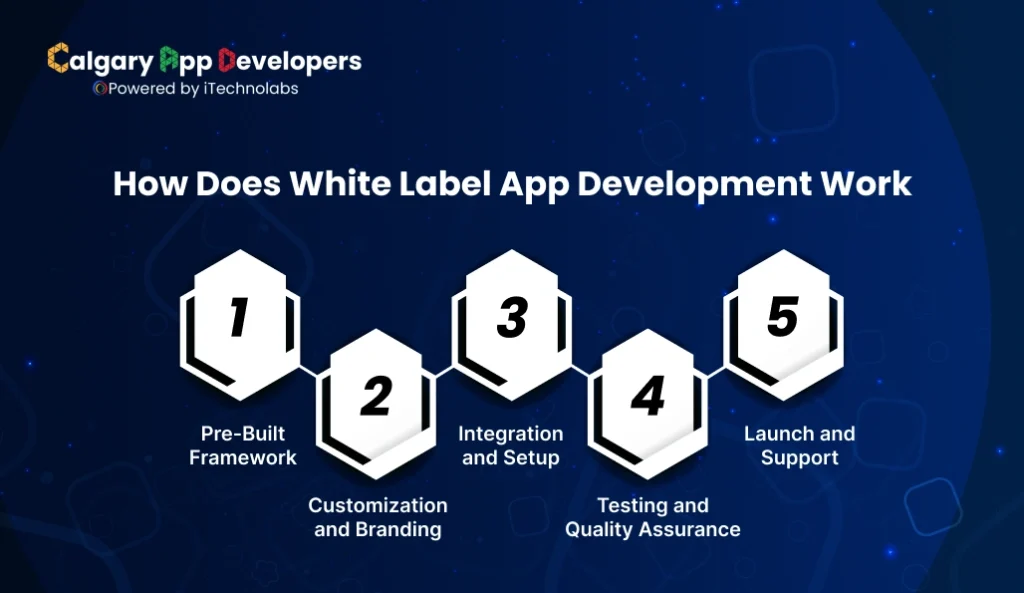
White label app development is a linear process designed around speed, customization, and scalability. It enables companies to get a refined product to the market without handling the intricacies of development.
Here’s how it works step by step:
- Pre-Built Framework: The development company creates a fully functional app framework that covers all the essential features and backend systems. This foundation is designed to be flexible so it can fit different industries and business models.
- Customization and Branding: Once you choose a white label solution, the next step is customization. You can add your brand identity, including your logo, color palette, typography, and visual style. Depending on the provider, you can also modify certain features or user flows to align with your specific business needs.
- Integration and Setup: The app is then integrated with your preferred tools, APIs, and services. This could include payment gateways, analytics platforms, CRM systems, or third-party plugins that enhance functionality.
- Testing and Quality Assurance: Before launch, the app goes through testing to ensure performance, security, and user experience meet professional standards. Since the base product is already tested, this step is usually faster than in full-scale custom development.
- Launch and Support: Once branded and tested, the app is launched under your company name on the App Store as well as Google Play. Ongoing support, updates, and maintenance to keep your app up and running are usually provided by most white label app development partners as well.
This method allows you to concentrate on business development, customer experience, and marketing, while the technical partner develops the technical aspects. It’s a cost-effective method of providing a great mobile app without developing everything internally.
Types of White Label Apps
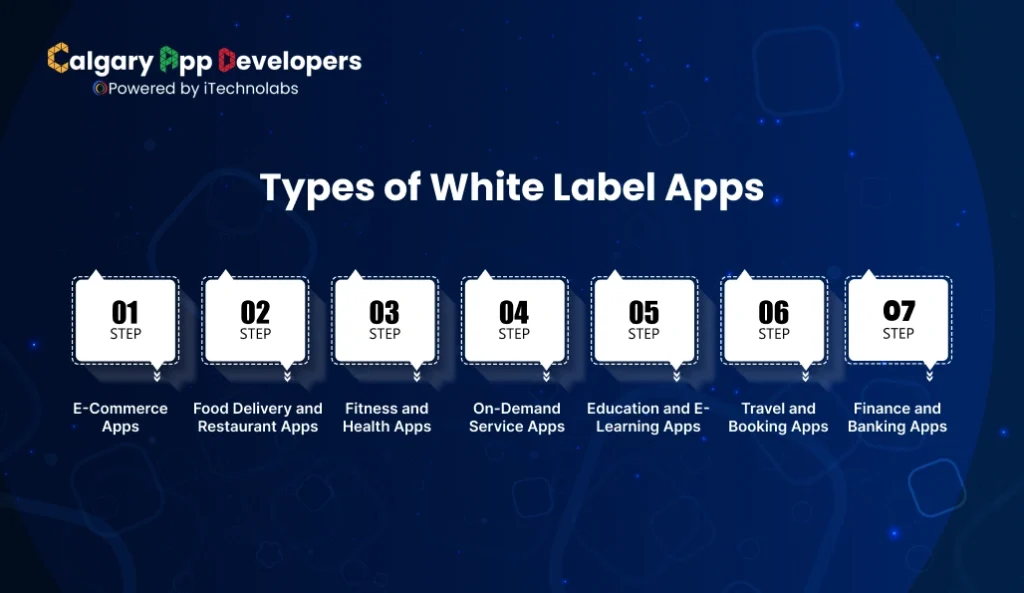
White label app development is cross-industry, with pre-built solutions that can be rebranded as your own by businesses. Based on your intentions, you can choose an app that suits your audience and saves time and development expense.
-
E-Commerce Apps
These apps let businesses sell products online with features like product catalogs, shopping carts, secure payments, and order tracking.
Key Features:
- Multi-currency support
- Push notifications
- Personalized recommendations
- Inventory management.
Popular Examples: Shopify, BigCommerce.
-
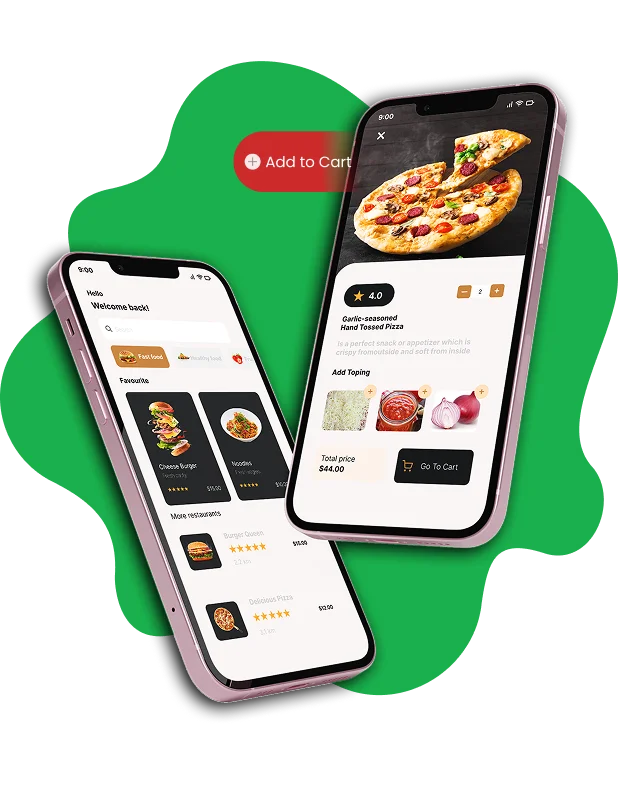
Food Delivery and Restaurant Apps
Designed for restaurants, cafes, and cloud kitchens, these apps handle online ordering, menu management, delivery tracking, and loyalty programs.
Key Features:
- Real-time order tracking
- In-app payments
- Ratings and reviews
- Offers and promotions.
Popular Examples: Uber Eats, Zomato, DoorDash.
-
Fitness and Health Apps
These apps provide workout plans, diet tracking, progress monitoring, and virtual coaching. Fitness centers and wellness brands can deliver a branded experience to clients.
Key Features:
- Custom workout routines
- Nutrition guides
- Progress analytics
- Push notifications for motivation.
Popular Examples: MyFitnessPal, Strava, Fitbit.
-
On-Demand Service Apps
From ride-hailing to home services, these apps connect users with service providers in real time.
Key Features:
- Booking system
- Real-time tracking
- In-app payments
- Service ratings.
Popular Examples: Uber, TaskRabbit, and Instacart.
-
Education and E-Learning Apps
These apps enable schools, colleges, and online learning platforms to deliver courses, quizzes, and interactive content.
Key Features:
- Video lessons
- Quizzes
- Progress tracking
- Certificates, gamification.
Popular Examples: Coursera, Duolingo, Udemy.
-
Travel and Booking Apps
Travel agencies and tour operators use these apps for booking management, itineraries, and customer support.
Key Features:
- Flight and hotel booking
- Itinerary planner
- Real-time updates
- In-app payments.
Popular Examples: Booking.com, Expedia, TripAdvisor.
-
Finance and Banking Apps:
These apps provide account management, payments, expense tracking, and investment tools for fintech brands and banks.
Key Features:
- Secure login
- Transaction history
- Bill payments
- Portfolio management.
Popular Examples: PayPal, Revolut, Robinhood.
White label app development gives businesses a ready-to-launch app framework while allowing full branding and customization. By choosing the right type, you can provide a professional digital experience quickly and cost-effectively.
White Label Apps vs. Custom App Development
When deciding how to launch a mobile app, businesses often weigh white label app development against building a custom app from scratch. Both approaches have advantages, but the choice depends on your goals, budget, timeline, and technical resources.
White Label App Development offers a pre-built solution that can be branded and launched quickly. It’s ideal for businesses that need to get to market fast, reduce costs, and rely on proven features without investing in a full development team.
Custom App Development involves building an app from the ground up to meet specific requirements. This provides complete control over features, design, and scalability but requires more time, expertise, and investment.
Here’s a detailed comparison:
| Feature | White Label App Development | Custom App Development |
| Development Time | Fast; ready-made framework allows quick launch | Longer; requires full design, coding, and testing |
| Cost | Lower; shared development reduces expense | Higher; fully tailored solution incurs more resources |
| Customization | Limited to branding and minor feature tweaks | Fully customizable features, design, and user experience |
| Maintenance | Managed by the provider; updates and support included | Requires in-house or outsourced team for maintenance |
| Time-to-Market | Short; ideal for rapid deployment | Longer; suitable for unique or complex applications |
| Technical Expertise Required | Minimal; provider handles technical backend | High; development team needed for coding, backend, and testing |
| Risk Factor | Lower; tested and stable framework | Higher; development errors and delays are possible |
| Scalability | Moderate; depends on provider’s framework | High; designed to grow with your business needs |
White label app development is a practical choice for businesses that want to save time and cost while delivering a professional mobile experience. Custom app development makes sense when you need unique functionality, full control over design, or a solution tailored for large-scale operations.
When Should You Choose White Label App Development
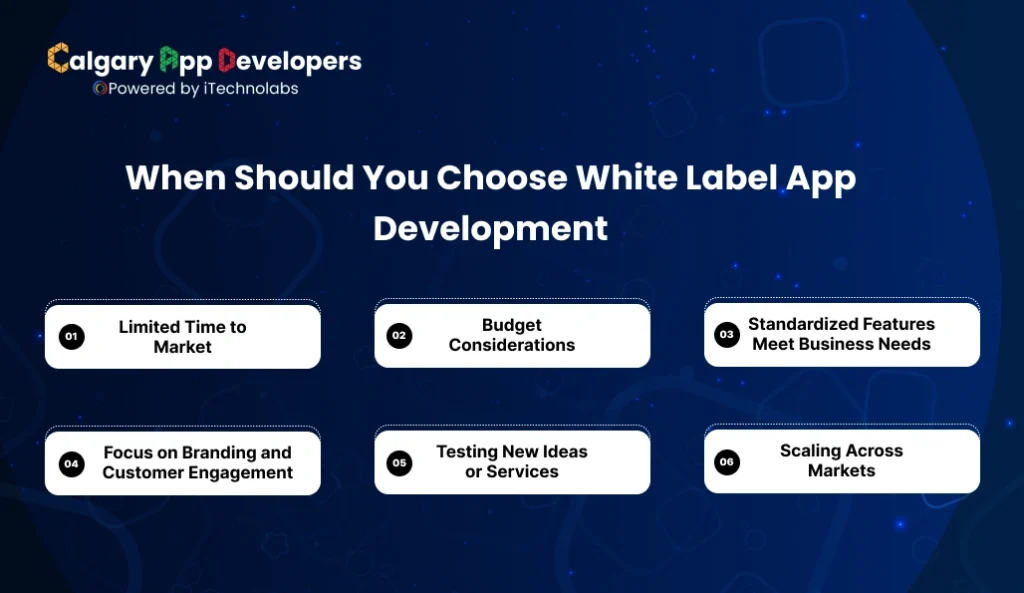
White label app development is a strategic solution for businesses that want to deliver a professional mobile experience without investing months or a large budget into custom development. Choosing this approach at the right time can save resources, accelerate growth, and provide a competitive edge.
- Limited Time to Market
For businesses that need to launch quickly, white label app development offers a ready-made solution that can be customized and deployed in a fraction of the time required for building an app from scratch. This makes it particularly valuable for startups, seasonal campaigns, or businesses entering highly competitive markets where speed is critical.
- Budget Considerations
Custom app development can be expensive, requiring investment in design, development, testing, and ongoing maintenance. White label apps provide a cost-effective alternative by leveraging pre-built frameworks, allowing businesses to allocate funds to marketing, user acquisition, or operational growth instead of technical development.
- Standardized Features Meet Business Needs
If your business model relies on common app features such as user accounts, payments, notifications, analytics, or booking systems, a white label solution can meet your requirements without the complexity of custom development. Businesses can select a solution that aligns with their operational model while still delivering a high-quality user experience.
- Focus on Branding and Customer Engagement
White label app development allows businesses to concentrate on building brand recognition and customer engagement. Companies can fully customize the interface, visual identity, and messaging to reflect their brand while leveraging a robust underlying system developed by experts.
- Testing New Ideas or Services
For businesses looking to experiment with new products or services, white label apps offer a low-risk method for market validation. By deploying a ready-made app, companies can test demand, gather user feedback, and iterate on features without committing the time and capital required for a fully custom solution.
- Scaling Across Markets
Businesses that plan to expand rapidly across multiple regions or service lines benefit from white label apps because the core technology is already built. Multiple branded versions can be launched quickly, providing consistency in quality while allowing customization for local markets or specific customer segments.
White label app development is most suitable when speed, cost efficiency, and proven functionality are priorities. It allows businesses to deliver a professional app experience to customers, focus on strategic growth initiatives, and avoid the time, expense, and risk associated with building a mobile app from the ground up.
Key Benefits of White Label App Development
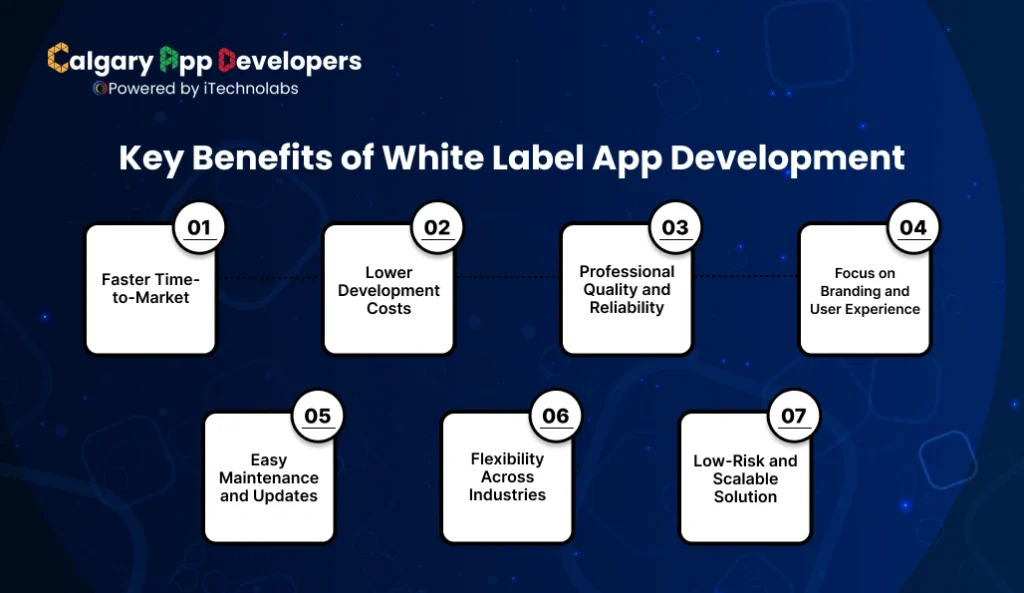
White label app development offers businesses a practical and efficient way to establish a mobile presence without the time, cost, and technical challenges of building an app from scratch. By leveraging a pre-built, fully functional app framework, companies can focus on branding, marketing, and customer engagement. Here are the key benefits:
- Faster Time-to-Market: Since the core app is already developed, white label solutions allow businesses to launch their apps quickly. This speed is crucial for startups, seasonal promotions, or companies entering competitive markets where timing can impact success.
- Lower Development Costs: Creating a custom app from scratch can be expensive, often requiring a full team of developers, designers, and testers. White label apps reduce these costs significantly by offering a ready-made framework that only needs branding and minor customization.
- Professional Quality and Reliability: White label apps are developed by experienced teams and thoroughly tested before delivery. This ensures a stable, secure, and user-friendly product, minimizing the risks associated with custom app development.
- Focus on Branding and User Experience: Businesses can fully customize the app’s design, colors, logos, and messaging to reflect their brand identity. This ensures a professional, cohesive experience for users while leveraging a technically robust foundation.
- Easy Maintenance and Updates: Most white label app providers offer ongoing support, updates, and maintenance. This means businesses do not need an in-house development team to manage technical issues or software upgrades.
- Flexibility Across Industries: White label app development can cater to various industries, from e-commerce and fitness to food delivery, education, and finance. Businesses can choose a solution tailored to their sector while retaining the flexibility to add or modify features.
- Low-Risk and Scalable Solution: Because white label apps are tested and proven, businesses face less risk of technical errors or delays. The model also allows for easy scaling, enabling expansion into new markets or additional services with minimal effort.
By opting for white label app development, businesses gain a cost-effective, reliable, and scalable mobile solution that allows them to focus on growth, marketing, and delivering value to their customers without the complexity of full-scale development.
Challenges and Limitations of White Label Apps
While white label app development offers speed, cost efficiency, and a ready-to-use solution, it is not without its limitations. Understanding these challenges helps businesses make informed decisions and ensures that the chosen approach aligns with long-term goals.
- Limited Customization Options
White label apps come with pre-built features and frameworks. While branding, colors, and minor functionalities can be adjusted, creating entirely unique features or workflows can be difficult. Businesses with highly specific or complex requirements may find the customization options restrictive. - Dependence on the Provider
Because the core app is developed and maintained by a third-party provider, businesses rely on the provider for updates, bug fixes, and ongoing technical support. Any delay or limitation on the provider’s side can impact the app’s performance or feature availability. - Risk of Similarity with Competitors
Since the same base app can be used by multiple companies, there is a possibility that competitors may offer similar features and experiences. Without strong branding or additional differentiators, it can be harder to stand out in the market. - Inhibited Control Over Backend Systems
White label apps have limited access to the backend structure. This can render it difficult for firms to install sophisticated analytics, combine highly specialized third-party systems, or optimally tune the app to intricate business processes. - Scaling Limitations
While white label apps are scalable to an extent, businesses planning rapid growth or expansion into multiple markets may encounter constraints. Adding highly specialized features or handling significantly larger user bases may require moving to custom development eventually. - Potential Licensing and Usage Restrictions
Some white label providers impose licensing or usage rules that limit how the app can be modified, distributed, or monetized. Businesses need to carefully review agreements to avoid future conflicts or unexpected costs.
White label app development is best suited for businesses seeking speed, cost savings, and proven functionality. However, companies with highly specialized needs, a desire for complete control over features, or plans for extensive long-term growth should weigh these limitations carefully before committing.
Who Can Use White Label Apps
White label app development is a flexible solution designed for businesses and organizations that want to establish a strong mobile presence without investing heavily in custom app creation. These apps are fully functional, professionally developed, and can be rebranded to match any company’s identity. Various types of businesses can benefit, and the functions they can leverage depend on their industry and goals.
-
Startups and Small Businesses
Startups and small businesses often need to launch products quickly and test ideas with minimal risk.
Functions They Can Leverage:
- Fast deployment of mobile solutions
- Customer engagement tools like notifications and in-app messaging
- Basic analytics to track user behavior and app performance
- Secure payment integration for services or products
-
Agencies and Marketing Firms
Digital agencies can offer mobile app solutions to clients without developing apps from scratch.
Functions They Can Leverage:
- Client-specific branding and customization
- Analytics dashboards to monitor user engagement
- Multi-client support and white-label delivery under the agency’s brand
- Easy updates and maintenance for multiple client apps
-
Retailers and E-Commerce Brands
Retail and e-commerce businesses can create mobile storefronts to increase sales and customer loyalty.
Functions They Can Leverage:
- Product catalogs and inventory management
- Online payments and order tracking
- Push notifications for promotions and discounts
- Customer account management and loyalty programs
-
Health, Fitness, and Wellness Providers
Gyms, personal trainers, and wellness brands can provide personalized experiences to clients.
Functions They Can Leverage:
- Workout and diet tracking
- Progress monitoring and analytics
- Booking and appointment scheduling
- Push notifications for motivation and reminders
-
Education and E-Learning Platforms
Schools, colleges, and online learning platforms can scale their digital offerings efficiently.
Functions They Can Leverage:
- Course delivery and video lessons
- Quizzes, assessments, and progress tracking
- Certificates and gamification features
- Student engagement tools like forums and messaging
-
Service-Based Businesses
Businesses offering on-demand services can simplify operations and enhance customer experience.
Functions They Can Leverage:
- Booking and scheduling systems
- Real-time tracking and service updates
- In-app payments and invoicing
- Ratings, reviews, and feedback management
-
Financial and Fintech Companies
Banks and fintech startups can provide secure, branded mobile banking and finance tools.
Functions They Can Leverage:
- Account management and transaction tracking
- Bill payments and fund transfers
- Investment tracking and portfolio management
- Security features such as encryption and authentication
White label app development allows these businesses to focus on branding, marketing, and customer experience while relying on a tested, fully functional app framework. It provides professional, scalable, and efficient solutions across industries without the time and cost of developing custom apps.
Industries That Rely on White Label App Solutions
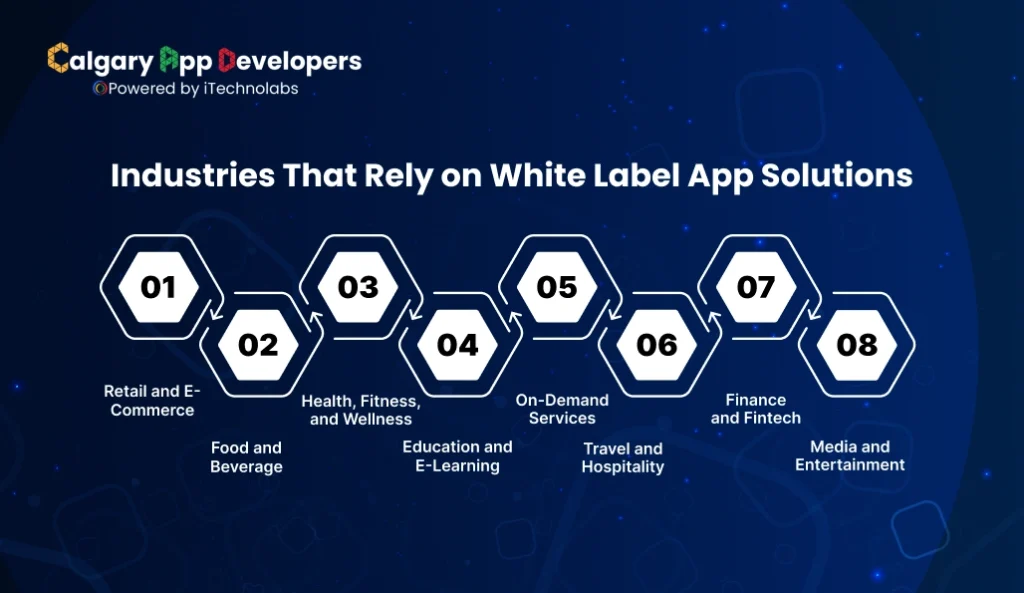
White label app development has become a go-to solution for businesses across multiple industries. It allows companies to launch professional, branded mobile apps quickly, reduce development costs, and focus on growth rather than technical challenges. Here’s a closer look at the industries that benefit the most:
- Retail and E-Commerce: Retailers and online stores use white label apps to offer a seamless shopping experience. These apps handle product listings, payments, order tracking, and customer engagement features like push notifications and loyalty programs.
- Food and Beverage: Restaurants, cafes, and cloud kitchens leverage white label apps for online ordering, menu management, delivery tracking, and promotions. They can provide a branded digital experience without building an app from scratch.
- Health, Fitness, and Wellness: Gyms, fitness studios, personal trainers, and wellness brands use white label apps to deliver workout routines, diet plans, progress tracking, and virtual coaching. These apps improve client engagement and retention.
- Education and E-Learning: Schools, colleges, and online learning platforms deploy white label apps to offer courses, quizzes, assessments, and interactive content. These apps allow institutions to scale digitally while maintaining a consistent brand presence.
- On-Demand Services: From ride-hailing to home services, white-label apps help businesses manage bookings, real-time tracking, payments, and customer feedback efficiently. They provide a smooth and professional experience for users.
- Travel and Hospitality: Travel agencies, tour operators, and hotels use white label apps to handle bookings, itineraries, payments, and customer support. These apps enhance user convenience while reflecting the brand’s identity.
- Finance and Fintech: Banks, fintech startups, and financial service providers use white label apps to offer secure mobile banking, payments, investment tracking, and expense management tools. These apps enable quick market entry while maintaining compliance and security standards.
- Media and Entertainment: Streaming platforms, news agencies, and content providers use white label apps to deliver audio, video, and written content. Features like subscriptions, personalized recommendations, and notifications enhance user engagement.
White label app development provides businesses in these industries with a reliable, ready-to-launch solution that combines proven functionality with full branding flexibility. By adopting these apps, companies can focus on marketing, customer experience, and growth while leaving the technical heavy lifting to experienced developers.
How to Build a White Label App Step-by-Step
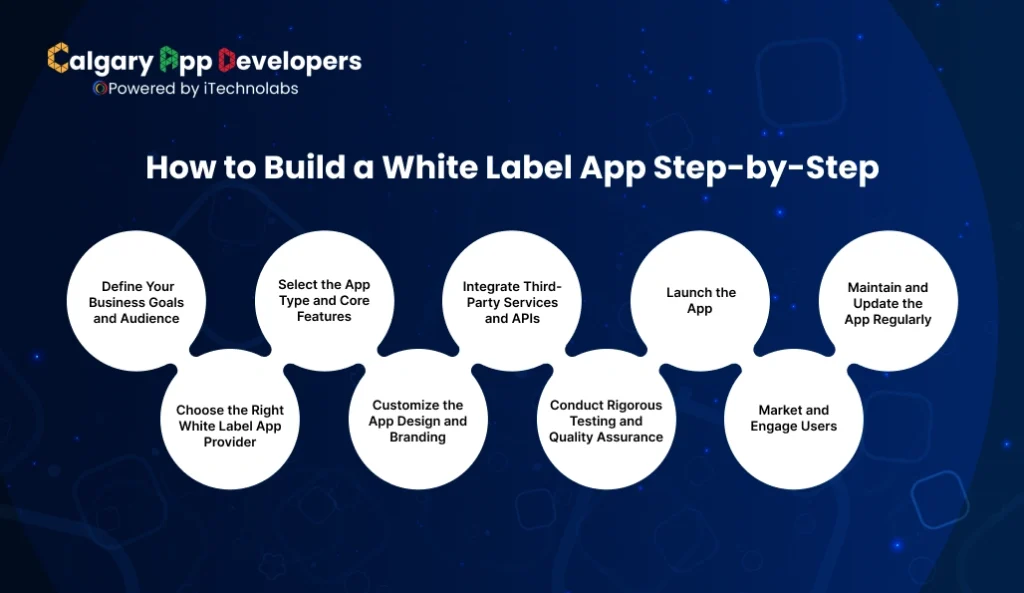
White label app development allows businesses to launch a fully functional, branded mobile app without the time, cost, and complexity of building one from scratch. While the foundation is already built, success depends on following a structured process to customize, deploy, and optimize the app for your audience. Here’s a detailed step-by-step guide:
- Define Your Business Goals and Audience
Start by clarifying why you need the app and who it will serve. Identify your target audience, their preferences, and the problem the app will solve. Establish measurable goals such as increasing sales, improving engagement, or streamlining services. A clear understanding of your objectives ensures that the chosen white label solution aligns with your business strategy.
- Choose the Right White Label App Provider
Selecting a reliable provider is critical. Look for companies with experience in your industry, strong technical expertise, and a portfolio of successful projects. Evaluate the provider’s customization options, support services, and post-launch assistance. A reputable provider reduces technical risks and ensures smooth long-term operation.
- Select the App Type and Core Features
Determine which type of white label app best suits your business—e-commerce, on-demand services, fitness, finance, education, or others. Identify the key features your audience expects, such as:
- Payment gateways and secure transactions
- User registration and profile management
- Push notifications and in-app messaging
- Analytics and reporting tools
- Booking or scheduling systems (if applicable)
- Customize the App Design and Branding
Once the base app is ready, customize it to reflect your brand identity. This includes:
- Logos, icons, and app splash screens
- Color schemes, fonts, and visual styles
- Messaging and user interface elements
- Minor functional adjustments to improve usability
Proper branding ensures the app feels uniquely yours and strengthens recognition with your audience.
- Integrate Third-Party Services and APIs
Enhance the app’s capabilities by integrating third-party tools relevant to your business. Examples include:
- Payment processors like Stripe or PayPal
- Customer relationship management systems
- Social media login options
- Analytics platforms to track user behavior
These integrations help create a seamless experience for your users while extending the app’s functionality.
- Conduct Rigorous Testing and Quality Assurance
Even though the core app is customized, apps require additional quality checks. Test for:
- Performance and speed across devices
- User interface consistency and usability
- Security vulnerabilities and data protection
- Compatibility with different operating systems
Thorough testing ensures the app functions smoothly and delivers a professional experience.
- Launch the App
Deploy the app under your brand on major app stores. Ensure your store listing is optimized with:
- Compelling descriptions
- Branded visuals and screenshots
- Relevant keywords for discoverability
A strong launch plan helps maximize downloads and early engagement.
- Market and Engage Users
After launch, focus on user acquisition and retention. Use:
- Push notifications for updates and promotions
- Social media campaigns to attract attention
- Email marketing for onboarding and engagement
- Analytics to monitor usage and optimize features
Effective marketing ensures your app reaches the right audience and drives business goals.
- Maintain and Update the App Regularly
White label app providers usually offer ongoing support, including updates and maintenance. Regularly update the app to:
- Maintain compatibility with new OS versions
- Fix bugs and improve performance
- Add minor enhancements to meet evolving user expectations
Continuous maintenance keeps the app reliable, secure, and aligned with your business growth.
Following this structured approach to white label app development allows businesses to launch a professional, branded app efficiently. It combines speed, cost-efficiency, and technical reliability while letting you focus on marketing, user engagement, and business growth.
Choosing the Right White Label App Development Company
Selecting the right partner is critical for a successful white label app development project. The right company ensures that your app is reliable, fully functional, and aligned with your brand, while minimizing technical risks and delays. Here’s a professional guide to help you make the right choice.
- Industry Experience and Expertise: Look for a company that has experience in your specific industry. Providers familiar with your sector understand the features, compliance requirements, and user expectations unique to your business. Their expertise ensures the app is both functional and relevant to your audience.
- Proven Portfolio and Case Studies: Examine the company’s past projects to evaluate the quality of their work. Case studies and client testimonials provide insight into their technical capabilities, delivery timelines, and post-launch support. A strong portfolio demonstrates reliability and consistency.
- Customization Capabilities: Even though white label apps are pre-built, the ability to customize branding, features, and user experience is crucial. Ensure the company offers sufficient flexibility to tailor the app to your brand identity and business requirements.
- Technical Support and Maintenance: Ongoing support is essential for updates, bug fixes, and troubleshooting. Confirm that the provider offers post-launch services and can maintain the app efficiently. A reliable support system ensures your app remains functional, secure, and up-to-date.
- Security and Compliance: Data security and regulatory compliance are non-negotiable. Verify that the company follows best practices for encryption, secure payments, and privacy regulations relevant to your industry. This is especially important for finance, healthcare, and e-commerce apps.
- Transparent Pricing and Contracts: Choose a provider that offers clear pricing models without hidden costs. Ensure you understand licensing, usage restrictions, and maintenance fees. Transparent agreements reduce the risk of unexpected expenses during or after development.
- Scalability and Future-Proofing: Your app should be able to grow with your business. Ensure the company provides a scalable solution that can accommodate increased users, additional features, or expansion into new markets. A future-ready app protects your investment over the long term.
- Communication and Collaboration: Effective collaboration and clear communication are essential throughout development. Choose a partner that is responsive, understands your vision, and provides regular updates. This ensures alignment and smooth project execution.
By carefully evaluating these factors, you can select a white label app development company that delivers a high-quality, branded mobile app while minimizing risk, reducing costs, and ensuring long-term success.
Real Cost of White Label App Development
The cost of white label app development typically starts around $5,000 to $15,000 for a basic app, depending on the platform and features included. However, the total investment can increase based on customization, integrations, and ongoing support needs. Understanding the full cost structure helps businesses plan their budget effectively.
Estimated Total Cost of the Complete Process
| Component | Typical Cost Range |
| Base white label app license | $5,000 – $10,000 |
| Branding and design customization | $1,000 – $3,000 |
| Feature enhancements/minor customizations | $1,500 – $5,000 |
| Third-party integrations (payments, analytics, APIs) | $500 – $2,500 |
| Testing and quality assurance | $500 – $1,500 |
| App store deployment (iOS and Android) | $100 – $500 |
| Ongoing maintenance and updates (annual) | $1,000 – $3,000 |
Total estimated cost for a fully branded and functional white label app typically ranges from $10,000 to $25,000, depending on the complexity and level of customization.
Factors Affecting the Cost of White Label App Development

There are many factors that affect the total cost of white label app development. By knowing about these factors, businesses can budget accordingly and select a provider that meets their requirements. Here’s a thorough analysis with emphasis on critical factors:
- Platform Choice
The choice of platform impacts development costs and market reach.
| Platform | Cost Impact | Considerations |
| iOS Only | Lower | Access to Apple users; simpler deployment |
| Android Only | Lower | Access to a wider global audience; requires extensive device testing |
| Both iOS & Android | Higher | Broader reach; increases development and QA requirements |
- Level of Customization
Simple branding is inexpensive, but adding complex features or modifying workflows increases costs.
| Customization Type | Estimated Cost Impact | Notes |
| Basic Branding (logo, colors, fonts) | Low | Quick and easy to implement |
| Moderate Customization (UI adjustments, minor features) | Medium | Requires additional design and testing |
| Extensive Customization (new modules, complex workflows) | High | May approach the cost of custom development |
- Third-Party Integrations
Integrations such as payment gateways, analytics, or CRM tools affect development time and licensing.
Examples:
- Payment gateways like Stripe or PayPal for secure transactions
- Analytics platforms like Google Analytics or Mixpanel for insights
- Social media login options for easier onboarding
- Feature Complexity
| Feature Type | Cost Impact | Notes |
| Basic Features (login, notifications, payments) | Low | Usually included in white label solutions |
| Intermediate Features (real-time tracking, booking systems) | Medium | Requires moderate customization |
| Advanced Features (AI-based recommendations, advanced analytics) | High | Additional coding or third-party services may be needed |
- Development Team Location
The location of the development team can significantly affect costs. Working with teams in cost-effective regions allows businesses to reduce expenses without compromising quality.
| Location | Typical Hourly Rate | Notes |
| Calgary, Canada | $25 – $40 | Affordable rates, skilled professionals, high-quality output |
| North America (US/Canada outside Calgary) | $50 – $120 | Higher costs due to labor and overhead |
| Western Europe | $60 – $150 | Premium pricing for development expertise |
| Asia | $15 – $35 | Very cost-effective but may involve communication or time-zone challenges |
Calgary emerges as a strategic choice for businesses seeking high-quality white label app development at competitive rates. The city combines skilled developers with cost-efficiency, making it an ideal location for outsourcing without compromising project standards.
Why Calgary App Developers is a Trusted White Label App Development Partner
Calgary App Developers has built a reputation as a reliable and cost-effective partner for white label app development, helping businesses launch professional, fully branded mobile apps quickly. Our expertise spans industries such as retail, fitness, finance, education, and on-demand services, ensuring every app we deliver meets user expectations and industry standards.
We combine affordability with quality, offering competitive pricing while maintaining high development standards. Our solutions allow businesses to fully customize branding, interface, and key features, creating a seamless and unique experience for users. Beyond development, we provide ongoing maintenance, updates, and technical support, so your app remains secure, functional, and up-to-date.
Key reasons to choose Calgary App Developers include:
- Extensive industry experience and proven track record
- Cost-effective white label solutions without compromising quality
- Flexible branding and feature customization
- Ongoing support, maintenance, and timely updates
- Strong focus on security, compliance, and user experience
- Efficient processes enabling rapid time-to-market
With a collaborative approach and attention to detail, Calgary App Developers ensures that businesses receive a professional, reliable, and market-ready white label app tailored to their goals and audience.
Our Proven Experience in White Label App Development
Our experience in white label app development comes from building production-ready platforms that businesses can brand, customize, and launch without starting from scratch. We focus on stability, scalability, and long-term usability so our clients can grow on top of a proven foundation rather than rebuilding core systems again and again.
One of the strongest examples of this approach is Camcloud, a cloud-based video monitoring platform designed for homes and small businesses. We delivered a white-label iOS application that allows users to access their Camcloud accounts from anywhere while keeping the experience simple and reliable.
What we built with Camcloud includes the following capabilities.
- A fully branded iOS app that clients could launch under their own identity
- Secure onboarding to add IP cameras quickly without technical complexity
- Live video streaming with consistent performance across supported devices
- Access to recorded footage with simple media management controls
- Real-time motion alerts and configurable detection settings
- Remote camera and account management from a single interface
The application supports a wide range of camera brands, making it flexible enough to work across different environments while keeping setup effortless for non-technical users. The result was a cost-effective, easy-to-deploy monitoring solution that worked equally well for home use, pet monitoring, childcare supervision, and small business security.
This project reflects how we approach white label app development. We build strong core platforms, abstract the complexity, and deliver apps that businesses can confidently brand, scale, and support without heavy ongoing engineering effort.
Conclusion
White label app development offers businesses a practical and efficient way to launch professional mobile apps without the time, cost, and complexity of building from scratch. It combines speed, reliability, and customization, allowing companies to focus on branding, user engagement, and growth.
By choosing a trusted partner, such as Calgary App Developers, businesses gain access to industry expertise, cost-effective solutions, and ongoing support, ensuring their apps remain secure, functional, and scalable. From startups and retailers to fitness brands and fintech companies, white label apps provide a ready-made framework that can be tailored to meet unique business needs.
For companies aiming to enter the mobile market quickly, deliver a polished user experience, and minimize development risks, white label app development is a strategic choice. With the right approach and partner, businesses can launch apps that strengthen their brand presence, engage users effectively, and drive long-term growth.
FAQs:
- Are White Label Apps Legal?
Yes, white label apps are fully legal. Businesses purchase the rights to rebrand and distribute an app developed by another company. As long as the licensing agreement is followed, using, customizing, and selling the app under your brand is completely legitimate. - How Much Does a White Label App Cost?
The cost of a white label app typically starts from $5,000 and can go up to $25,000 depending on customization, features, platform choice, and integrations. Ongoing maintenance and updates may add to the overall investment. - How Can I Obtain a White Label App?
You can get a white label app by partnering with a reputable app development company. Select a solution that fits your industry, customize branding and features, test thoroughly, and deploy it on app stores under your company’s name. - What Is the Total Cost of Developing a White Label Mobile App?
Total costs include the base app license, branding, minor feature customization, third-party integrations, testing, app store deployment, and ongoing support. Typically, the overall investment ranges from $10,000 to $25,000 depending on complexity and services. - How Do I Find a White Label App Development Company?
Look for companies with industry experience, a strong portfolio, flexible customization options, and reliable post-launch support. Reviews, case studies, and client testimonials help assess credibility and technical capability. - What Are the Advantages of White Label Mobile App Development?
White label apps offer faster time-to-market, lower development costs, reliable pre-tested frameworks, brand customization, easy maintenance, scalability, and reduced technical risk, allowing businesses to focus on growth and user engagement. - How Is a White Label Service Different from a Private Label Solution?
White label solutions are ready-made products rebranded for multiple clients, whereas private label solutions are developed exclusively for one company. Both allow branding, but private label offers more exclusivity and customization. - What Does ‘White Labeling’ Mean?
White labeling is the process of taking a pre-built product or service and rebranding it to sell under your own name. It enables businesses to offer professional solutions quickly without creating them from scratch. - What Is White Label Web Development and How Does It Work?
White label web development involves using pre-built website frameworks or templates, customizing branding and features, and delivering it under your brand. The provider handles the technical development while you focus on client relationships and marketing. - What Is the Best Way to Distribute White Label Solutions?
The best approach is to brand the solution, ensure proper customization, and deploy it across appropriate platforms, such as app stores or web portals. Marketing, onboarding, and ongoing support ensure successful distribution and user adoption.


Pankaj Arora is a seasoned technology leader and the Founder of Calgary App Developer, with 10+ years of expertise in crafting high-performance digital solutions. His core competencies include full-stack app development, cloud-native architecture, API integration, and agile product delivery. Under his leadership, Calgary App Developers has empowered startups and enterprises alike with scalable mobile applications, secure web platforms, and AI-driven SaaS products.