





What Is a Restaurant Mobile App & Why Your Business Needs One
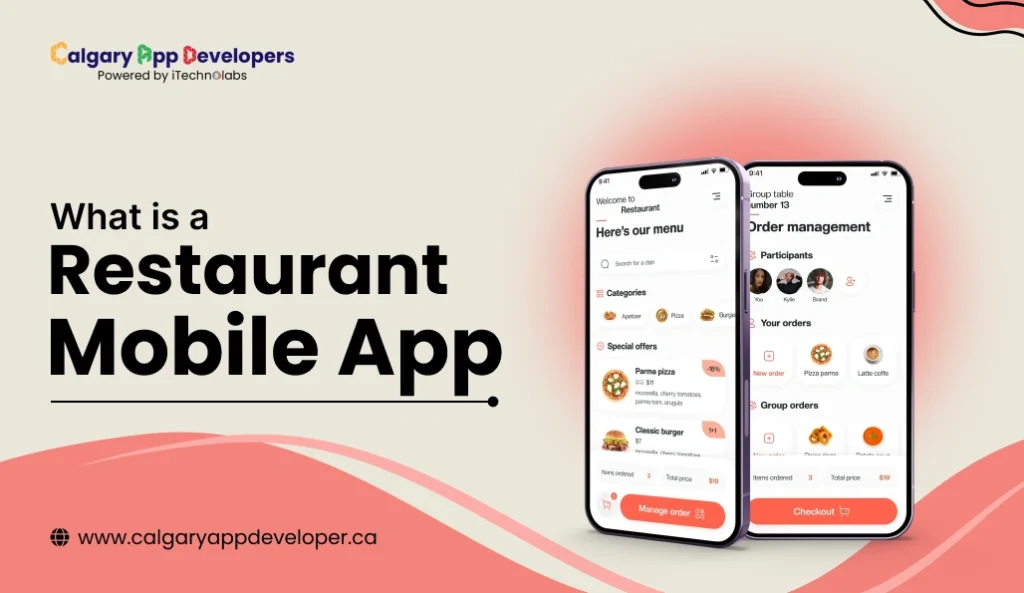
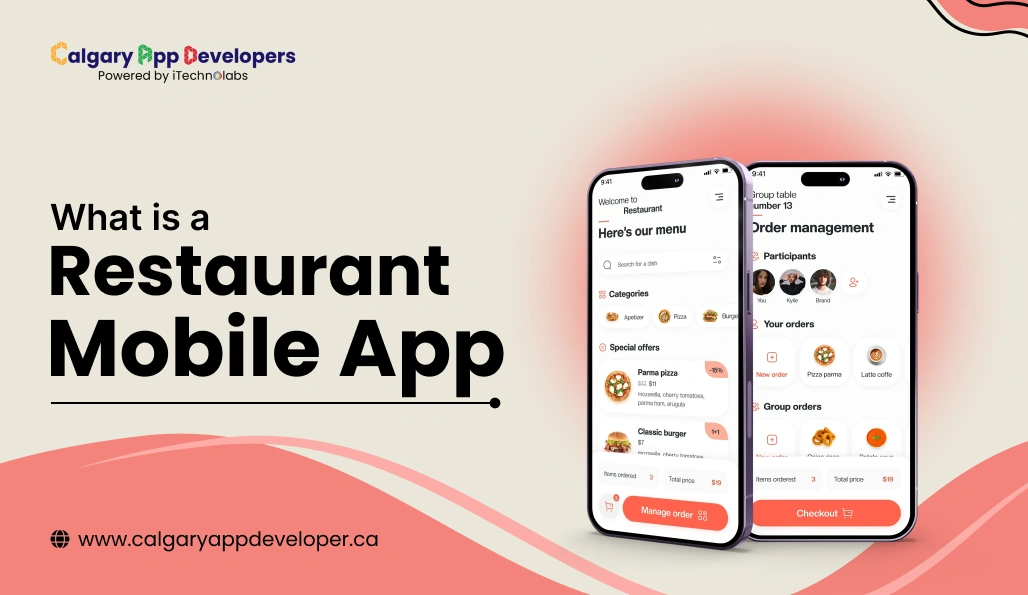
If you manage a restaurant or plan to open one, you have likely heard about a restaurant mobile app. A restaurant mobile app is an application for smartphones that lets customers browse the menu, place orders for delivery or takeaway, pay online, save favorite dishes, and access loyalty rewards.
More than a convenience, a restaurant mobile app is shaping how people expect to dine and order. Global demand for food-delivery apps is rising sharply. The market for food-delivery mobile applications is projected to grow from USD 6.75 billion in 2020 to roughly USD 62.84 billion by 2030, almost a tenfold increase.
These numbers show a strong shift in how consumers order meals. More people rely on smartphones and internet access to order food from home rather than calling or visiting. For a restaurant owner, relying only on dine-in or phone orders may no longer suffice.
A restaurant mobile app offers direct access to customers, avoids fees charged by third-party aggregators and opens up a channel to build customer loyalty and recurring orders.
Soon a restaurant mobile app will feel less like an optional add-on and more like a core part of running a restaurant. As more consumers make digital ordering part of everyday life, businesses that fail to adapt may fall behind.
- A restaurant mobile app helps customers browse, order, and stay connected with your restaurant.
- Digital ordering is growing quickly, and customers now expect simple mobile access.
- Building your own app gives you control, better margins, and stronger loyalty.
- A well-planned app improves operations, increases revenue, and supports long-term growth.
- A restaurant mobile app centralizes menu browsing, ordering, payments, and loyalty features in one place so customers can interact with your restaurant easily.
- The rise of mobile food ordering shows a clear shift toward digital dining behavior, making direct online access essential for modern restaurants.
- Creating your own app allows you to protect margins by reducing dependence on third-party platforms and gives you ownership of customer relationships and data.
- Building a restaurant mobile app requires a structured process that includes research, MVP planning, design, development, testing, and ongoing optimization.
- Integrating the app with point-of-sale systems, menu management tools, kitchen workflows, and loyalty programs ensures smooth operations.
- Measuring user engagement, order patterns, operational efficiency, and revenue impact helps you refine the app and turn it into a long-term business asset.
- A strong restaurant mobile app strengthens visibility, supports repeat business, and positions your restaurant for growth in an increasingly digital market.
What Is A Restaurant Mobile App And A Restaurant Ordering App?
A restaurant mobile app is a smartphone application that lets customers interact with your restaurant in a simple and consistent way. It brings your menu, ordering, payments, loyalty programs, and communication into one place. Customers use it to explore your food, place orders, and stay connected without relying on third-party platforms.
A restaurant ordering app is a more focused version of this. Its core purpose is to help customers select items, customize their order, and complete payment with minimal effort. It removes friction from the ordering journey and gives customers clearer control over their experience.
Key functions of a restaurant mobile app
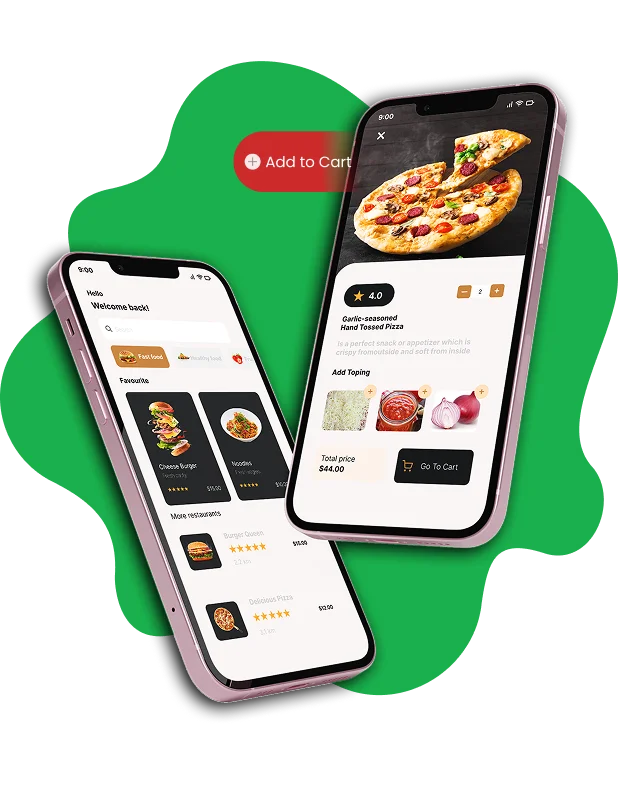
- Digital menu with photos, item details, and dietary information
- Ordering for delivery, takeaway, or dine-in
- Customisation options for each dish
- Secure digital payments
- Real-time order updates and estimated preparation times
- Loyalty points or rewards
- Push notifications for offers and updates
- Saved addresses, favourites, and quick reorder
- Customer support and feedback
- Table reservation or waitlist management, depending on the restaurant
A restaurant mobile app builds a direct link between your business and your customers. The ordering features help convert that connection into consistent revenue while keeping people engaged with your brand.
Also Read: Online Ordering Systems for Restaurants: A Complete Guide
Why Your Restaurant Should Consider Its Own App?
A dedicated restaurant mobile app gives you a level of control that third-party platforms can never match. Customers want a simple way to order, check prices, track delivery, and stay connected with the places they enjoy. When diners interact with your restaurant through other platforms, you lose visibility into their behavior, you depend on someone else’s system, and you pay commissions that eat into already tight margins.
A restaurant mobile app brings the entire journey back to you. It becomes a digital extension of your brand that customers carry in their pocket. It helps you shape how they discover new dishes, how they reorder, and how often they return. As digital ordering keeps rising, having your own app is becoming a practical requirement rather than a luxury for growth-minded restaurants.
Key reasons to consider building your own app
- You own your customer data and can understand purchasing patterns
- You avoid commissions that reduce profits and gain more control over pricing
- You strengthen your brand presence with a personalised experience
- You offer faster and more reliable ordering with saved preferences
- You stay connected through notifications and timely offers
- You encourage repeat business through loyalty rewards
- You promote discounts and campaigns without paying for placement
- You build long-term digital assets that support scale, new locations, and new menu launches
A restaurant mobile app helps you stay competitive, visible, and relevant. It positions your business for the way customers now prefer to order and engage.
How To Build A Restaurant Mobile App
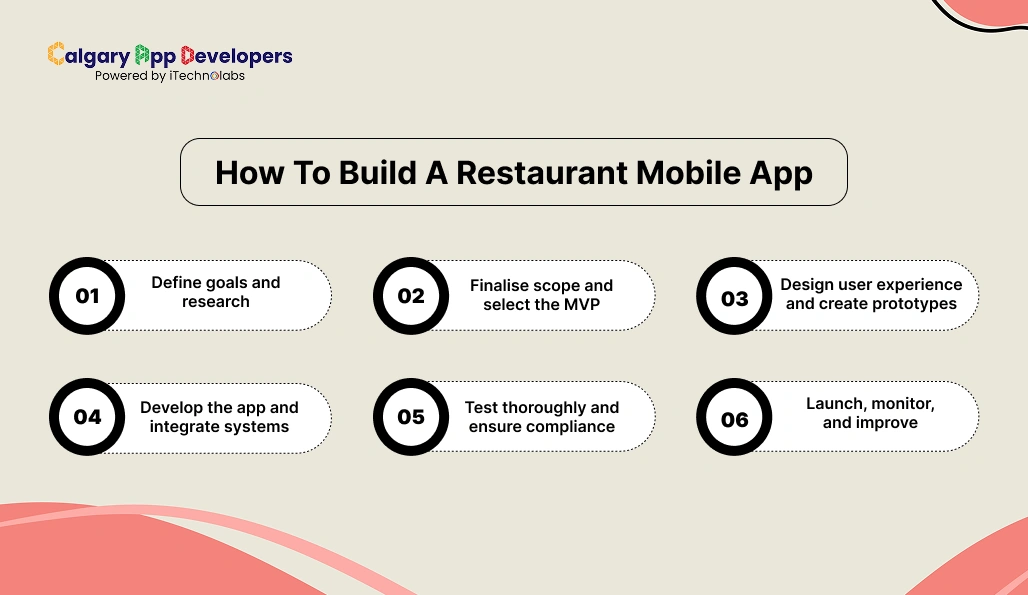
Below is a professionally structured six-step process that guides you from planning to launch. Each step includes clear explanations and supporting bullet points.
Step 1. Define goals and research
Start with clarity. Understand what you want the restaurant mobile app to achieve and how customers will use it.
- Identify the primary purpose such as ordering, loyalty, or reservations
- Study customer behaviour and map their ordering journey
- Review competitor apps and note useful patterns
- Set measurable targets like monthly active users and order volume
Step 2. Finalise scope and select the MVP
Build only what delivers value at launch. Add advanced features later based on real usage.
- List all features and rank them by importance and complexity
- Select the core set for your minimum viable product
- Choose your platform strategy for example iOS, Android, or both
- Plan the roadmap for loyalty, table management, and multi-location support
Step 3. Design user experience and create prototypes
Strong design makes the app intuitive and encourages repeat orders.
- Create user flows covering tasks like browsing, ordering, and reordering
- Build wireframes and convert them into a clickable prototype
- Develop a visual style that aligns with your restaurant brand
- Test the prototype with real customers and staff
Step 4. Develop the app and integrate systems
This stage turns planning into a functional product that works smoothly with your current operations.
- Set up backend systems for menu management, orders, and analytics
- Connect the app to your point of sale or kitchen display system
- Add secure payment options that meet compliance requirements
- Include delivery modules or third-party integrations if needed
Step 5. Test thoroughly and ensure compliance
Testing protects you from operational issues and negative customer experiences.
- Run functional, load, and stress tests across devices
- Ensure the app meets all App Store and Play Store submission rules
- Validate data security, encrypted communication, and safe authentication
- Conduct a soft launch with a small audience for final feedback
Step 6. Launch, monitor, and improve
Releasing the app begins a cycle of measurement and refinement.
- Publish with clear store descriptions, visuals, and keywords
- Track performance metrics through analytics tools
- Identify weak points and test new improvements such as better checkout flows
- Maintain the app with regular updates, security patches, and new features
A well-built restaurant mobile app becomes a reliable digital channel for orders and customer engagement. This step-by-step approach helps you launch with confidence and grow the app over time.
Read Also: Top POS Systems for Restaurants with AI Tools
Connecting Your App With Your Current Systems
A restaurant mobile app only delivers real value when it works in harmony with the systems you already use. The goal is to create a unified flow where orders move from the customer’s phone to your kitchen, billing, and loyalty tools without friction. When the app connects cleanly to your point of sale, your menu management setup, and your rewards program, the entire operation becomes faster and more predictable.
A well-integrated restaurant mobile app strengthens the guest experience in ways customers notice. Orders appear instantly on kitchen screens. Staff see accurate item details with modifiers. Loyalty points update as soon as a transaction is completed. Customers feel the difference because the entire journey feels smooth from the moment they place an order to the moment they pick it up.
Below are the core areas to connect before launching your restaurant mobile app.
Point of sale integration
- Make sure all mobile orders land directly in your point of sale so the kitchen never misses a ticket.
- Sync prices, taxes, and item availability to avoid mismatched totals
- Allow automatic printing or digital routing of tickets to the correct stations
Menu and inventory sync
- Keep menu items updated in real time so customers do not see unavailable dishes
- Ensure modifiers, add-ons, and combos match your in-store setup
- Sync inventory rules so the app reflects stock shortages instantly
Loyalty and rewards alignment
- Connect the app to your existing loyalty system so customers earn and redeem rewards
- Make sure reward balances, coupons, and offers update in real time
- Allow customers to track points, benefits, and personalised deals directly in the app
Kitchen workflow integration
- Route mobile orders to the appropriate preparation station
- Display preparation times consistently across the app and kitchen screens
- Provide clear identifiers so staff can match the right order to the right customer
If your current in-store systems are outdated or unreliable, fix those first. A restaurant mobile app will only perform as well as the technology underneath it. A strong foundation ensures your app becomes a growth engine rather than an operational burden.
Also Read: How to Create a Branded Mobile App for Restaurants?
Measuring Performance And Return On Investment
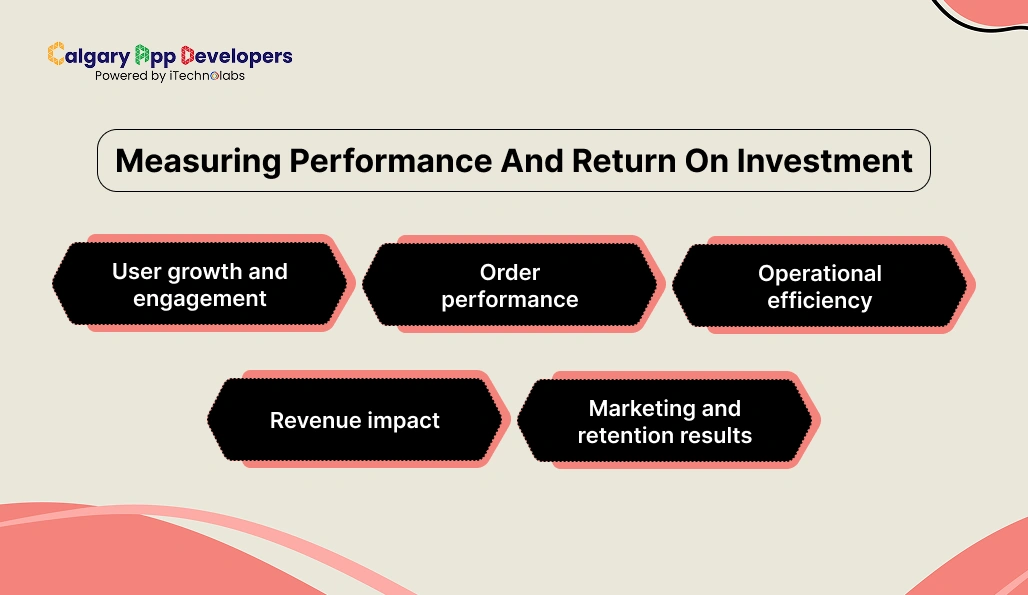
Once your restaurant mobile app is in the hands of customers, your next responsibility is to understand how well it performs. The way people use the app, the frequency of their orders, and the revenue the app produces will show whether your investment is paying off. This is the stage where data begins to guide your decisions. It moves the app from a launch milestone to a long-term business asset.
- User growth and engagement
Start by tracking how many customers are downloading the app and how many of them return after their first visit. These numbers reveal how useful the app feels in everyday life. High install numbers with low engagement often point to a confusing interface or an unclear value proposition. When customers keep coming back, saving their favorite items, and completing their profiles, you know the app is becoming part of their regular ordering routine.
- Order performance
Next, look closely at ordering behavior. Compare the number of app orders with in-store and phone orders to understand how the digital channel is growing. Review the average order value to see whether customers buy more through the app. Examine how many people browse the menu but leave before checkout. This helps you identify friction points that might be slowing down conversions. Repeated orders are especially important because they reveal how quickly casual users become loyal customers.
- Operational efficiency
A strong restaurant mobile app should improve how your restaurant runs behind the scenes. Measure how many app orders reach the point of sale without manual adjustments from staff. Check how long it takes for the kitchen to accept and prepare mobile orders. Look for patterns in delays or cancellations. If preparation times rise or items are frequently marked unavailable, the issue often traces back to menu sync or outdated in-store systems. When the app and operations are aligned, your team spends less time correcting mistakes and more time serving guests.
- Revenue impact
One of the clearest indicators of success is the share of revenue the app generates. Track the total income from app orders and compare it with what you earn through aggregator platforms. This tells you how much margin you are saving by moving customers to your own channel. Pay attention to customers who previously ordered through third-party apps but now choose your restaurant mobile app. This shift strengthens profitability over time because it reduces commissions and gives you ownership of the customer relationship.
- Marketing and retention results
Finally, review how customers respond to your marketing efforts inside the app. Look at how many people open push notifications, redeem offers, or claim loyalty rewards. These numbers show whether your messaging resonates with users or needs refinement. If customers slowly disengage, the data helps you pinpoint when and why it happens, allowing you to adapt your strategy before churn grows.
A restaurant mobile app becomes a powerful engine for growth when every improvement is guided by real numbers. Consistent measurement helps you strengthen customer experience, increase order frequency, and build a channel that produces long-term value for your restaurant.
Read Also: How to Create Restaurant Inventory Tracking Software
Conclusion
A restaurant mobile app is no longer a side project. It is one of the most reliable ways to build direct relationships, increase order volume, and keep your brand in a customer’s daily routine. When the app is planned well, integrated with your existing systems, and measured with intention, it becomes a steady source of revenue and loyalty. It also protects your margins by shifting customers away from commission-based platforms and into a channel you fully control.
If you are ready to build a restaurant mobile app that reflects your brand and supports real growth, Calgary App Developers can guide you through every stage. Our team designs, develops, and integrates restaurant apps that work smoothly with your point of sale, menu systems, and loyalty programs.
The result is a digital extension of your restaurant that improves efficiency and gives customers a reason to return.


Pankaj Arora is a seasoned technology leader and the Founder of Calgary App Developer, with 10+ years of expertise in crafting high-performance digital solutions. His core competencies include full-stack app development, cloud-native architecture, API integration, and agile product delivery. Under his leadership, Calgary App Developers has empowered startups and enterprises alike with scalable mobile applications, secure web platforms, and AI-driven SaaS products.