











API Development: Complete Guide for Beginners & Experts 2026

Businesses are moving faster than ever to build connected digital products, and APIs sit at the center of that transformation. Whether it is a mobile app pulling real-time data, a SaaS platform integrating third-party services, or an enterprise system streamlining internal workflows, APIs make it all possible.
As organizations scale, the need for custom API development becomes more strategic than optional. Off-the-shelf solutions often fall short when it comes to performance, flexibility, and long-term control. A well-designed API not only connects systems but also unlocks new capabilities, improves user experiences, and supports future growth.
At the same time, decision makers are becoming more conscious about development investments. Conversations around API strategy are now closely tied to broader technology spending. Businesses want solutions that are not just functional, but efficient, scalable, and aligned with long-term ROI.
This guide breaks down everything you need to know about custom API development, from fundamentals and architecture to security, cost considerations, and real-world use cases. Whether you are planning your first API or optimizing an existing ecosystem, this resource will help you make informed decisions with confidence.
TL;DR
- Custom API development is essential for building scalable, connected, and future-ready digital products.
- APIs enable faster development, seamless integrations, and efficient use of AI capabilities.
- The cost of API development varies based on complexity, technology, and integrations.
- A strategic approach ensures better performance, security, and long-term ROI.
Key Points
- APIs act as the foundation of modern software by enabling communication between systems, applications, and services without exposing internal logic.
- Custom API development provides greater flexibility, control, and scalability compared to off-the-shelf solutions, making it a strategic investment for growing businesses.
- Businesses use APIs to accelerate development, integrate third-party services, and deliver better user experiences across platforms.
- A structured API development process includes planning, design, technology selection, implementation, security, testing, and ongoing maintenance.
- Different types of APIs, including public, private, partner, REST, GraphQL, and gRPC, serve specific use cases depending on access level and performance needs.
- Choosing the right tools and technologies, such as backend frameworks, databases, and cloud platforms, directly impacts performance, scalability, and cost efficiency.
- High-quality APIs include essential features like strong security, scalability, clear documentation, and consistent design to ensure reliability and ease of use.
- APIs are widely used across industries such as finance, healthcare, eCommerce, logistics, and SaaS to enable real-time data exchange and automation.
- API security requires a multi-layer approach that includes authentication, encryption, monitoring, and regular audits to protect systems and data.
- API development costs depend on factors such as complexity, integrations, infrastructure, and team location, with additional considerations for AI integration.
- APIs can be monetized through subscription models, usage-based pricing, partnerships, and data access, creating new revenue opportunities.
- Following best practices such as versioning, performance optimization, and continuous monitoring ensures APIs remain scalable and maintainable over time.
- Common challenges in API development, including scalability issues, security risks, and integration complexity, can be addressed through proper design and proactive strategies.
- Emerging trends such as AI-driven APIs, microservices architecture, and API first development are shaping the future of digital ecosystems.
Understanding APIs and Their Role in Modern Software
APIs, or Application Programming Interfaces, are the building blocks that allow different software systems to communicate with each other. They define how applications request and exchange data, enabling seamless interaction between services without exposing internal logic. From mobile apps and web platforms to enterprise systems and cloud services, APIs power nearly every digital experience today.
In modern software architecture, APIs act as connectors that bring flexibility and scalability. Instead of building everything from scratch, businesses can integrate external services such as payment gateways, authentication systems, and mapping tools. This approach accelerates development, reduces redundancy, and allows teams to focus on core product features.
APIs also support modular development. Teams can work on separate components independently while ensuring everything functions together through well-defined interfaces. This improves development speed, simplifies maintenance, and makes it easier to upgrade or replace specific parts of a system without disrupting the entire application.
As companies increasingly adopt AI-driven features, APIs play an even more critical role. Many AI services, including machine learning models, natural language processing tools, and recommendation engines, are accessed through APIs. This allows businesses to integrate advanced intelligence into their products without building complex models from the ground up. As a result, discussions around API strategy often align with broader considerations, where efficiency and scalability directly impact long-term investment.
A well-designed API is not just a technical asset. It is a strategic enabler that supports innovation, accelerates product development, and opens the door to new business opportunities.
How APIs Work: A Simple Breakdown
Understanding how APIs function does not require deep technical expertise. At a basic level, an API acts as a messenger that carries requests from one system to another and delivers the response back. Here is a clear breakdown of how the process works:
- A Request Is Sent: A client, such as a mobile app or web application, sends a request to an API. This request includes specific details like the type of data needed and any required parameters.
- The API Receives and Processes the Request: The API acts as an intermediary. It validates the request, checks permissions, and determines how to handle it based on predefined rules.
- Communication with the Server: Once validated, the API communicates with the server or database. It retrieves or processes the required data, which could involve calculations, data storage, or external service calls.
- Response Is Generated: After processing, the server sends the data back to the API. The API then formats this data into a structured response, usually in JSON or XML format.
- The Client Receives the Response: The API delivers the response back to the client application. The app then presents the data to the user in a meaningful way.
- Authentication and Security Checks: Most APIs include authentication mechanisms such as API keys or tokens. These ensure that only authorized users or systems can access the data.
- Error Handling and Status Codes: If something goes wrong, the API returns status codes that explain the issue. This helps developers quickly identify and fix problems.
APIs simplify complex interactions by standardizing how systems communicate. This efficiency becomes especially important when integrating advanced technologies.
Also Read: Best API Development Tools to Build & Test APIs Faster
Why Businesses Invest in Custom API Development
Custom API development has moved from a technical choice to a strategic investment. Businesses are no longer building APIs only for integration. They are building them to drive growth, unlock new revenue streams, and stay competitive in an AI-driven landscape.
Here are the key reasons behind this shift, supported by current data and future projections:
- APIs Are Becoming Core Revenue Drivers
APIs are no longer just connectors. They are business assets. According to Postman’s State of the API report, 65 percent of organizations now generate revenue directly from APIs.
Companies that adopt an API first approach also see a stronger financial impact, with a significant share generating over a quarter of their total revenue through APIs.
This signals a clear shift. APIs are not supporting the business. They are part of the business model.
- Rapid Growth of the API Economy
The API ecosystem is expanding at a strong pace. The API management market alone is projected to grow from $10.32 billion in 2026 to $22.11 billion by 2031, reflecting sustained enterprise demand.
At the same time, API marketplaces are expected to scale significantly, reaching over $82 billion by 2033, driven by increased adoption of AI and cloud-based services.
This growth highlights one thing clearly. Businesses investing in custom APIs today are positioning themselves for a much larger digital economy tomorrow.
- Faster development and Time to Market
Custom APIs allow teams to build modular systems. Instead of developing every feature internally, teams can connect services and reuse components. This significantly reduces development time and accelerates product launches.
In competitive markets, speed often determines success. APIs enable businesses to experiment, iterate, and release features faster without compromising system stability.
- Flexibility and Long-Term Control
Off-the-shelf APIs often come with limitations in customization, performance, and scalability. Custom APIs provide full control over how systems communicate, how data is handled, and how performance is optimized.
This becomes critical as businesses scale. A well-designed custom API ensures that systems can evolve without constant rework or dependency on third-party constraints.
- Future Ready Digital Infrastructure
The future of software is composable and interconnected. APIs are the foundation of that architecture. Predictions around the API economy emphasize deeper integration with AI agents, automation, and intelligent systems.
As AI adoption continues to accelerate across industries, APIs will become the primary interface through which systems interact, learn, and make decisions.
Businesses investing in custom API development today are not just solving current needs. They are building infrastructure that supports long-term innovation.
Step-by-Step Guide to Building a Custom API
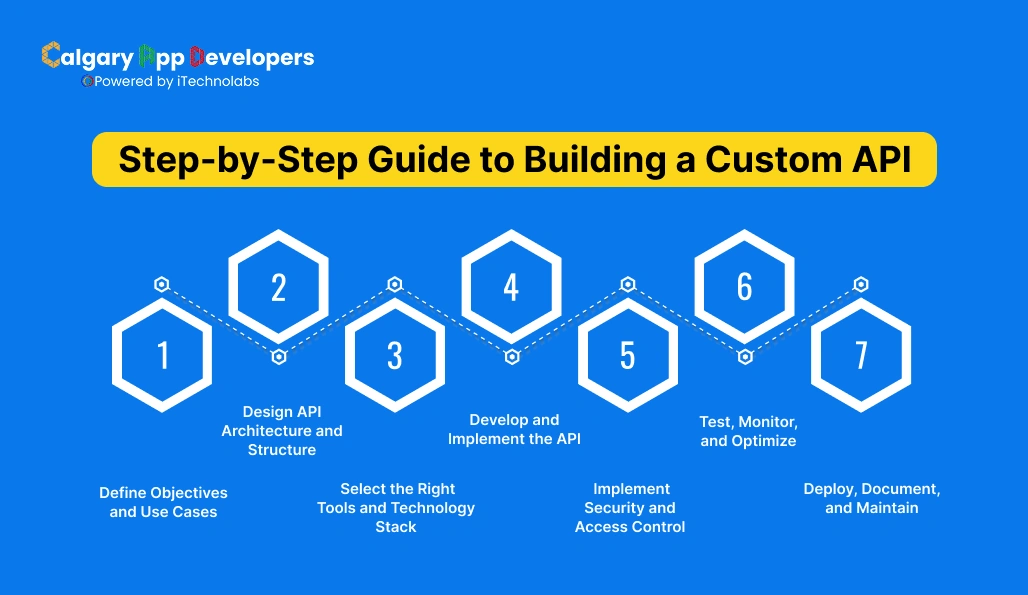
Building a custom API is not just a technical exercise. It is a product decision that affects performance, scalability, security, and long-term cost. A well-structured process ensures that the API supports current requirements while remaining flexible enough for future expansion.
- Define Objectives and Use Cases
Every successful API begins with clarity on why it is being built and who will use it.
- Identify the core business problem the API will solve, such as enabling integrations, automating workflows, or exposing services to partners.
- Define the primary users, whether they are internal teams, third-party developers, or customers.
- Outline detailed use cases that describe how the API will be consumed in real scenarios.
- Determine the type of data that needs to be accessed, created, updated, or deleted.
- Establish success metrics such as performance benchmarks, adoption rate, and scalability targets.
This stage sets the direction for everything that follows. Poor planning here often leads to redesign and increased costs later.
- Design API Architecture and Structure
A thoughtful design ensures the API remains easy to use, maintain, and scale.
- Choose the architectural style based on requirements, such as REST for simplicity, GraphQL for flexible data queries, or gRPC for high-performance communication.
- Define endpoints clearly, including resource naming, HTTP methods, and expected inputs and outputs.
- Standardize response formats so developers can interact with the API consistently.
- Design data models that reflect real-world relationships and ensure efficient data retrieval.
- Plan versioning from the beginning to handle future updates without breaking existing integrations.
- Consider scalability at the design stage to avoid performance bottlenecks as usage grows.
Good design reduces complexity during development and makes the API easier to adopt.
- Select the Right Tools and Technology Stack
Technology choices influence not only performance but also long-term maintenance and cost.
- Select a backend framework that aligns with team expertise and project requirements, such as Node.js for scalability, Django for rapid development, or Spring Boot for enterprise systems.
- Choose a database that fits the data structure, whether relational for structured data or NoSQL for flexible, large-scale datasets.
- Use API gateways to manage traffic, authentication, and monitoring efficiently.
- Integrate third-party services where needed, including payment systems, communication tools, or AI APIs.
- Decide on hosting infrastructure such as cloud platforms, which offer scalability and cost control.
- Evaluate how these choices impact operational efficiency.
The right stack ensures stability while allowing room for growth.
- Develop and Implement the API
This is where the design turns into a working system.
- Build endpoints based on the defined structure, ensuring each one performs a clear and specific function.
- Implement business logic that processes requests and interacts with the database or external services.
- Validate incoming data to prevent errors and maintain data integrity.
- Handle exceptions and errors gracefully, returning meaningful responses to users.
- Maintain clean, modular code to simplify future updates and debugging.
- Create and maintain API documentation alongside development to support faster adoption.
Strong implementation practices reduce technical debt and improve reliability.
- Implement Security and Access Control
Security is critical for protecting sensitive data and maintaining trust.
- Use authentication mechanisms such as API keys, OAuth, or token-based systems to verify users.
- Implement role-based access control to ensure users can only access what they are authorized to.
- Encrypt data both in transit and at rest to prevent unauthorized access.
- Apply rate limiting to protect the API from abuse and ensure consistent performance.
- Monitor for vulnerabilities and regularly update security protocols.
- Ensure compliance with relevant data protection regulations.
A secure API protects both the business and its users from potential risks.
- Test, Monitor, and Optimize
Testing ensures the API performs reliably under different conditions.
- Conduct unit testing to verify that individual components function correctly.
- Perform integration testing to ensure all parts of the system work together as expected.
- Run load and stress tests to evaluate performance under high traffic.
- Monitor real-time metrics such as response time, error rates, and system load.
- Optimize database queries and API responses to improve speed and efficiency.
- Use feedback from developers and users to refine functionality.
- Continuous optimization helps maintain performance as usage scales.
- Deploy, Document, and Maintain
Deployment is the start of the API lifecycle, not the end.
- Deploy the API using reliable infrastructure with proper configuration and scaling capabilities.
- Provide detailed and user-friendly documentation to help developers understand and use the API effectively.
- Track usage analytics to identify trends, issues, and opportunities for improvement.
- Implement version control to manage updates without disrupting existing users.
- Regularly maintain and update the API to fix bugs, improve performance, and add new features.
Ongoing maintenance ensures the API remains relevant, secure, and efficient over time.
A structured approach to API development reduces risk, improves efficiency, and supports long-term scalability.
Types of APIs and When to Use Them
Not all APIs serve the same purpose. The type of API you choose depends on who will use it, how it will be accessed, and what level of control and security is required. Selecting the right type is essential for performance, scalability, and managing long-term costs.
| API Type | Access Level | Best Use Case | Advantages | Limitations |
| Open APIs | Public | Third-party integrations and ecosystems | Expands reach and innovation | Requires strong security and monitoring |
| Internal APIs | Private | Internal system communication | High control and security | Limited to internal use |
| Partner APIs | Restricted | B2B collaborations | Controlled sharing with partners | Requires access management |
| Composite APIs | Varies | Complex data retrieval | Reduces multiple requests, improves performance | Can be complex to design |
| REST APIs | Public or Private | General-purpose applications | Simple, scalable, widely adopted | May lead to over-fetching data |
| GraphQL APIs | Public or Private | Flexible data queries | Efficient data usage | More complex implementation |
| gRPC APIs | Private or Hybrid | High-performance systems | Fast and efficient communication | Limited browser support |
- Open APIs (Public APIs)
Open APIs are available to external developers and third parties. They are designed to encourage integration and innovation.
- Best used when you want to expand your ecosystem or allow third-party developers to build on your platform.
- Common in platforms like payment gateways, social media integrations, and mapping services.
- Requires strong security and rate limiting to prevent misuse.
- Internal APIs (Private APIs)
Internal APIs are used within an organization to connect internal systems and services.
- Ideal for improving operational efficiency and enabling communication between internal tools.
- Common in enterprise systems where multiple teams or services need to interact.
- Offers high control and security since access is restricted.
- Partner APIs
Partner APIs are shared with specific business partners rather than the public.
- Useful for collaborations, such as integrating with vendors, suppliers, or strategic partners.
- Provides controlled access with defined permissions.
- Often used in B2B ecosystems where data sharing is necessary but limited.
- Composite APIs
Composite APIs combine multiple endpoints into a single request.
- Best for reducing the number of API calls and improving performance.
- Common in complex applications where multiple data sources need to be fetched at once.
- Helps optimize response time and user experience.
- REST APIs
REST is the most widely used API architecture due to its simplicity and flexibility.
- Ideal for web and mobile applications.
- Uses standard HTTP methods and is easy to scale.
- Works well for most general-purpose applications.
- GraphQL APIs
GraphQL allows clients to request only the data they need.
- Useful when applications require flexible and efficient data fetching.
- Reduces over-fetching and under-fetching of data.
- Often used in modern frontend-heavy applications.
- gRPC APIs
gRPC is designed for high-performance and low-latency communication.
- Best for real-time systems and microservices architecture.
- Uses binary data format for faster communication.
- Suitable for systems requiring speed and efficiency at scale.
Choosing the right API type is a strategic decision. It impacts how systems scale, how secure they are, and how efficiently they integrate with emerging technologies. A well-chosen API approach helps businesses optimize performance while keeping API development manageable as systems evolve.
Tools and Technologies Used in API Development
The tools and technologies you choose for API development shape performance, scalability, and long-term maintainability. A well-planned tech stack ensures smooth development, efficient integrations, and controlled costs.
| Category | Popular Tools and Technologies | Purpose |
| Backend Frameworks | Node.js, Django, Spring Boot | Build API logic and handle requests |
| API Architecture | REST, GraphQL, gRPC | Define communication and data exchange style |
| Databases | PostgreSQL, MySQL, MongoDB | Store and manage application data |
| API Gateways | AWS API Gateway, Apigee, Kong | Manage traffic, security, and monitoring |
| Authentication | OAuth, JWT, API Keys | Secure API access and user verification |
| Testing and Documentation | Postman, Swagger, Insomnia | Test APIs and generate documentation |
| Cloud Platforms | AWS, Google Cloud, Microsoft Azure | Host, scale, and manage infrastructure |
- Backend Frameworks
Backend frameworks provide the foundation for building API logic and handling requests. Popular options like Node.js, Django, and Spring Boot allow developers to create scalable and efficient APIs while maintaining a clean code structure and faster development cycles.
- API Architectural Styles
Choosing the right architecture defines how the API behaves and communicates. REST remains the most widely used due to its simplicity, while GraphQL offers flexible data fetching. gRPC is preferred for high-performance systems that require fast and efficient communication.
- Databases
Databases store and manage the data that APIs interact with. Relational databases like PostgreSQL and MySQL are ideal for structured data, while NoSQL options like MongoDB are better suited for handling large volumes of unstructured or dynamic data.
- API Gateways and Management Tools
API gateways act as a control layer between clients and services. Tools like AWS API Gateway and Apigee help manage traffic, enforce security, monitor usage, and ensure consistent performance across the API ecosystem.
- Authentication and Security Tools
Security tools ensure that APIs are accessed only by authorized users. Technologies such as OAuth, JWT, and API keys help manage authentication and protect sensitive data from unauthorized access.
- Testing and Documentation Tools
Testing tools like Postman and Swagger simplify API testing and validation. They also help generate clear documentation, making it easier for developers to understand and integrate APIs effectively.
- Cloud Platforms and Infrastructure
Cloud platforms such as AWS, Google Cloud, and Azure provide scalable infrastructure for deploying and managing APIs. They offer flexibility, cost control, and support for integrating advanced services.
Essential Features of a High Quality API
A high-quality API is not defined only by functionality. It is defined by how reliably, securely, and efficiently it performs under real-world conditions. The right features ensure that an API is easy to use, scalable, and capable of supporting advanced integrations.
Here are the essential features every high-quality API should include:
- Consistent and Intuitive Design: A well-designed API follows clear naming conventions and predictable structures. This makes it easier for developers to understand, integrate, and work with the API without confusion or repeated trial and error.
- Strong Security Mechanisms: Security is fundamental. A high-quality API includes authentication, authorization, encryption, and rate limiting to protect data and prevent unauthorized access or misuse.
- High Performance and Low Latency: Fast response times are critical for user experience. Efficient data handling, optimized queries, and minimal processing delays ensure the API performs reliably even under heavy usage.
- Scalability and Flexibility: A strong API is built to grow with demand. It should handle increasing traffic and evolving business requirements without requiring major architectural changes.
- Comprehensive Documentation: Clear and detailed documentation allows developers to quickly understand how to use the API. It reduces onboarding time and minimizes integration errors.
- Robust Error Handling: Effective error handling provides clear and meaningful responses when something goes wrong. This helps developers troubleshoot issues quickly and improves overall reliability.
- Versioning Support: Versioning ensures that updates and improvements do not disrupt existing integrations. It allows businesses to evolve their APIs while maintaining backward compatibility.
- Monitoring and Analytics: A high-quality API includes monitoring tools to track usage, performance, and errors. This data helps identify bottlenecks, improve performance, and make informed decisions.
- Interoperability and Integration Readiness: The API should easily integrate with different systems, platforms, and third-party services. This flexibility is essential for building connected digital ecosystems.
- Maintainability and Clean Architecture: Well-structured code and modular design make the API easier to maintain and update. This reduces technical debt and ensures long-term sustainability.
These features collectively ensure that an API is not only functional but also reliable, secure, and ready to support future innovation.
Real World API Use Cases Across Industries
APIs have become the backbone of modern digital infrastructure, enabling systems to communicate, share data, and deliver connected experiences at scale. They allow businesses to move faster, integrate smarter, and build products that adapt to evolving user expectations. Across industries, APIs are not just supporting operations. They are shaping how services are delivered, optimized, and expanded.
Below are detailed use cases across major industries, along with the key features that make APIs effective in each scenario:
- Fintech and Digital Payments
APIs are fundamental to modern financial services, enabling secure, fast, and reliable transactions. They allow banks, payment processors, and fintech platforms to connect seamlessly, supporting everything from instant payments to fraud detection.
Key features:
- Secure authentication and encryption for financial data protection.
- Real-time transaction processing and validation.
- Integration with banking systems and third-party financial services.
- Support for open banking and regulatory compliance.
- High reliability and uptime for critical financial operations.
- eCommerce and Retail
In eCommerce, APIs connect multiple systems to create a unified shopping experience. They handle product listings, inventory updates, payment processing, and order tracking across platforms.
Key features:
- Real-time inventory and product data synchronization.
- Seamless payment gateway integration.
- Order management and tracking capabilities.
- Integration with logistics and shipping providers.
- Personalization through customer data and recommendation engines.
- Healthcare and Telemedicine
Healthcare systems rely on APIs to securely exchange patient data and enable digital health services. They support interoperability between different medical systems and improve access to care.
Key features:
- Secure data exchange compliant with healthcare regulations.
- Integration with electronic health records and diagnostic systems.
- Real-time appointment scheduling and teleconsultation support.
- Data accuracy and consistency across platforms.
- Scalability for handling large volumes of sensitive data.
- Travel and Hospitality
APIs enable travel platforms to aggregate data from airlines, hotels, and transport services. This allows users to compare options and make bookings in real time.
Key features:
- Real-time availability and pricing updates.
- Integration with multiple service providers.
- Centralized booking and reservation management.
- Dynamic pricing and recommendation capabilities.
- High performance to handle peak user demand.
- Social Media and Communication Platforms
APIs allow businesses to integrate social features and communication tools directly into their applications, enhancing engagement and accessibility.
Key features:
- Social login and authentication integration.
- Content sharing across platforms.
- Messaging and notification capabilities.
- User data synchronization and analytics.
- Scalable infrastructure to support large user bases.
- Logistics and Supply Chain
APIs bring visibility and automation to supply chain operations by connecting warehouses, transport systems, and tracking tools.
Key features:
- Real-time shipment tracking and updates.
- Automated order processing and routing.
- Integration with warehouse and inventory systems.
- Data-driven insights for operational efficiency.
- Reliable communication across distributed systems.
- SaaS and Enterprise Software
APIs enable enterprise platforms to integrate with a wide range of tools, creating connected workflows and improving productivity across teams.
Key features:
- Integration with CRM, ERP, and marketing platforms.
- Data synchronization across multiple systems.
- Workflow automation and process optimization.
- Role-based access control for secure usage.
- Scalable architecture for enterprise-level operations.
- Media and Entertainment
APIs power content delivery, personalization, and user engagement in streaming platforms and digital media services.
Key features:
- Personalized content recommendations using user data.
- Efficient content delivery and streaming support.
- Subscription and billing management.
- Integration with analytics and advertising platforms.
- High performance for handling large user traffic.
- AI and Data-Driven Applications
APIs play a crucial role in making AI accessible. Businesses can integrate machine learning models, natural language processing, and predictive analytics without building them from scratch.
Key features:
- Access to pre-trained AI models through API endpoints.
- Real-time data processing and insights generation.
- Scalability for handling large datasets.
- Integration with existing applications and workflows.
- Cost efficiency by reducing the need for in-house AI infrastructure.
- Smart Devices and IoT
In IoT ecosystems, APIs connect devices and systems, enabling real-time communication and automation across environments.
Key features:
- Real-time data exchange between devices and platforms.
- Remote monitoring and control capabilities.
- Integration with cloud infrastructure.
- Automation of processes based on sensor data.
- Scalability to support growing networks of connected devices.
Across industries, APIs are enabling faster innovation, better user experiences, and more efficient operations. Their ability to connect systems and integrate advanced technologies makes them essential for businesses aiming to scale while keeping API development optimized and predictable.
API Security: How to Protect Your Systems and Data
API security is critical for safeguarding sensitive data, maintaining system integrity, and ensuring trust between services. As APIs become central to business operations and AI integrations, strong security practices are essential to prevent breaches and control API development costs associated with risk and recovery.
Here are five key measures to secure your APIs effectively:
- Implement Strong Authentication and Authorization: Ensure that only verified users and systems can access your API. Use secure authentication methods such as OAuth or token-based systems, and apply role-based access control to limit what each user can do within the API.
- Encrypt Data in Transit and at Rest: Protect sensitive information by encrypting data during transmission using HTTPS and SSL protocols. Additionally, encrypt stored data to prevent unauthorized access in case of a breach or system compromise.
- Apply Rate Limiting and Throttling: Control how often users can make requests to your API. Rate limiting helps prevent abuse, reduces the risk of denial of service attacks, and ensures fair usage across all users.
- Validate Input and Sanitize Data: Always validate incoming data to prevent malicious inputs such as SQL injection or script-based attacks. Proper validation ensures that only clean and expected data is processed by the system.
- Monitor, Log, and Regularly Audit APIs: Continuously monitor API activity to detect unusual behavior or potential threats. Maintain detailed logs for analysis and conduct regular security audits to identify vulnerabilities and improve defenses.
A proactive approach to API security not only protects systems and data but also ensures long-term stability, compliance, and cost efficiency as your API ecosystem grows.
API development Cost: What to Expect
The cost of API development typically ranges from $5,000 to $50,000+, depending on complexity, features, integrations, and scalability requirements.
This range can vary significantly based on the scope of the project, the technology stack, and whether advanced capabilities like AI integrations are involved, which directly influence overall API development cost.
Estimated Cost Breakdown of API Development
| Development Stage | Estimated Cost Range | Description |
| Planning and Requirement Analysis | $500 to $3,000 | Defining use cases, architecture, and scope |
| API Design and Architecture | $1,000 to $5,000 | Structuring endpoints, data models, and workflows |
| Development and Implementation | $3,000 to $25,000+ | Coding, integrations, and core functionality |
| Security Implementation | $500 to $5,000 | Authentication, encryption, and access control |
| Testing and Quality Assurance | $1,000 to $5,000 | Functional, performance, and load testing |
| Deployment and Documentation | $500 to $3,000 | Hosting setup and API documentation |
| Maintenance and Updates | $1,000 to $10,000 annually | Ongoing support, monitoring, and improvements |
Key Factors That Influence API Development Cost
Several factors determine how much you will ultimately spend on API development. Understanding these helps you plan better and avoid unnecessary expenses.
- API Complexity and Features: The more complex the API, the higher the cost. Simple APIs with basic CRUD operations are relatively affordable, while APIs with advanced workflows, multiple integrations, or real-time processing require more development effort and resources.
- Integration with Third-Party Services: Connecting your API with external systems such as payment gateways, CRMs, or AI services increases both development time and cost. However, these integrations can also reduce the need to build features from scratch, helping balance API development cost in the long run.
- Technology Stack and Infrastructure: The choice of programming languages, frameworks, and hosting platforms affects both initial and ongoing costs. Cloud infrastructure offers scalability but may introduce recurring expenses based on usage.
- Security Requirements: APIs handling sensitive data require advanced security measures, including encryption, authentication layers, and compliance standards. Higher security needs naturally increase development and maintenance costs.
- Development Team Location: Where your development team is based plays a major role in pricing. Cities like Calgary are emerging as strong technology hubs that offer a balance between quality and cost efficiency. Businesses working with experienced teams in such regions often benefit from high-quality development without the premium pricing seen in larger tech markets.
- Scalability and Future Readiness: APIs designed for scale require better architecture, load handling capabilities, and performance optimization. While this increases upfront cost, it reduces long-term expenses by avoiding major rebuilds as usage grows.
- Maintenance and Ongoing Support: Development cost does not end at deployment. Continuous monitoring, updates, and improvements are necessary to keep the API secure and efficient. These ongoing costs should always be factored into the total budget.
A clear understanding of API development cost helps businesses make informed decisions and allocate resources effectively. With the right approach, it is possible to build scalable, secure APIs while keeping the cost under control and aligned with long-term business goals.
API Monetization: Turning APIs into Revenue Streams
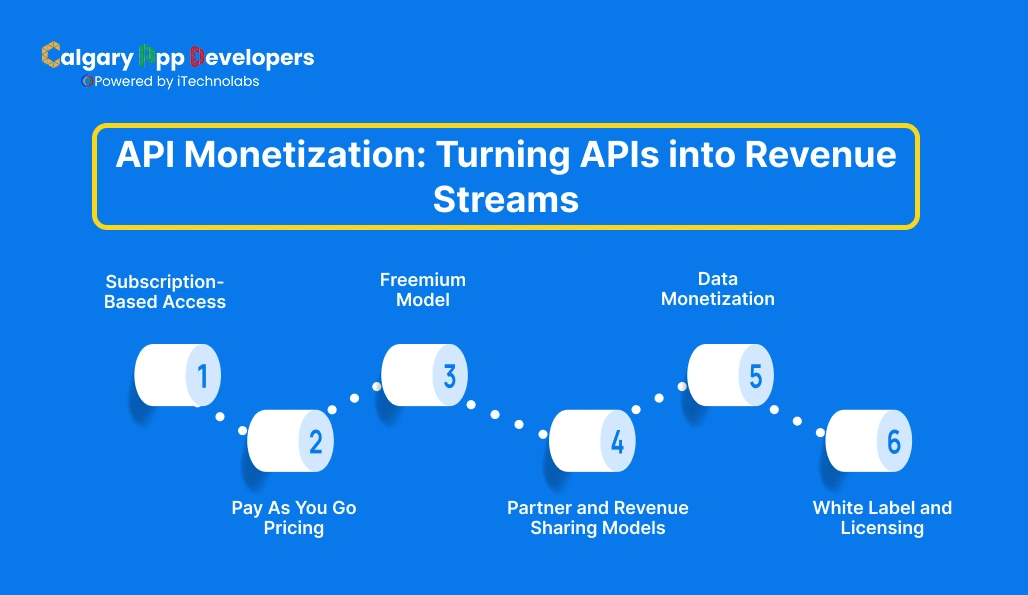
APIs are no longer just technical tools. They are revenue-generating assets that allow businesses to package data, services, and capabilities into scalable products. With the right monetization strategy, APIs can create new income streams while expanding your ecosystem and increasing product value.
Here are the most effective ways businesses monetize APIs:
- Subscription-Based Access
In this model, users pay a recurring fee to access the API. Pricing is typically tiered based on usage limits, features, or performance levels.
- Predictable and recurring revenue.
- Easy to scale with different pricing tiers.
- Ideal for SaaS platforms and data services.
- Pay As You Go Pricing
Users are charged based on actual API usage, such as the number of requests or data processed.
- Flexible pricing for users with varying needs.
- Attracts a wider range of customers.
- Aligns cost with value delivered.
- Freemium Model
Basic API access is offered for free, with premium features available at a cost.
- Encourages adoption and developer onboarding.
- Builds a large user base quickly.
- Converts free users into paying customers over time.
- Partner and Revenue Sharing Models
Businesses collaborate with partners and share revenue generated through API usage.
- Strengthens strategic partnerships.
- Expands reach into new markets.
- Creates mutual value for all parties involved.
- Data Monetization
Companies provide access to valuable datasets through APIs.
- Generates revenue from existing data assets.
- Supports industries like finance, healthcare, and marketing.
- Enables data-driven innovation for third parties.
- White Label and Licensing
APIs can be licensed to other businesses, allowing them to build products using your technology.
- Creates additional revenue without direct customer acquisition.
- Position your API as a core infrastructure product.
- Ideal for platforms with specialized capabilities.
Key Considerations for Successful API Monetization
To build a sustainable revenue model, businesses must focus on more than pricing.
- Ensure high reliability and performance to maintain user trust.
- Provide clear documentation and developer support to encourage adoption.
- Implement strong security to protect data and transactions.
- Use analytics to track usage patterns and optimize pricing strategies.
- Continuously improve features to stay competitive.
API monetization is most effective when it aligns with business goals and user needs. A well monetized API not only generates revenue but also strengthens your market position, expands your ecosystem, and supports scalable growth.
Best Practices for Scalable and Maintainable APIs
Building an API is only the first step. Ensuring it remains scalable and easy to maintain over time requires disciplined design and ongoing optimization. Following proven best practices helps prevent performance issues, reduces technical debt, and keeps systems efficient as they grow.
Here are five essential practices to follow:
- Design with Consistency and Standards
Consistency makes APIs easier to use and maintain. Follow clear naming conventions, standard HTTP methods, and predictable response formats. A uniform structure reduces confusion for developers and simplifies long-term updates.
- Implement Versioning from the Start
APIs evolve, and versioning ensures changes do not break existing integrations. By maintaining multiple versions, you can introduce improvements while supporting current users without disruption.
- Optimize for Performance and Scalability
Efficient APIs handle increasing traffic without slowing down. Use caching, pagination, and optimized database queries to improve response times. Plan infrastructure that can scale based on demand to avoid bottlenecks.
- Maintain Clear Documentation and Developer Experience
Well-documented APIs reduce onboarding time and errors. Provide detailed guides, examples, and use cases so developers can integrate quickly and correctly. A strong developer experience drives adoption and reduces support overhead.
- Monitor, Test, and Continuously Improve
Ongoing monitoring helps identify performance issues, errors, and usage patterns. Regular testing ensures reliability, while continuous improvements keep the API aligned with changing business needs and technology trends.
Following these practices ensures that your API remains reliable, scalable, and easy to manage.
Common API Development Challenges and Practical Solutions
API development comes with its own set of challenges, especially as systems grow more complex and interconnected. Identifying these challenges early and addressing them with practical solutions helps ensure long-term stability, performance, and cost efficiency.
Here are some of the most common challenges and how to solve them effectively:
- Poor API Design and Inconsistency
Inconsistent endpoints, unclear naming, and poorly structured responses make APIs difficult to use and maintain.
- Solution: Follow established design standards such as REST principles, maintain consistent naming conventions, and use standardized response formats. Invest time in proper planning and documentation before development begins.
- Scalability Issues Under High Traffic
APIs that are not designed for scale can struggle with increased usage, leading to slow response times or system failures.
- Solution: Implement caching, load balancing, and horizontal scaling. Use a cloud infrastructure that can automatically adjust resources based on demand to maintain performance.
- Security Vulnerabilities
APIs are common targets for attacks such as unauthorized access, data breaches, and injection attacks.
- Solution: Use strong authentication methods, encrypt data, validate inputs, and regularly audit your API for vulnerabilities. Apply rate limiting to prevent abuse.
- Integration Complexity with Multiple Systems
Connecting APIs with different systems, formats, and protocols can become complex and time-consuming.
- Solution: Use middleware or API gateways to standardize communication. Clearly define data formats and use well-documented interfaces to simplify integrations.
- Lack of Proper Documentation
Poor documentation slows down development and increases the risk of incorrect implementations.
- Solution: Create detailed, up-to-date documentation with examples, use cases, and error-handling guidelines. Use tools that automatically generate and maintain documentation.
- Versioning and Backward Compatibility Issues
Updating APIs without proper version control can break existing integrations and disrupt users.
- Solution: Implement versioning from the start and maintain backward compatibility wherever possible. Communicate changes clearly to users before updates are deployed.
- Performance Bottlenecks
Inefficient queries and heavy payloads can slow down API responses and impact user experience.
- Solution: Optimize database queries, use pagination, and limit unnecessary data in responses. Monitor performance metrics to identify and fix bottlenecks.
- Managing Costs and Resource Usage
Unoptimized APIs can lead to increased infrastructure and operational costs, especially when scaling or integrating AI services.
- Solution: Use efficient architecture, monitor usage, and optimize resource allocation. Leveraging APIs for AI services instead of building from scratch can help control budget while maintaining performance.
Addressing these challenges with the right strategies ensures that your API remains reliable, secure, and scalable. It also helps businesses avoid unnecessary expenses and maintain a strong foundation for future growth.
The Future of APIs and Emerging Trends
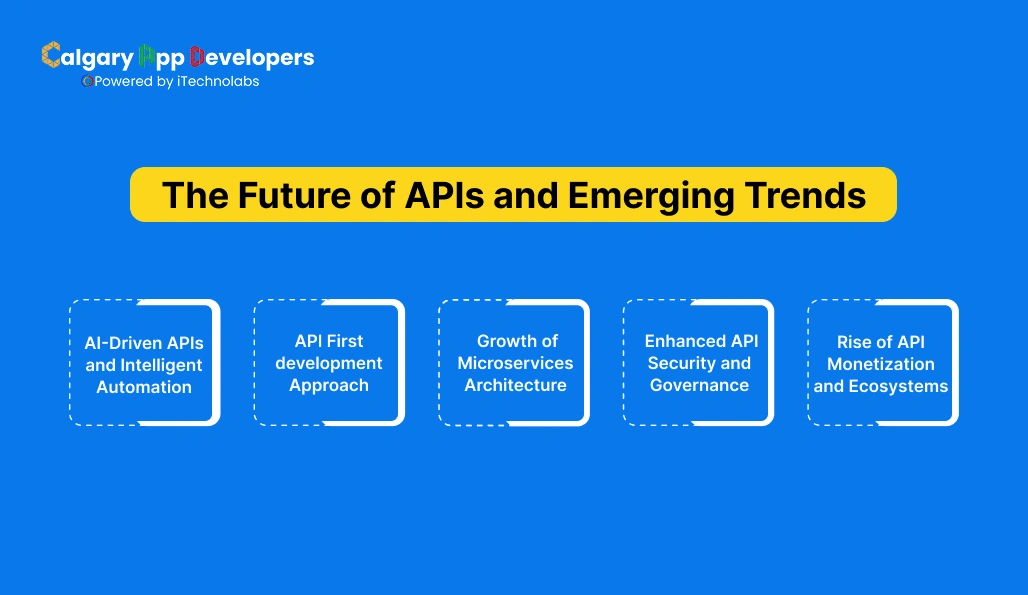
APIs are evolving from simple integration tools into intelligent, business-critical infrastructure. As technology advances, APIs are becoming more adaptive, secure, and deeply embedded in digital ecosystems. Understanding where APIs are heading helps businesses prepare for long-term innovation.
Here are five key trends shaping the future of APIs:
- AI-Driven APIs and Intelligent Automation
APIs are increasingly becoming the gateway to AI capabilities. From natural language processing to predictive analytics, businesses are integrating AI-powered APIs to deliver smarter user experiences.
- APIs will enable faster adoption of AI without heavy in-house development.
- Automation will become more intelligent with real-time decision-making.
- Businesses will rely on APIs to scale AI features while optimizing cost.
- API First development Approach
More organizations are adopting an API first strategy, where APIs are designed before building applications.
- Ensures better scalability and consistency across systems.
- Speeds up development by enabling parallel workflows.
- Improves collaboration between teams and reduces rework.
- Growth of Microservices Architecture
Microservices rely heavily on APIs to connect independent services within a system.
- Applications will become more modular and flexible.
- Easier updates and maintenance without affecting the entire system.
- Improved scalability and fault isolation.
- Enhanced API Security and Governance
As APIs handle more sensitive data, security and governance will become even more critical.
- Increased adoption of zero-trust security models.
- Advanced monitoring and threat detection.
- Stronger compliance with global data protection standards.
- Rise of API Monetization and Ecosystems
APIs are becoming products that generate revenue and build ecosystems.
- More businesses will offer APIs as standalone services.
- Expansion of API marketplaces and developer platforms.
- Stronger focus on developer experience to drive adoption.
The future of APIs is closely tied to the evolution of digital ecosystems and AI. Businesses that invest in modern API strategies today will be better positioned to innovate, scale, and control API development cost while staying competitive in a rapidly changing landscape.
Conclusion
Custom API development has become a critical part of building modern, scalable, and future-ready digital products. From enabling seamless integrations to supporting AI-driven capabilities, APIs are no longer optional. They are central to how businesses operate, innovate, and grow.
A well-designed API improves performance, strengthens security, and creates opportunities for new revenue streams through monetization. At the same time, it helps businesses stay flexible as technology evolves, ensuring systems can scale without unnecessary complexity or rising costs.
Success in API development comes down to making the right decisions at every stage, from planning and design to technology selection, security, and long-term maintenance. Businesses that take a structured and strategic approach are better positioned to build reliable systems that deliver consistent value.
If you are looking to build high-quality, scalable APIs tailored to your business needs, working with the right development partner makes all the difference. Calgary App Developer specializes in custom API development, helping businesses design, build, and scale robust digital solutions that are aligned with performance, security, and long-term growth.
With the right strategy and the right team, APIs can become one of your strongest assets in driving innovation and staying competitive in an increasingly connected digital world.
FAQs
1. How much time is required to build a custom API?
Building a custom API usually takes anywhere from 2 weeks to 3 months, depending on complexity, integrations, and security requirements. Simple APIs with basic functionality can be developed quickly, while enterprise-level APIs with multiple integrations and scalability needs require more planning, testing, and optimization to ensure long-term reliability.
2. REST vs GraphQL for custom APIs: which should you choose?
REST is ideal for simplicity, standardization, and wide compatibility, making it suitable for most applications. GraphQL is better when clients need flexible data queries and want to avoid over-fetching. The choice depends on project requirements, performance needs, and how dynamic the data interactions are within your application.
3. What are the best ways to secure an API?
API security involves multiple layers, including authentication, authorization, encryption, and rate limiting. Using secure protocols, validating inputs, and monitoring activity are essential practices. Regular security audits and updates help prevent vulnerabilities and ensure that sensitive data remains protected from unauthorized access or malicious attacks.
4. Can custom APIs work with legacy systems?
Yes, custom APIs can be designed to integrate with legacy systems effectively. They act as a ridge that allows older systems to communicate with modern applications without requiring a complete rebuild. This approach helps extend the life of existing infrastructure while enabling gradual digital transformation.
5. Which industries gain the most value from custom APIs?
Industries such as finance, healthcare, eCommerce, logistics, and SaaS benefit significantly from custom APIs. These sectors rely on real-time data exchange, system integration, and automation. APIs help improve efficiency, enhance customer experience, and support innovation across digital products and services.
6. How are custom APIs maintained and updated over time?
Maintaining an API involves regular monitoring, performance optimization, and security updates. Versioning ensures that new features can be added without disrupting existing users. Continuous testing and feedback help identify improvements, while proper documentation ensures that updates are implemented smoothly and efficiently.
7. What is the process for creating an API from scratch?
Creating an API from scratch involves defining objectives, designing endpoints, selecting a technology stack, developing core functionality, implementing security, and testing thoroughly. After deployment, ongoing monitoring and maintenance are required to ensure performance, scalability, and alignment with evolving business needs.
8. What does an API mean in software development?
An API, or Application Programming Interface, is a set of rules that allows different software systems to communicate with each other. It enables applications to request and exchange data without exposing internal logic, making it easier to build integrated and scalable digital solutions.
9. What is the difference between REST and SOAP APIs?
REST APIs use standard HTTP methods and are lightweight, flexible, and easy to integrate. SOAP APIs follow a strict protocol with XML-based messaging and built-in security features. REST is more commonly used for modern applications, while SOAP is preferred in systems requiring strict standards and formal contracts.
10. How can you design an effective RESTful API?
A good RESTful API follows clear naming conventions, uses standard HTTP methods, and provides consistent response formats. It should include proper error handling, versioning, and documentation. Designing with scalability and simplicity in mind ensures better usability and long-term maintainability.
11. What is a JSON API and why is it important?
A JSON API is an API that uses JSON format for data exchange. It is widely used because it is lightweight, easy to read, and compatible with most programming languages. JSON improves performance by reducing data size and simplifying integration across web and mobile applications.
12. How do you build an API that is secure and scalable?
Building a secure and scalable API requires strong authentication, data encryption, efficient architecture, and performance optimization. Using cloud infrastructure, implementing rate limiting, and monitoring usage help maintain stability. A well-planned design ensures the API can handle growth without compromising security or performance.
13. How do APIs integrate with third-party services?
APIs integrate with third-party services by sending requests to external endpoints and receiving structured responses. This allows applications to use features like payments, messaging, or AI without building them internally. Proper documentation and standardized formats make these integrations efficient and reliable.
14. How do APIs improve mobile app performance and user experience?
APIs enable mobile apps to fetch only the required data, reducing load times and improving responsiveness. They allow apps to connect with backend services efficiently, ensuring real-time updates and smooth functionality. This results in faster performance and a more seamless user experience.
15. Why do enterprises invest in custom API development?
Enterprises invest in custom APIs to improve system integration, enhance scalability, and gain better control over their digital infrastructure. Custom APIs support automation, enable innovation, and help businesses adapt quickly to changing market demands while maintaining efficiency and performance.
16. How do APIs support digital transformation in organizations?
APIs play a key role in digital transformation by connecting systems, enabling data flow, and supporting automation. They allow businesses to modernize legacy systems, integrate new technologies, and build flexible architectures that can adapt to evolving digital strategies and customer expectations.


Pankaj Arora is a seasoned technology leader and the Founder of Calgary App Developer, with 10+ years of expertise in crafting high-performance digital solutions. His core competencies include full-stack app development, cloud-native architecture, API integration, and agile product delivery. Under his leadership, Calgary App Developers has empowered startups and enterprises alike with scalable mobile applications, secure web platforms, and AI-driven SaaS products.