





Vibe Coded Projects: Pros, Limits & When to Hire Devs Today
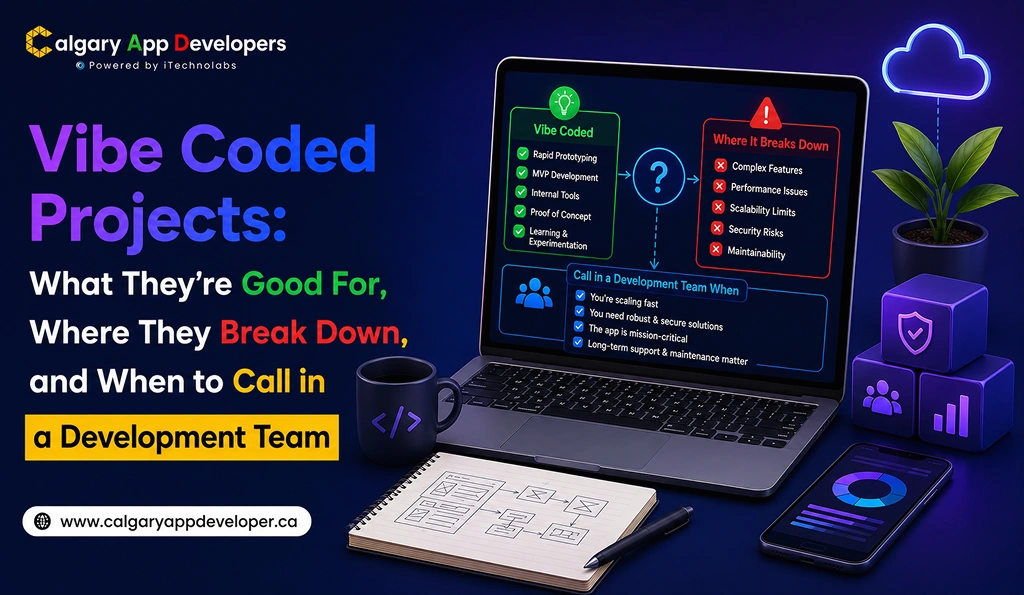
Vibe coding has changed how software gets built. Today, founders, creators, and non-technical teams can open tools like Cursor, Bolt, or Lovable, describe an idea in plain English, and generate a working application in a matter of hours instead of months. What once required a full engineering team and a large development budget can now start with a prompt and a prototype.
That speed is powerful. It allows businesses to validate ideas faster, test concepts with real users, and build early momentum without waiting for traditional development cycles. For MVPs, internal tools, experiments, and early-stage product validation, vibe coding can dramatically reduce the barrier to entry.
But here’s the reality many founders discover too late: a working prototype is not the same thing as production-ready software.
Most vibe-coded projects are optimized for speed, not scalability, maintainability, security, or long-term growth. They can look polished on the surface while hiding architectural problems underneath. As usage grows, those problems become harder and more expensive to fix. Features start breaking unexpectedly, integrations become unstable, performance declines, and the codebase becomes increasingly difficult for professional developers to work with.
The risk becomes even greater once real users, customer data, payments, or business operations depend on the product. At that point, gaps in security, infrastructure, and system design are no longer small technical issues. They become business risks.
This guide explains where vibe-coded projects deliver real value, where they typically begin to break down, and the key signs that it’s time to involve a professional development team. You’ll also learn how to transition from an AI-generated prototype to a scalable production system without throwing away the progress you’ve already made.
TL;DR
- Vibe-coded projects are excellent for prototyping, validating ideas, and testing user flows quickly with minimal development cost.
- Most AI-generated apps are not built for scalability, security, compliance, or long-term maintainability.
- Real users, sensitive data, integrations, and product growth expose the limitations of vibe-coded software very quickly.
- Transitioning from prototype to production usually requires a professional development team to rebuild or restructure the foundation properly.
Key Points
- Vibe coding allows founders and non-technical teams to turn ideas into working prototypes using AI tools like Cursor, Bolt, and Lovable without traditional software development workflows.
- AI-generated applications are useful for MVPs, user testing, investor demos, workflow validation, and rapid experimentation before committing to large development budgets.
- Most vibe-coded projects lack the architecture needed for secure authentication, scalable infrastructure, performance optimization, compliance requirements, and reliable system integrations.
- AI coding tools can generate functional interfaces quickly, but they often introduce hidden bugs, inconsistent logic, weak security practices, and technical debt that becomes harder to manage as the product grows.
- Signs that a vibe-coded project has outgrown its prototype stage include onboarding real users, handling sensitive data, integrating with external systems, failing under normal usage, or becoming difficult to modify safely.
- Professional development teams help transition AI-generated prototypes into production-ready systems by auditing the existing codebase, identifying what can be reused, and rebuilding critical infrastructure correctly.
- Founders should treat vibe-coded software as a fast validation tool rather than a long-term engineering solution for products expected to scale or support real business operations.
What Is Vibe Coding? (And Why Everyone’s Talking About It)
Vibe coding refers to the practice of building software by describing what you want in natural language and letting an AI model generate the underlying code. The term was coined by OpenAI co-founder Andrej Karpathy in early 2025, and it spread quickly because it described something founders, product managers, and non-technical operators were already doing.
The tools at the centre of the vibe coding movement include Cursor (an AI-powered code editor), Bolt and Lovable (which generate full-stack web apps from prompts), Replit (a browser-based coding environment with AI built in), and v0 by Vercel (focused on front-end UI generation). Each works roughly the same way: you describe what you want, the AI writes the code, you review the output, and you iterate.
What makes this significant is the barrier it removes. Before these tools existed, turning an idea into something clickable required either hiring a developer or spending months learning to code. Now, a founder with no technical background can have a working prototype up in an afternoon. That’s genuinely useful. What it isn’t is a replacement for software engineering.
The confusion happens when people treat vibe-coded projects as finished products rather than starting points. An app that runs on your laptop during a demo is not the same as an app that handles 500 concurrent users, protects payment data, and stays online at 2 am when you’re asleep. Those are different problems requiring different skills.
Also Read: Vibe Coding: Smart Guide For Vibe Coding Tools & Platforms
What Vibe Coded Projects Are Actually Good For
Let’s be clear about something: vibe coding isn’t a gimmick. For the right use cases, it’s one of the most efficient tools available to founders and product teams. The issue isn’t the technology itself. It’s using it beyond what it was designed to do.
Here’s where vibe-coded projects genuinely shine:
- Rapid Prototyping Before Committing Budget: If you’re not sure whether your idea is worth an $80,000 development investment, building a rough version first makes sense. A vibe-coded prototype lets you validate the core concept in days, not months, and at a fraction of the cost.
- Testing UX Flows Before You’ve Hired a Designer: Should your dashboard lead with charts or a task list? Is a sidebar navigation clearer than a top menu? These are questions you can answer by building and testing, not just by debating them in a meeting room.
- Exploring What’s Actually Confusing About Your Idea: Every product founder has assumptions baked into their concept that they don’t know are assumptions. Building a rough version forces those assumptions into the open. You’ll discover what’s confusing, what’s missing, and what the flow actually needs to be before a developer writes a single line of production code.
- Communicating Your Vision to a Development Team: Describing a product in words is hard. Handing a developer a working prototype, even a rough one, closes the gap between what you’re imagining and what they build. It makes implicit decisions visible and gives your development team something concrete to react to.
- Getting Investor-Ready Faster: Investors fund teams and traction, but a clickable demo that shows your product’s core value proposition is more persuasive than a slide deck. A vibe-coded prototype can get you into those conversations sooner.
- Running Early User Tests Without Development Cost: Real user feedback on a rough prototype is infinitely more valuable than assumptions. You don’t need a polished product to learn whether your core idea resonates; you just need something a real user can click through.
- Scoping Your Development Project More Accurately: When you hand off a prototype to a development team, they can give you a more precise estimate because they can see what you’re actually building. “I want a scheduling tool” leaves enormous room for misunderstanding. A working prototype with four screens and a calendar view does not.
The Real Limitations of Vibe Coded Projects
Vibe-coded projects look polished. That’s part of what makes them dangerous. A prototype that feels real in a demo can obscure a foundation that won’t hold up under production conditions. Here’s what’s actually happening under the hood.
- AI Models Produce Bugs at a High Rate: Research from multiple independent studies has found that AI code generators introduce bugs roughly 48% of the time. These aren’t always obvious bugs that break the app immediately. Many are subtle logic errors, edge case failures, or performance issues that only surface under real usage patterns.
- AI Tools Hallucinate Software Packages: AI code generators recommend software dependencies that don’t actually exist more than 5% of the time. When your app gets built on phantom libraries, you’re accumulating invisible technical debt that will eventually surface as failures you can’t diagnose without a developer auditing every dependency.
- Security Is Not Built In: Vibe-coded projects don’t come with authentication best practices, input validation, SQL injection protection, or data encryption. These aren’t optional features. They’re table stakes for any app handling real user data. An AI-generated login screen looks like a login screen, but it won’t have the security architecture a professional would implement.
- Scalability is an Afterthought: AI-generated code is optimized to run, not to scale. The architecture that works for 10 users often collapses under 500. Database query patterns, API design, caching strategy, server architecture: these are engineering decisions that require deliberate expertise, not prompt iteration.
- There’s No Documentation And No Test Coverage: Real software has documentation that explains how it works and tests that verify it keeps working as changes are made. Vibe-coded projects have neither by default. That means every change carries risk, and no one joining the project later can understand it without reading every line of AI-generated code.
- Maintenance Becomes Impossible At Scale: When you need to add a feature or fix a bug in a vibe-coded project, you’re often regenerating large sections of code and hoping the AI keeps everything consistent. This works on a small scale. It breaks down badly as complexity grows.
- Code Ownership and IP Clarity Get Murky: When your entire product is AI-generated code, questions about intellectual property and code ownership become genuinely complicated, especially if you’re building for regulated industries or seeking investment from sophisticated investors who’ll ask about it.
Read Also: How Vibe Coding Helps Startups Turn Ideas into Prototypes
8 Signs Your Vibe Coded Project Is Ready for a Development Team
This is the question most founders get wrong. They either hand off too early (before validating the idea) or too late (after the prototype has accumulated so much debt that it’s cheaper to rewrite from scratch than salvage). Here are the signals that your timing is right.
- You’re Onboarding Real Users, and Actual Data is Flowing Through The System.
This is the line between a personal experiment and a real software product.
When people start creating accounts, uploading files, entering payment details, sharing customer records, or even submitting contact forms, your responsibilities change immediately. You’re no longer just testing an idea. You’re storing information that can hurt people if exposed, lost, or mishandled.
Most vibe-coded projects lack:
- Proper authentication and session handling
- Secure password storage
- Data encryption
- Permission systems
- Database backup strategies
- Logging and monitoring
- Protection against common attacks like SQL injection or token leakage
AI-generated code often “works” on the surface while hiding major security vulnerabilities underneath. A founder may never notice the issue until there’s a breach, data leak, or customer complaint.
Once real users trust your product with real information, the product needs professional engineering standards behind it.
- You’ve Found Product-Market Fit and Need To Move Fast.
Many founders assume product market fit means it’s time to scale the prototype. In reality, it’s usually the moment you should stabilize the foundation first.
A vibe-coded MVP is optimized for speed of creation, not long-term growth. It helps validate whether people care about the idea. But once demand starts increasing, weaknesses compound quickly.
Here’s what typically happens:
- Features become harder to add
- Performance slows as usage grows
- Bugs multiply after every update
- Developers become afraid to touch certain parts of the system
- Infrastructure costs rise inefficiently
At early stages, technical shortcuts are acceptable because speed matters more than perfection. But after validation, every shortcut becomes future debt.
This is why experienced startups often rebuild core systems after proving demand. They’re not rebuilding because the idea failed. They’re rebuilding because the idea succeeded.
- You Need Integrations With Real External Systems:
This is where many AI-generated applications hit a wall.
Simple prototypes can fake workflows internally. Real businesses cannot.
The moment your product needs to connect with external systems, complexity increases dramatically. For example:
- Payment gateways require secure token handling and fraud prevention
- ERP systems require strict data consistency
- CRMs require synchronization logic
- APIs require retry handling, caching, and rate limit management
- File storage systems require permissions and secure access rules
Most AI coding tools can generate the “happy path” integration. The problem is that real software lives in edge cases.
What happens if:
- The API times out?
- The payment partially succeeds?
- Two systems disagree on the same data?
- A webhook arrives twice?
- A third party changes their API version unexpectedly?
Professional development teams build systems that survive failure scenarios, not just demo scenarios.
- You’re Pitching to Investors Who’ll Conduct Technical Due Diligence:
Non-technical investors may focus on traction and storytelling. Sophisticated investors go deeper.
Before writing large checks, many VCs hire technical advisors to inspect:
- Code quality
- Security risks
- Scalability
- Infrastructure decisions
- Engineering practices
- Dependency management
- Team capability
If the codebase looks unstable, investors start worrying about execution risk. Even if the idea is strong, they may conclude the company will struggle to scale.
A vibe-coded product often creates concerns like:
- No clear architecture
- Massive duplication across files
- Unmaintainable logic
- Missing testing infrastructure
- Security vulnerabilities
Over-reliance on AI-generated patterns nobody understands
A professional engineering team helps turn the prototype into something defensible. Investors do not expect perfection at an early stage, but they do expect evidence that the company can mature technically.
- Security and Compliance Requirements Apply to Your Product:
This becomes critical the moment your app touches regulated industries or sensitive user data.
For example:
- Healthcare apps may need HIPAA
- Canadian companies may need PIPEDA compliance
- European users may trigger GDPR obligations
- Financial products may require audit trails and fraud protections
- Children’s apps face stricter consent and privacy rules
Compliance is not just about adding a privacy policy page.
It affects:
- How data is collected
- How consent is stored
- Where information is hosted
- How long are records retained
- Who can access sensitive data
How breaches are reported - How user deletion requests are handled
Vibe coding tools do not think about legal exposure, regulatory frameworks, or audit requirements. Professional teams do.
This matters because compliance failures can create legal, financial, and reputational damage that destroys trust early.
- The Prototype is Breaking Under Normal Usage:
Founders often assume instability means they just need better prompts or minor fixes.
Usually, the issue is deeper.
Many vibe-coded systems are built without considering:
- Database indexing
- Concurrent users
- Queue management
- Memory usage
- Efficient queries
- Horizontal scaling
- Background processing
- Caching strategies
A prototype might work perfectly with 5 users and completely fail with 100.
You may see symptoms like:
- Pages loading slowly
- Random crashes
- Failed requests
- Inconsistent data
- Features work sometimes, but not others
- Server costs are increasing rapidly
These are architectural warning signs, not cosmetic bugs.
At this stage, patching the system repeatedly becomes more expensive than redesigning the foundation properly.
- You Can’t Extend or Modify it Without Breaking Something Else:
This is one of the clearest signs that the codebase is becoming dangerous.
Healthy software is modular. Changes in one area should not unpredictably damage another area.
In fragile vibe-coded systems, features are often tightly coupled because the AI is optimized for immediate output rather than long-term maintainability.
The result:
- Duplicate logic everywhere
- Unclear dependencies
- Poor state management
- Inconsistent naming conventions
- Hidden side effects
So adding a small feature suddenly breaks authentication, dashboard rendering, or notifications somewhere else.
When developers start saying things like:
- “Don’t touch that file.”
- “We’re not sure why this works.”
- “Everything is connected somehow.”
That’s usually technical debt reaching a dangerous level.
And here’s the important part: technical debt compounds. The longer you wait, the harder the cleanup becomes.
- You Want to Build a Real Team Around the Product:
A real company cannot scale around fragile code nobody understands.
Experienced engineers evaluate a codebase very quickly. If they open the project and see chaos, it damages confidence immediately.
Strong developers want:
- Clear architecture
- Documentation
- Consistent patterns
- Testing systems
- Predictable workflows
- Maintainable code
Without that, onboarding slows down dramatically. Developers spend more time reverse-engineering the product than building new features.
This also affects:
- Hiring
- Team morale
- Delivery speed
- Product quality
- Retention of technical talent
A proper transition process gives your future team something stable to build on instead of forcing them into constant firefighting.
The earlier you address this, the easier it becomes to attract strong engineering talent.
Also Check: Top Vibe Coding Companies in Canada for Small Businesses
How to Hand Off a Vibe Coded Project to a Development Team
A good handoff isn’t just “here’s the GitHub link.” The more context you bring to the handoff, the faster a development team can assess what’s there and build a clear plan forward. Here’s how to approach it.
- Document What you Built and Why: Write down the core user flows, the decisions you made, and the problems you were trying to solve. Even a rough document is better than expecting a development team to reverse-engineer your intent from the code.
- Be Honest About What Doesn’t Work: Every vibe-coded project has sections the founder knows are fragile or incomplete. Flag them. Hiding them doesn’t make them go away; it just means the development team discovers them under worse circumstances.
- Prepare For a Code Audit: Any reputable development team will want to assess the codebase before committing to a scope or timeline. This isn’t a judgment on your work; it’s a necessary step to give you an accurate estimate. At CalgaryAppDeveloper, we call this an Application Health Assessment, and it’s the fastest way to understand what you’re actually working with.
- Get Clear on What “Production-Ready” Means for your Product: Does your app need to handle 1,000 users or 100,000? Does it process payments? Does it store health data? The answers determine the engineering decisions your development team will need to make.
Here’s how a developer reads the features you’ve already built:
| What You Built in Your Prototype | What It Tells Your Developer |
| User login and profile screen | Authentication architecture, session management, and security protocols needed |
| Dashboard with live metrics | Real-time data pipeline, WebSocket, or polling architecture required |
| Inventory that syncs with sales | Database design, integration layer, and conflict resolution strategy needed |
| Report generation feature | Query optimization, background processing, and export infrastructure are required |
| Payment checkout flow | PCI-compliant payment processor integration, error handling, and audit logging |
| Admin panel with user management | Role-based access control, a permission system, and an audit trail are needed |
Every feature in your prototype represents a category of real engineering work. The prototype communicates what you want. The development team figures out how to build it so it actually works at scale.
How to Choose the Right Development Team for Your Vibe Coded Project in Calgary
Not every development team is the right fit for a vibe-to-production handoff. This is a specific type of engagement that requires both technical breadth and honest communication. Here’s what to look for.
- They’re willing to audit before they quote: A team that gives you a price without reviewing the existing codebase is guessing. A team that wants to do a proper assessment before committing to the scope is protecting both of you.
- They have experience with prototypes, not just greenfield builds: Taking a vibe-coded project to production requires understanding what’s there, what to keep, what to refactor, and what to rewrite. That’s a different skill set than starting from scratch.
- They communicate in plain language: You shouldn’t need a computer science degree to understand what your development team is telling you. If they can’t explain the trade-offs in plain terms, that’s a problem that’ll surface throughout the engagement.
- They understand the Canadian compliance context: PIPEDA, Alberta’s PIPA, and sector-specific regulations like those covering health data or financial services are part of the landscape for Canadian apps. A development team that knows this landscape won’t leave you exposed.
Red flags to watch for: teams that promise a fixed price without scoping the work, developers who dismiss the existing prototype entirely without reviewing it, and partners who can’t clearly explain what production-ready means for your specific product.
Also Read: What Is a Vibe Coding Cleanup Specialist & How Can One Help You
Canadian Considerations for Vibe Coded Projects
If you’re building a product for Canadian users or operating as a Canadian business, there are a few considerations that vibe coding tools won’t handle for you.
- PIPEDA Compliance Is Mandatory, Not Optional: The Personal Information Protection and Electronic Documents Act requires Canadian businesses to obtain meaningful consent before collecting personal information, store it securely, and give users the ability to access and correct it. AI-generated code doesn’t come with PIPEDA compliance built in. If your app collects names, emails, location data, or anything else that identifies a user, this applies to you.
- SR&ED Tax Credits Can Offset Your Development Investment: Canada’s Scientific Research and Experimental Development (SR&ED) program offers tax credits on eligible software development work. If your development project involves solving technically uncertain problems, your Calgary development team can help you identify what qualifies. This is a program many founders don’t know about, and it can meaningfully reduce your net development cost.
- Alberta’s Energy, Real Estate, and Agri-Tech Sectors Have Specific Needs: If you’re building for oil and gas operations, real estate transaction platforms, or agricultural management, you’re building in industries that Calgary development teams know well. Vibe coding tools won’t account for industry-specific data requirements, integration standards, or workflow realities in these sectors. A team with domain experience will.
- Bilingual Requirements Matter For National Reach: If your product targets users across Canada, French-language support isn’t just considerate; it’s often expected and in some cases required. This is a feature decision that should be scoped into your development plan from the start.
- CDAP Funding May Be Available For Smaller Businesses: The Canada Digital Adoption Program has offered grants and interest-free loans to help small and medium businesses adopt digital technology. Eligibility and program details change, so check with your development team or a funding advisor about current availability.
Read Also: What Is Vibe Coding Cleanup? Benefits & Best Practices
Ready to Take Your Vibe Coded Project Further?
Vibe coding has made it faster and cheaper than ever to go from idea to something clickable. That’s a real shift, and it’s one worth taking advantage of. The founders and product teams getting the most value out of vibe-coded projects are the ones who use them for exactly what they’re built for: validating ideas, testing assumptions, and communicating vision.
What they’re not doing is trying to run a real business on a vibe-coded foundation. When the users are real, the data is real, the stakes are real; that’s when professional software development earns its place in the conversation.
If your vibe-coded project has reached that inflection point, the CalgaryAppDeveloper team can help you understand exactly what it’ll take to bring it to production. We’ll audit what you’ve built, give you an honest assessment of what to keep and what to rebuild, and work with you to scope a development plan that fits your timeline and budget.
Get in touch with the team at calgaryappdeveloper.ca and let’s talk about what comes next for your project.
FAQs About Vibe Coded Projects
1. What exactly is a vibe-coded project?
A vibe-coded project is software built primarily or entirely through AI code generation tools like Cursor, Bolt, Lovable, Replit, or v0, using natural language prompts rather than traditional manual coding. The term was coined by Andrej Karpathy in 2025 to describe the practice of directing AI to write code and iterating on the output without necessarily understanding the underlying implementation. Vibe-coded projects are typically used for prototyping, proof-of-concept validation, and early user testing. They’re not designed or intended for production use at scale.
2. Can a vibe-coded project ever become the final product?
Rarely, and only in very limited circumstances. For extremely simple internal tools with a small number of trusted users and no sensitive data, a vibe-coded project might remain functional indefinitely. But for anything handling real user data, requiring uptime reliability, needing integrations, or facing growth, the underlying architecture will need to be professionally rebuilt. The prototype communicates the vision; a development team builds the thing that actually works.
3. How long does it take to take a vibe-coded project to production?
Most production-ready rebuilds of vibe-coded projects take between two and six months from initial assessment to launch, depending on scope and complexity. A simple web app with a clean prototype and minimal integrations can move quickly. A multi-platform product with compliance requirements and significant integrations takes longer. The discovery and scoping phase at the beginning is the most important investment of time you’ll make; it determines the accuracy of everything that follows.
4. What happens to my existing prototype when I hire a development team?
It depends on what the code audit finds. Some vibe-coded projects have sections that are structured well enough to carry forward with refactoring. Others are better rebuilt from scratch using the prototype as a functional specification rather than a code base. In most cases, it’s a mix: some components get reused or adapted, others get replaced. What always carries forward is your understanding of the product, the user flows you’ve validated, and the decisions you’ve made about what the product should do.
5. Does PIPEDA apply to my app if I built it with AI tools?
Yes. PIPEDA applies to how you collect, store, and use personal information, not to how the software was built. If your app handles any personal data about Canadian users, PIPEDA applies regardless of whether a developer wrote the code or an AI did. Most vibe-coded projects don’t include the consent mechanisms, data storage practices, or user rights management that PIPEDA requires. A professional development team will address this as part of the production build.


Pankaj Arora is a seasoned technology leader and the Founder of Calgary App Developer, with 10+ years of expertise in crafting high-performance digital solutions. His core competencies include full-stack app development, cloud-native architecture, API integration, and agile product delivery. Under his leadership, Calgary App Developers has empowered startups and enterprises alike with scalable mobile applications, secure web platforms, and AI-driven SaaS products.