








What Makes an AI Application Production-Ready? 9 Essential Requirements Before Launch
Building an AI application that works during a demonstration is one thing. Making it reliable enough for real users, business operations, and growing workloads is another.
The gap between AI experimentation and production deployment remains significant. According to McKinsey’s 2026 State of AI report, nearly 9 in 10 organizations regularly use AI, but only 44% report scaling it across their enterprises. Meanwhile, IDC forecasts that global AI infrastructure spending will reach $1.17 trillion by 2029, reflecting growing demand for production-scale AI capabilities.
This shift makes production readiness increasingly important. Beyond model accuracy, businesses need reliable data pipelines, scalable architecture, security controls, measurable performance, and continuous monitoring. Without these foundations, applications can struggle with inconsistent outputs, rising costs, and operational failures.
This guide explores nine essential requirements for moving AI applications from prototypes to reliable, production-ready systems.
TL;DR
- Production-ready AI applications require more than a working model or successful prototype.
- Reliable data, scalable architecture, security, and model evaluation are essential before deployment.
- Continuous monitoring, cost optimization, and maintenance help maintain application performance.
- A structured development and testing process reduces deployment risks and supports long-term business value.
Key Takeaways
- Establish clear use cases, performance benchmarks, and KPIs before starting production deployment.
- Build reliable data pipelines that deliver accurate, consistent, secure, and up-to-date information.
- Assess model accuracy, response time, consistency, resource requirements, and inference costs.
- Prepare application infrastructure to handle increasing workloads, service interruptions, and growing user demand.
- Protect sensitive information through authentication, encryption, access management, and AI-specific safeguards.
- Validate functionality, integrations, model outputs, security, and performance under realistic conditions.
- Track output quality, latency, errors, resource usage, and model drift after deployment.
- Optimize model selection, infrastructure usage, token consumption, and recurring expenses.
- Use CI/CD, version control, controlled releases, and regular evaluations to keep the application reliable.
What Does Production-Ready Mean for an AI Application?
A production-ready AI application is a solution that can consistently perform its intended tasks in a real business environment while meeting defined requirements for accuracy, reliability, security, performance, and maintainability.
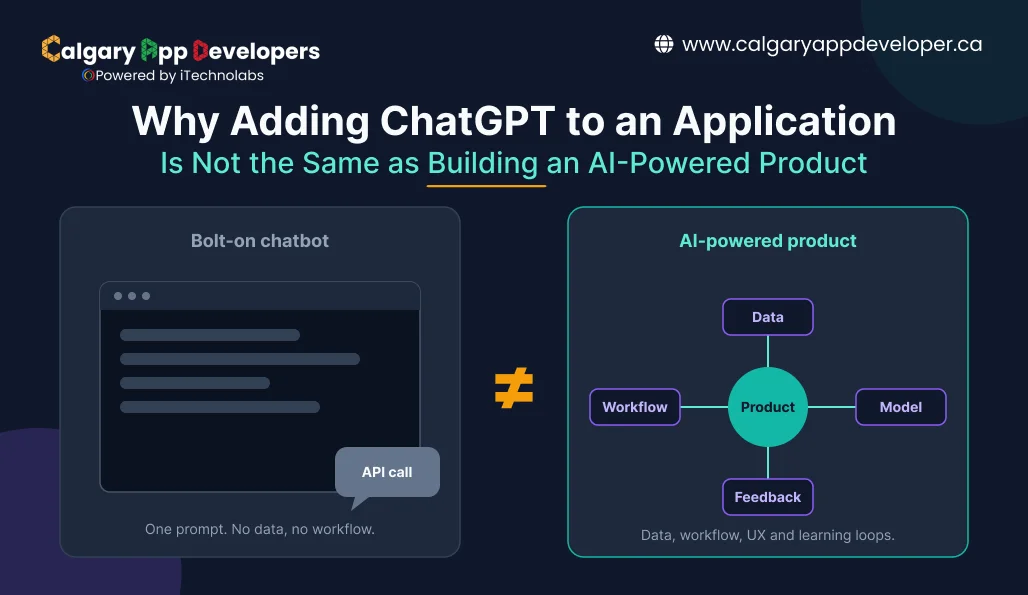
The distinction between an AI prototype, MVP, and production application is important.
A prototype demonstrates whether an idea is technically possible. An MVP validates its usefulness with a limited set of features and users. A production application is prepared to support actual business operations, handle unpredictable inputs, protect information, and maintain consistent performance as usage grows.
For example, an AI-powered customer support assistant may generate useful responses during testing. However, production deployment requires additional capabilities, including access to approved knowledge sources, protection against inappropriate responses, integration with customer support systems, and monitoring of response quality.
Production readiness means the application can deliver dependable business value beyond controlled testing conditions.
9 Essential Requirements That Make an AI Application Production Ready
An AI application needs several interconnected capabilities before it can reliably support real users. The following nine requirements provide a practical foundation for production deployment.
1. A Clearly Defined Use Case and Measurable Business Goals
Production readiness begins with understanding what the application needs to accomplish.
Without a clearly defined use case, development teams may focus on building advanced AI capabilities without establishing whether they solve an actual business problem.
Start by identifying the workflow, user group, and expected outcome. Determine whether the application needs to automate repetitive tasks, improve decision-making, process documents, answer customer queries, or support internal operations.
Next, establish measurable key performance indicators (KPIs) that help evaluate its effectiveness.
For example, an AI document processing application might be evaluated using:
- Document extraction accuracy.
- Average processing time per document.
- Percentage of documents requiring manual review.
- Processing cost per document.
- Reduction in manual data entry.
These metrics create a baseline for testing and future improvements. They also help teams determine whether the application is ready for deployment.
2. Reliable Data Pipelines and Data Quality
AI applications depend on data to generate predictions, recommendations, classifications, and responses. Poor quality data can undermine even a well-designed model.
Before deployment, businesses must ensure that the application receives accurate, relevant, consistent, and properly structured information.
This involves establishing reliable data pipelines for collecting, processing, validating, and transferring information between systems.
Important considerations include:
- Data accuracy: Check whether incoming information is correct and complete.
- Data consistency: Maintain standardized formats across different sources.
- Data freshness: Ensure the application works with sufficiently updated information.
- Data access: Define who and what can access specific datasets.
- Data versioning: Maintain records of dataset changes to support testing and troubleshooting.
For applications using retrieval-augmented generation (RAG), teams should also evaluate document quality, chunking strategies, metadata, indexing, and retrieval relevance.
For example, an internal AI knowledge assistant may produce incorrect answers if its knowledge base contains outdated policies or duplicate documents.
Reliable data pipelines help reduce these issues and provide a stronger foundation for consistent AI outputs.
3. Proper Model Selection and Performance Evaluation
Choosing a model based only on its capabilities or popularity can create unnecessary technical and operational challenges.
The right model should match the application’s requirements, available data, expected workload, performance expectations, and operating budget.
A large language model may be suitable for complex reasoning and conversational applications. However, a smaller model could be more appropriate for classification, extraction, or repetitive tasks where response speed and cost matter more.
Before production deployment, evaluate models across several dimensions:
- Accuracy: Does the model produce correct and relevant outputs?
- Latency: How long does it take to generate a response?
- Consistency: Does it perform reliably across similar inputs?
- Resource consumption: How much computing power does it require?
- Inference cost: Is the cost of generating each prediction or response sustainable?
Testing should use representative datasets and realistic scenarios rather than a few carefully selected examples.
For generative AI applications, evaluation should also consider hallucinations, relevance, instruction following, and harmful or unsupported responses.
Establishing clear acceptance criteria helps development teams decide whether a model is suitable for production or requires further optimization.
4. Scalable and Resilient Application Architecture
An AI application that works for ten users may struggle when hundreds or thousands of users access it simultaneously.
Production architecture must account for increasing demand, changing workloads, infrastructure limitations, and potential service interruptions.
A scalable architecture should allow individual components to handle growth without requiring the entire application to be redesigned.
Depending on the use case, this may involve:
- Modular application components and microservices.
- API gateways for managing incoming requests.
- Load balancing to distribute traffic.
- Caching to reduce repeated processing.
- Queue-based processing for resource-intensive tasks.
- Auto-scaling to accommodate changing workloads.
Resilience is equally important. Applications should have appropriate timeout handling, retry mechanisms, fallback options, and recovery procedures.
For example, if an external AI model provider becomes temporarily unavailable, a customer support application should have a defined fallback rather than leaving users with failed requests.
The architecture should also support graceful degradation, allowing essential application functions to continue when certain AI services are unavailable.
5. Security, Privacy, and Responsible AI Controls
AI applications often process customer information, internal documents, financial records, or other sensitive business data. This makes security and privacy essential production requirements.
A secure application needs protection across its data pipelines, model integrations, APIs, infrastructure, and user interfaces.
Key safeguards include:
- Authentication and role-based access controls.
- Encryption for data in transit and at rest.
- Secure API keys and credential management.
- Input validation and output filtering.
- Data retention and access policies.
- Audit logs for important application activities.
Generative AI applications also introduce risks that traditional software security practices may not fully address.
Prompt injection, sensitive information disclosure, unsafe tool execution, and unreliable model outputs require additional safeguards.
For example, an AI assistant connected to internal company documents should only retrieve information that the requesting employee is authorized to access.
Human review should also be incorporated into workflows involving sensitive decisions or significant business consequences.
Security requirements should be evaluated against applicable regulations and industry standards before deployment, not treated as improvements to add later.
6. Comprehensive AI Testing and Validation
Traditional software testing alone is not sufficient for AI applications.
Unlike conventional software, AI systems can produce different outputs for similar inputs. Their behavior may also change when models, prompts, datasets, or external dependencies are updated.
A production-ready application therefore requires testing at multiple levels.
- Functional testing: Verify that application features behave according to requirements.
- Integration testing: Check communication between AI models, databases, APIs, and existing business systems.
- Model evaluation: Assess output accuracy, relevance, consistency, and reliability using representative test datasets.
- Performance testing: Measure response times, throughput, and resource consumption under different workloads.
- Security testing: Identify vulnerabilities involving unauthorized access, data exposure, prompt injection, and unsafe inputs.
- Edge case testing: Evaluate how the application responds to incomplete information, unexpected inputs, ambiguous requests, and unavailable services.
Consider an AI invoice processing application. Testing should cover more than correctly formatted invoices. It should also include handwritten entries, missing fields, duplicate documents, unusual layouts, and incorrect data.
A structured testing process helps uncover weaknesses before they affect real users and business operations.
7. Continuous Monitoring and Observability
AI application performance does not remain constant after deployment.
Changes in user behavior, incoming data, model providers, and application dependencies can affect output quality and system performance.
Continuous monitoring helps teams identify these issues before they become major operational problems.
A production monitoring strategy should track both application health and AI-specific performance.
Important metrics include:
- Response latency and API availability.
- Request volume and failure rates.
- Model accuracy and output quality.
- Token consumption and inference costs.
- Data quality and model drift.
- Resource utilization and infrastructure performance.
For generative AI applications, teams should also monitor hallucinations, retrieval quality, refusal behavior, and policy violations where relevant.
Logging and tracing help developers understand how individual requests move through different application components. Alerts can notify teams when performance falls below established thresholds.
Monitoring should also connect to an improvement process. When the application begins producing unreliable results, teams need a way to investigate the cause, evaluate corrective actions, and validate changes before releasing them.
8. Cost Optimization and Infrastructure Readiness
An AI application may perform well technically but still become commercially unsustainable if its operating costs are too high.
Production planning should account for more than initial development expenses. Businesses also need to estimate recurring infrastructure, model inference, storage, data processing, API usage, and maintenance costs.
Cost optimization begins with understanding which application components consume the most resources.
Practical approaches include:
- Selecting models based on task complexity.
- Using smaller models for simpler operations.
- Implementing caching for repeated requests.
- Optimizing prompts and reducing unnecessary token consumption.
- Processing suitable workloads in batches.
- Setting usage limits and cost alerts.
- Monitoring infrastructure utilization.
For example, an AI customer support application may not need an expensive model for every incoming request. Basic queries can be handled through simpler workflows, while complex requests can be routed to more capable models.
Infrastructure should also be selected according to expected traffic, availability requirements, data residency needs, and future growth.
The objective is to maintain the required application performance without allowing operational costs to grow unnecessarily.
9. CI/CD, Version Control, and Ongoing Maintenance
Launching an AI application is not the final development milestone. Models, prompts, datasets, dependencies, and business requirements can all change over time.
Without controlled updates, even a previously reliable application can experience unexpected performance issues.
Continuous integration and continuous deployment (CI/CD) practices help teams introduce changes through repeatable testing and release workflows.
A production-ready development process should include:
- Version control for application code and configuration.
- Model and dataset versioning.
- Prompt and evaluation dataset management.
- Automated testing before deployment.
- Controlled release and rollback procedures.
- Documentation of application changes.
- Defined maintenance ownership.
For example, when a team replaces an existing language model with a newer version, it should evaluate the new model against established benchmarks before releasing it to users.
A staged rollout can further reduce deployment risks by exposing changes to a limited group before wider adoption.
Businesses should also assign clear responsibility for monitoring, incident response, updates, and ongoing optimization.
Without ownership and maintenance processes, production readiness can gradually deteriorate even when the initial deployment is successful.
How to Evaluate Whether Your AI Application Is Ready for Production
Before launching, businesses should evaluate whether the application meets its technical, operational, and business requirements.
A production readiness assessment helps identify gaps that could affect application performance after deployment.
Use the following scorecard as a starting point.
| Evaluation area | Production readiness criteria |
| Business readiness | Defined use case, objectives, and KPIs |
| Data readiness | Validated, secure, and accessible data |
| Model readiness | Tested accuracy, consistency, and latency |
| Architecture readiness | Scalability, resilience, and recovery |
| Security readiness | Authentication, encryption, and access controls |
| Testing readiness | Functional, integration, and performance testing |
| Operational readiness | Monitoring, alerts, and assigned ownership |
| Financial readiness | Estimated infrastructure and inference costs |
Each requirement should have documented evidence, an accountable owner, and clearly defined acceptance criteria.
Not every requirement carries the same risk. For example, an application handling sensitive customer information should not launch with unresolved security vulnerabilities, even if its model performance is excellent.
Common Mistakes That Prevent AI Applications From Reaching Production
Even promising AI projects can struggle during deployment because of decisions made early in development.
Here are five mistakes businesses should avoid:
- Treating a successful prototype as a finished product: A working demonstration does not establish reliability under real user workloads.
- Prioritizing model accuracy alone: Response time, consistency, infrastructure requirements, and operating costs also affect application quality.
- Overlooking data quality: Inaccurate, outdated, or inconsistent information can lead to unreliable outputs.
- Launching without monitoring: Without performance tracking and alerts, teams may not identify problems until users report them.
- Ignoring long-term maintenance: Models, integrations, and business requirements change, making ongoing evaluation necessary.
Avoiding these mistakes requires production planning to begin during architecture and development rather than immediately before launch.
From AI Prototype to Production: A Practical Development Approach
Moving an AI application into production requires a structured development process. Businesses should approach it through the following stages:
- Discovery and planning: Identify the business problem, target users, available data, and expected outcomes.
- MVP development: Build a focused version of the application to validate its functionality and business value.
- Architecture and integration: Prepare the infrastructure, model integrations, data pipelines, and security controls.
- Testing and validation: Evaluate accuracy, performance, reliability, and security against established benchmarks.
- Controlled deployment: Release the application through staged rollouts with monitoring and rollback procedures.
- Continuous improvement: Review production performance, address issues, and optimize models and application components.
This approach helps businesses identify technical limitations early and avoid investing in unnecessary complexity before validating the solution.
Final Thoughts: Production Readiness Is an Ongoing Process
Making an AI application production-ready requires more than deploying a model or completing development. Businesses need reliable data, appropriate architecture, security controls, measurable performance, and ongoing operational support.
The real objective is to build an application that continues delivering value as users, workloads, and business requirements change. Production readiness should therefore be treated as a continuous process of evaluation, monitoring, and improvement.
FAQs
- What makes an AI application production-ready?
An AI application is production-ready when it meets defined requirements for accuracy, reliability, security, scalability, and performance. It should also have validated data pipelines, appropriate testing, continuous monitoring, and documented maintenance processes.
- How do you test an AI application before deployment?
Test its functionality, model accuracy, integration reliability, response times, security, and behavior under unexpected inputs. Use representative datasets and realistic workloads to identify weaknesses before releasing the application to users.
- How long does it take to make an AI application production-ready?
The timeline depends on application complexity, data readiness, integrations, security requirements, and infrastructure. A straightforward application may require a few additional weeks of preparation, while complex enterprise AI systems can take several months.
- What are the biggest challenges in deploying AI applications?
Common challenges include poor data quality, inconsistent model outputs, integration difficulties, security vulnerabilities, scalability limitations, and unpredictable operating costs. Addressing these challenges early makes production deployment more manageable.
- How do you maintain an AI application after deployment?
Maintain an AI application through continuous monitoring, regular performance evaluations, security updates, model and dependency versioning, and infrastructure optimization. Teams should also establish incident response procedures and review application performance against business objectives.


Pankaj Arora is a seasoned technology leader and the Founder of Calgary App Developer, with 10+ years of expertise in crafting high-performance digital solutions. His core competencies include full-stack app development, cloud-native architecture, API integration, and agile product delivery. Under his leadership, Calgary App Developers has empowered startups and enterprises alike with scalable mobile applications, secure web platforms, and AI-driven SaaS products.