









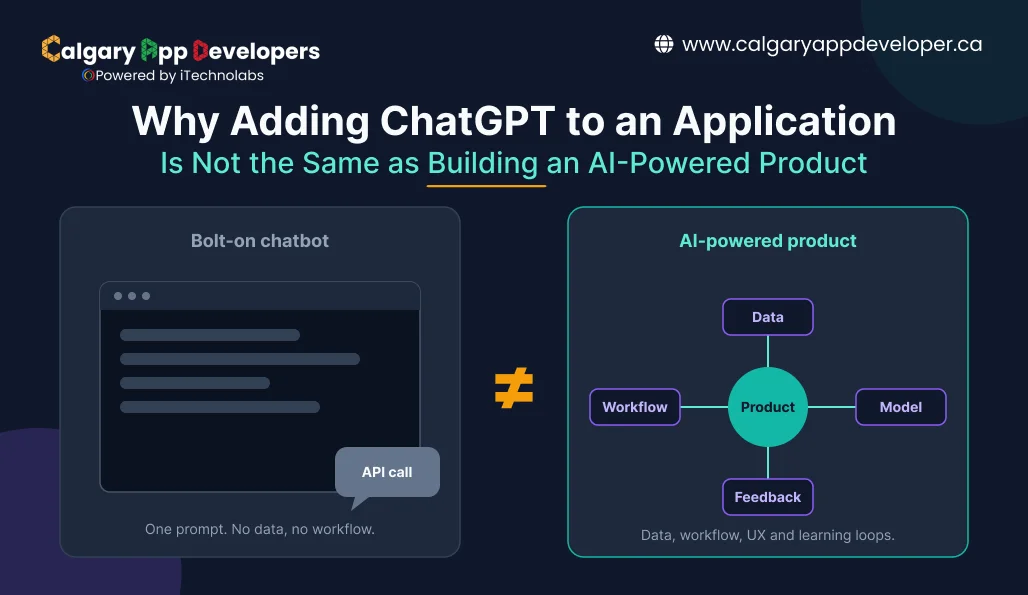
Why Adding ChatGPT to an Application Is Not the Same as Building an AI-Powered Product
Key Takeaway
- A ChatGPT integration sends a prompt and renders a reply. An AI-powered product wraps that call in your data, your business rules, an evaluation harness, and a monitoring layer, which is where 80% of the engineering lives.
- Features that demo beautifully fail in production for predictable reasons. No retrieval over your own records. No regression testing when the model updates. Token costs that scale with usage instead of revenue. No audit trail when a customer disputes an answer.
- Canadian builds carry a privacy requirement most offshore quotes ignore. PIPEDA and Alberta’s PIPA apply the moment customer records hit a third-party API, and your contract needs to say where that data lands.
- Expect $35,000 to $90,000 CAD for a production-grade retrieval product in Calgary, versus $8,000 to $25,000 for a prompt feature. The second number is real. It just buys something different.
- Ask a prospective vendor nine specific questions about retrieval, evals, and model portability. If the answers are vague, you’re buying a wrapper at product prices.
Your team shipped the chat box in three weeks. Leadership loved the demo. Then the support tickets started: wrong prices quoted, policies invented out of thin air, answers that contradicted what the same question returned on Monday.
Nothing broke. The integration works exactly as built. That’s the problem.
An AI-powered product owns the data, the rules, the testing, and the cost of being wrong. A ChatGPT integration owns a prompt and a text box. Both ships. Only one holds up when real customers lean on it, and the distance between them is where most budgets quietly disappear.
That distance shows up in the numbers. MIT’s NANDA initiative looked at 300 public deployments for its GenAI Divide report. Researchers also surveyed 350 employees and interviewed 150 business leaders. It found 95% of corporate generative AI pilots stall before scaled adoption, and only about 5% drove real revenue growth. The lead author pointed at integration and organizational fit, not model quality, as the cause.
If you’re a founder or product lead in Calgary weighing what to build next, the question isn’t whether to use a language model. You should. The question is which of the two things you’re actually paying for, and whether your budget matches the one you picked.
What Does “Adding ChatGPT” Actually Mean in a Product?
Most teams mean one thing by this, and it’s narrower than it sounds. Here’s what the architecture really looks like.
A typical integration has three moving parts. Your backend takes whatever the user typed. It staples that to a system prompt describing the tone and a few rules, then posts the whole thing to an API endpoint. The model returns text. You render it.
That’s it. There’s no step where your product checks whether the answer is true.
The system prompt usually carries all the business logic. “You are a helpful assistant for a plumbing supply company. Be friendly. Don’t discuss competitors.” Maybe someone pasted the return policy in there. Maybe a list of product categories. It grows over months as edge cases appear, until it’s 2,000 words of accumulated instructions nobody wants to touch.
This approach has real uses, and I want to be clear about that. For a marketing site chat widget, an internal drafting tool, or a first validation test of whether users even want the feature, it’s the right call. You’ll know within a month whether the idea has legs, and you spent $12,000 instead of $70,000 finding out.
What it doesn’t do is know anything about your business. The model knows what was in its training data and what you pasted into the prompt. Your inventory, your customer’s order history, your pricing tiers, last Tuesday’s policy change: invisible. When a user asks about any of it, the model does what it’s built to do and produces a fluent, confident, plausible answer. Sometimes that answer is right.
The gap between “produces an answer” and “produces a correct answer” is the entire subject of this article.
What Makes Something an AI-Powered Product Instead?
A real product adds six layers around the model call. Each one exists because something broke without it.
A data layer that holds your truth. Your records, documents, policies, and transactions get indexed into a store the system can search. Usually a vector database alongside your existing relational data. This is the piece that lets the product answer questions about your business rather than about the world in general.
Retrieval that runs before generation. Instead of hoping the model remembers, the system searches your indexed data for the few passages relevant to this question. It hands only those to the model, with an instruction to answer from them. People call this RAG. It’s the single highest-leverage thing you can add, and it’s what separates a product from a chat box.
Rules that live outside the prompt. Pricing logic, eligibility checks, approval thresholds, compliance rules. These belong in code where they can be unit tested, not in a paragraph of English the model may or may not follow. A model that’s been told “never quote prices above the tier limit” will break that rule. A function that validates the output against the tier limit won’t.
An evaluation harness. This is the layer almost nobody builds, and it’s the one I’d fight for hardest. You assemble 100 to 300 real questions with known-correct answers, then run them automatically against the system on every change. Prompt edit, model version bump, new data source: run the suite, see what regressed. Without it you’re flying blind and your users are your test coverage.
Monitoring and a feedback loop. Log every interaction with the retrieved context, the output, latency, token spend, and whatever the user did next. Thumbs down, rephrased question, escalated to a human. That log is how you find out which 5% of queries are failing, which you cannot discover any other way.
Cost controls. Caching for repeat questions, routing simple queries to cheaper models, context trimming, and hard spend caps. Token costs scale with usage. Your pricing probably doesn’t, which is a margin problem that only becomes visible at scale.
Build all six and you’ve got something durable. Skip them and you’ve got a demo with a monthly API bill.
ChatGPT Integration vs AI-Powered Product: What’s the Real Difference?
The differences aren’t philosophical. They show up in six places you can audit. Here’s how the two approaches compare on the factors that decide whether a build survives contact with customers.
| Factor | ChatGPT Integration | AI-Powered Product |
| Knowledge source | Model training data plus a system prompt | Your indexed records, documents, and live data via retrieval |
| Business logic | Written in English inside the prompt | Coded, tested, enforced outside the model |
| Accuracy on your data | Unverifiable, fails silently | Measured against a known-answer test suite on every change |
| Model dependency | Rewrite required if the provider changes behaviour | Swappable; the value sits in your data and eval layer |
| Cost at scale | Rises with every user, uncapped | Managed through caching, routing, and context limits |
| Audit trail | Prompt and reply, if logged at all | Full record of query, sources used, output, and user response |
The row that matters most is accuracy. Everything else you can retrofit later at some expense, but a system with no way to measure whether it’s right cannot be improved, only guessed at. Teams that skip the eval harness end up shipping prompt changes based on vibes and finding out about regressions from angry customers.
Model dependency is the second one worth sitting with. If your entire product is a prompt, your product is OpenAI’s roadmap. When a provider deprecates a model or shifts its default behaviour, prompt-only builds break in ways that are hard to diagnose. Products built around their own data and test suite swap the model underneath and re-run the suite.
Why Do ChatGPT Features Demo Well and Then Fail in Production?
Demos run on happy paths and friendly questions. Production runs on everything else. These are the eight failure modes I see most often, roughly in the order they show up.
It invents facts about your own business. A customer asks whether their warranty covers a part. The model has never seen your warranty document, so it constructs an answer from general knowledge of how warranties usually work. The tone is perfect. The answer is fiction. This is the single most common production failure, and no amount of prompt tuning fixes it, because the information simply isn’t there.
Answers change between Monday and Tuesday. Language models are probabilistic. Ask the same question twice and you’ll often get two differently worded replies, which is fine for a creative tool and unacceptable for a price quote. Users notice fast, and once they catch the system contradicting itself, they stop trusting any of it.
Prompt edits silently break what used to work. Someone adds a line to handle a new edge case. Three other behaviours shift as a side effect. Nobody finds out until a customer complains, because there’s no test suite to catch it. Teams end up afraid to touch the prompt at all.
A model update changes everything overnight. Providers update models. Behaviour that your prompt relied on shifts, and output that was reliably formatted as JSON starts arriving with explanatory preamble. If parsing that output is load-bearing in your app, your app is down.
Latency creeps past what users tolerate. Early on the context is short and replies come in two seconds. Then you stuff more into the prompt to patch accuracy problems, and the same request takes nine seconds. Retrieval fixes this by sending a small number of relevant passages instead of everything you’ve got.
Token costs scale faster than revenue. At 200 users a month the API bill is rounding error. At 20,000 it’s a line item your CFO wants explained, and if you charge a flat subscription, every power user erodes margin. Nobody models this before launch.
No audit trail when something goes wrong. A customer insists your app told them they’d be refunded. You have no log of what was retrieved, what was generated, or when. In a regulated vertical that’s not an inconvenience, it’s a compliance failure.
There’s no fallback when the API is down. Provider outages happen. If your core workflow routes through one external endpoint with no graceful degradation, your product goes dark along with it. Real builds queue, retry, fail over to a second provider, or fall back to a rules-based path.
Every one of these is predictable and every one is preventable. They just get prevented at build time, not patched afterward.
Where Does Your Data Actually Go, and Does PIPEDA Care?
Short answer: it cares, and most quotes skip this entirely. Here’s what applies to a Canadian build.
The moment your application sends customer information to a third-party API, you’ve disclosed personal information to a service provider. PIPEDA makes your organization accountable for that information even after it leaves your servers. Alberta’s PIPA layers on top for provincially regulated businesses here. Neither law bans sending data across the border, which surprises people. Both require that you know where it’s going. You also have to tell your users, and the receiving party has to protect it to a comparable standard.
That translates into four things your build needs.
A documented data flow. Which fields leave your system, to which endpoint, in which region, retained for how long. If you can’t produce this diagram, you can’t answer a privacy officer’s questions and you can’t honestly fill out an enterprise security questionnaire.
Zero-retention or enterprise API terms. Consumer-tier API terms and enterprise terms differ on whether your inputs can be retained or used for training. Enterprise and business tiers generally offer no-training commitments and configurable retention. Get it in writing before you build, not after a client asks.
Redaction before the call. The cheapest privacy control available is simply not sending what you don’t need. Strip names, account numbers, and health details before the request, or substitute tokens you re-expand on the way back. Most integrations send the entire record because it was easier.
Data residency when the client demands it. Alberta public sector work, healthcare, and some financial contracts come with residency requirements that rule out certain regions outright. Canadian-region deployment is available from the major cloud providers, but it has to be designed in. Retrofitting residency after launch means rebuilding the data layer.
One more thing worth saying plainly. If your vendor hasn’t raised any of this with you, they’re either not thinking about it or they’re hoping you won’t. Both are reasons to ask harder questions.
What Does It Cost to Build an AI-Powered Product in Canada?
Most production-grade AI-powered product builds in Canada range from $35,000 to $180,000 CAD, while a prompt-only ChatGPT integration typically lands between $8,000 and $25,000. The spread comes down to how much of the six-layer stack you actually build, how messy your existing data is, and whether compliance requirements are in scope.
Here’s how those ranges break down by market, for a production build with retrieval, evaluation, and monitoring in place.
| Location | Typical Cost Range (CAD) | Notes |
| Toronto, ON | $90,000 – $250,000+ | Largest agency market; premium rates and longer procurement cycles |
| Vancouver, BC | $85,000 – $220,000+ | Deep ML talent pool, priced accordingly |
| Calgary, AB | $45,000 – $150,000 | Senior talent, competitive rates, lower overhead than central Canada |
| Ottawa, ON | $60,000 – $170,000 | Strong gov-tech and compliance experience built into pricing |
| Montreal, QC | $45,000 – $135,000 | Cost-effective, strong research ecosystem, bilingual capability |
| Offshore | $12,000 – $55,000 | Lowest sticker price; revision cycles, timezone friction, and weak privacy accountability rarely priced in |
Calgary sits where it does for structural reasons rather than marketing ones. Office and salary overhead runs below Toronto and Vancouver. The energy and logistics sectors here have produced engineers used to data-heavy systems with real consequences. And you’re in your own timezone, working with a team that understands Canadian privacy obligations without a briefing.
What Actually Drives the Number?
Six variables decide where your project falls in that range. Each one is worth asking about before you sign anything.
The state of your data. This is the biggest swing factor and the one most often underestimated. Clean, well-documented records in a modern database mean the retrieval layer takes two to three weeks. Policies scattered across PDFs, a decade-old CRM, and three people’s inboxes can double the timeline before a single model call gets written. Budget a discovery phase if you’re honestly unsure which situation you’re in.
How much of the stack you build. A prompt feature is one layer. A retrieval product is four. Add fine-tuning, multi-step agent workflows, or human-in-the-loop approval routing and you’re at six or seven. Each layer is real engineering with real testing attached, and the honest version of this conversation starts with which layers you need now versus in a year.
Compliance scope. PIPEDA alignment on a straightforward build adds modest cost. Healthcare privacy, financial oversight, or Alberta residency requirements add considerably more. They bring audit logging, access controls, residency architecture, and documentation that has to survive external review.
Integration surface. One clean REST API is straightforward. Six systems, two of them legacy, one with no documentation and a maintainer who left in 2019, is where projects slip. Count your integration points early and be pessimistic about the old ones.
Evaluation depth. A basic evaluation suite of 100 test cases is a week of work. A rigorous one with adversarial cases, domain expert review, and automated regression gates on every deploy is three to four weeks. It’s the least glamorous line in the quote and the one I’d protect first when budgets tighten.
Location and engagement model. Calgary rates typically run 25% to 40% below Toronto and Vancouver for comparable senior talent, without the trade-offs offshore brings. The offshore sticker price looks attractive until you count the revision rounds. Then add the cost of explaining Canadian privacy law to a team that’s never encountered it. Then add what happens when something breaks at 3am your time and nobody picks up.
Worth checking before you budget. SR&ED credits can recover a meaningful share of eligible development spend. Model evaluation and retrieval engineering often qualify as experimental development. Alberta’s Innovation Employment Grant may also apply to qualifying R&D. Talk to your accountant early, because documentation requirements start on day one, not at filing.
Which Build Path Fits Your Product?
Four paths, and the right answer depends on what the output has to do. Pick deliberately.
Path one: the prompt feature. A system prompt, an API call, a text box. Right when you’re validating demand, when the task is generic drafting or summarizing, and when being wrong costs nothing. Two to four weeks, $8,000 to $25,000 CAD. Treat it as an experiment with an expiry date rather than a foundation.
Path two: the retrieval product. Your data indexed, searched before generation, with answers grounded in retrieved sources and an eval suite behind them. This is the right answer for roughly 70% of the businesses I talk to, because most of what they want is accurate answers about their own operations. Eight to fourteen weeks, $45,000 to $120,000 CAD.
Path three: the hybrid or fine-tuned build. Retrieval plus a model tuned on your own examples. Right when output format or domain language matters enough to justify it. Legal document drafting, technical field reports, specialized classification. It needs a few thousand quality training examples, which is the real barrier. Twelve to twenty weeks, $90,000 to $200,000 CAD.
Path four: the agentic workflow. The system doesn’t just answer, it acts. Books, updates, routes, triggers. Right when the task is genuinely multi-step and the downstream systems are reliable, wrong when you haven’t yet proven the simpler version works. Highest complexity, highest testing burden, and every action needs a rollback path. Sixteen weeks and up, $120,000 CAD and up.
Most teams reach for path four because it’s the exciting one. Most teams need path two. The sequence that works is validating with path one, building path two properly, then adding actions once the answers are trustworthy.
How Can You Tell If a Vendor Is Selling You a Wrapper?
Nine questions. Ask them in a first call and the answers will sort your shortlist faster than any proposal.
“Where will our data be indexed, and what retrieves it?” You want a specific store and a specific retrieval strategy. If the answer is that your documents go in the prompt, that’s a prompt feature with a product price tag.
“How will you measure accuracy before launch?” You want a test set with known answers, a target score, and a plan for what happens when it fails. “We’ll test it thoroughly” is not an answer.
“What happens to our evals when the model version changes?” You want an automated suite that re-runs on every change. This question alone separates teams who’ve shipped production systems from teams who’ve shipped demos.
“Can we switch model providers later, and what breaks?” You want an abstraction layer and an honest list of what needs re-tuning. A vendor who says “nothing breaks” hasn’t done it.
“Where does business logic live?” You want code. If pricing rules and eligibility checks live in the system prompt, they’ll be violated, and you’ll find out from a customer.
“What’s our projected monthly token spend at ten times current volume?” You want a number with assumptions attached. Vendors who haven’t modelled this will hand you a surprise in month six.
“What’s logged on every request, and who can see it?” You want query, retrieved sources, output, latency, cost, and user action, with access controls. This is your audit trail and your improvement loop.
“How does the system behave when the provider API is down?” You want a fallback described in concrete terms. Queue, retry, secondary provider, rules-based path. “That rarely happens” means no plan.
“Which PIPEDA obligations apply to us, and how does the build address them?” You want specifics about data flow, retention terms, and residency. A vendor who looks surprised by this question has not built for Canadian clients.
A good partner will answer all nine quickly and tell you which layers you can safely defer to phase two. That last part is the tell. Anyone who says you need everything immediately is selling scope, and anyone who says you need none of it is selling a prototype.
How Do You Move From a ChatGPT Feature to a Real Product?
You don’t rebuild from scratch. You add layers in order of leverage, and you can usually keep what’s already shipped.
| Phase | What Happens | Timeline | Outcome |
| 1. Audit and baseline | Collect 100 real user queries, score current answers for accuracy, document the data flow | 1–2 weeks | You finally know your real failure rate |
| 2. Retrieval layer | Index your documents and records, wire search before generation, ground answers in sources | 3–5 weeks | Accuracy on business questions jumps sharply |
| 3. Eval harness | Build the test suite from phase one, automate it on every deploy | 1–2 weeks | Prompt and model changes stop being a gamble |
| 4. Logic extraction | Move pricing, eligibility, and compliance rules from prompt to code with tests | 2–3 weeks | Rules get enforced instead of suggested |
| 5. Monitoring and cost control | Full request logging, caching, model routing, spend caps and alerts | 2 weeks | Visibility into quality and margin |
| 6. Hardening | Fallbacks, retries, privacy review, residency if required | 2–3 weeks | Survives outages and security questionnaires |
Phase one is non-negotiable and it’s the phase teams want to skip. Scoring a hundred real answers against ground truth is tedious work that produces an uncomfortable number, and that number is what justifies everything after it. I’ve seen teams discover their beloved chat feature was wrong on 40% of business-specific questions, which changed the budget conversation in about ten minutes.
Phases two and three together deliver most of the value, and they’re where I’d spend first if your runway is tight. Document the hours as you go for SR&ED purposes, since retrieval tuning and evaluation design often read as experimental development.
Why Choose CalgaryAppDeveloper for AI-Powered Product Development?
We build the layers that don’t demo. Retrieval over your own data, evaluation suites that catch regressions before your customers do, business logic in tested code, and monitoring that shows you both quality and cost.
We’re Canadian, and that shapes the work. PIPEDA and Alberta PIPA obligations get designed in rather than discovered during a client security review, and data residency is a configuration decision we make with you up front. You work with senior engineers in your own timezone.
Conclusion
Adding ChatGPT to your application is a reasonable first move, and plenty of good products started exactly there. The mistake isn’t starting with a prompt and an API call. The mistake is believing that’s what you shipped when you promised your board an AI-powered product, then being surprised when it buckles under real usage.
The difference is structural, not cosmetic. A product owns its own data through retrieval. It enforces rules in code, proves accuracy against a test suite, logs enough to be audited, and controls what it costs to run. A feature owns a prompt. Both have their place, and the trouble starts when the budget and the expectations belong to one while the build belongs to the other.
If you’ve already shipped a ChatGPT feature and it isn’t holding up, you’re in a better position than you think. The work ahead is additive. Audit what you have, measure the real failure rate, add retrieval and evals, and you’ll have something worth building on inside a quarter.
If you’re still deciding, decide deliberately. Pick the path that matches what being wrong actually costs your business, and budget for the layers that keep it right.
Ready to find out what you’ve actually got? Our Calgary team will audit your setup and score it against real queries. You get a phased plan with honest CAD numbers. No obligation.
FAQs
Q. How much does it cost to build an AI-powered product in Canada?
Production builds with retrieval, evaluation, and monitoring typically run $45,000 to $150,000 CAD in Calgary, with Toronto and Vancouver 25% to 40% higher. A prompt-only ChatGPT integration costs $8,000 to $25,000. Your data’s condition is the biggest swing factor, so budget a discovery phase if your records are scattered.
Q. How long does it take to move from a ChatGPT feature to a real product?
Expect eleven to seventeen weeks across six phases. The audit takes one to two weeks, the retrieval layer three to five, and the eval harness another one to two. Phases two and three deliver most of the accuracy gain, so you’ll see measurable improvement around week seven rather than waiting for the full build.
Q. Is a ChatGPT wrapper ever the right choice?
Yes, for validation. Say you’re testing whether users want the feature at all, or the task is generic drafting where being wrong costs nothing. A prompt feature answers that in a month, for a fraction of the price. Treat it as an experiment with an end date, not a foundation you’ll build on.
Q. What happens to our product if we want to switch model providers?
With an abstraction layer and an eval suite, you swap the provider, re-run your tests, and tune where scores dropped. Usually a week or two. Without those layers, your prompt is the product and you’re rewriting it blind, which is why portability is worth asking about before you build.
Q. Does PIPEDA allow sending customer data to OpenAI?
It does, with conditions. Your organization stays accountable for information disclosed to any service provider. So you need a documented data flow, enterprise API terms covering retention and training, user disclosure, and comparable protection at the other end. Some healthcare and public sector contracts add residency requirements that need designing in.
Q. Should we build this in-house or hire an agency?
Build in-house if you already have engineers who’ve shipped and maintained a retrieval system with evals. Most teams haven’t, and the learning curve lands on the layers that matter most. A sensible middle path is hiring a partner for the first production build with knowledge transfer written into the contract, then maintaining it yourself.


Pankaj Arora is a seasoned technology leader and the Founder of Calgary App Developer, with 10+ years of expertise in crafting high-performance digital solutions. His core competencies include full-stack app development, cloud-native architecture, API integration, and agile product delivery. Under his leadership, Calgary App Developers has empowered startups and enterprises alike with scalable mobile applications, secure web platforms, and AI-driven SaaS products.