









RAG vs Fine-Tuning: What Should CTOs Actually Choose?
Key Takeaways
- RAG changes what your model can see. Fine-tuning changes how it behaves. If your answers go stale when a document changes, that’s retrieval. If your answers are current but the format or tone is wrong, that’s training.
- Try prompting and long-context first. A surprising number of projects labelled “we need RAG” are solved by putting the right 40 pages in the prompt. That costs almost nothing to test.
- Fine-tuning does not teach your model new facts reliably. It teaches patterns. Teams who miss this distinction waste the most money.
- RAG costs land roughly between $35,000 and $140,000 CAD to build in Canada. Fine-tuning runs wider, from $25,000 for a light adapter to well past $200,000 for a full training pipeline with ongoing retraining.
- Most production systems end up using both. Retrieval handles the facts, a light fine-tune handles the format and voice. That’s the common destination, not a compromise.
- Build your evaluation set before you pick an architecture. Without 50 to 100 scored examples, you can’t tell whether a change helped, and you’ll argue about vibes in budget meetings.
A six-figure budget and four months of engineering time can disappear into a fine-tuned model that was never going to fix the problem. The team wanted the assistant to stop giving customers outdated pricing. They trained a model on last quarter’s price list. Three weeks after launch, pricing changed again, and they were back where they started.
That’s the real issue with the RAG vs fine-tuning question. It gets framed as a technical comparison when it’s actually a diagnosis. You’re not choosing between two tools that do the same job slightly differently. You’re deciding whether your model has a knowledge problem or a behaviour problem, and those have completely different fixes. Get the diagnosis wrong and no amount of engineering talent saves the project.
Most of the guidance floating around treats this as a performance bake-off. It isn’t one. Here’s how to actually make the call, what each path costs in CAD, and how to tell which one you need before you’ve spent the budget.
What Are You Actually Deciding Between?
Both approaches start from the same place: a base model that doesn’t know your business and doesn’t speak the way your business speaks. Where they diverge is the mechanism.
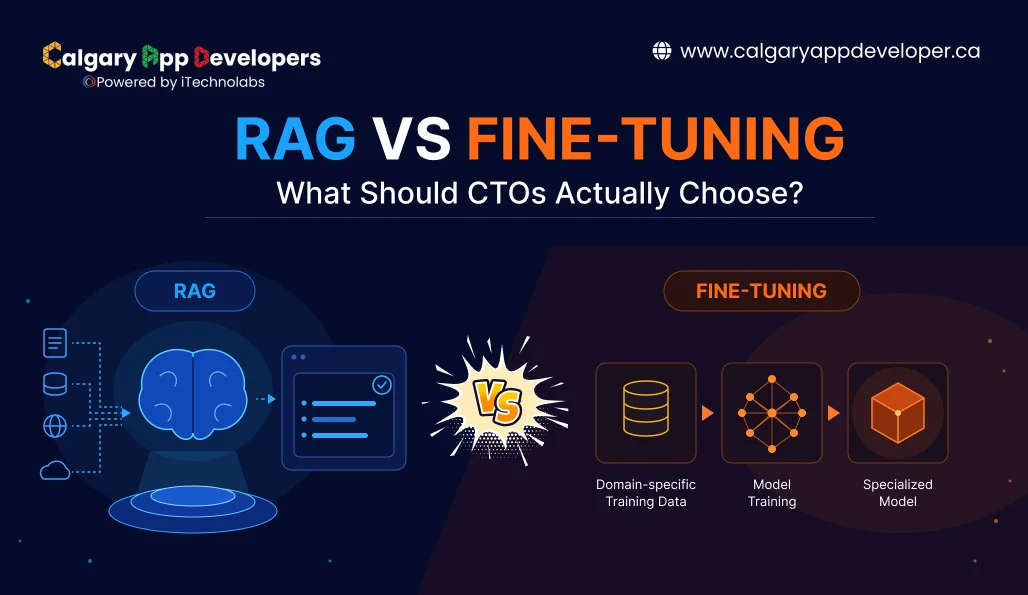
RAG, retrieval-augmented generation, leaves the model’s weights completely alone. You build an index of your content, and at the moment a user asks something, you search that index, pull the handful of passages most likely to contain the answer, and hand them to the model inside the prompt. The model answers from what it just read. Change the source document and the next answer reflects the change immediately. Nothing gets retrained.
Fine-tuning works the other way. You assemble a few hundred to a few thousand examples of the exact input and output you want, then run a training job that adjusts the model’s weights until that pattern is internalized. Nothing gets retrieved at answer time. The behaviour is baked in. Response latency drops because there’s no lookup step, and your prompts get shorter because you’re no longer spending tokens on instructions and examples.
Here’s the part that catches teams out. Fine-tuning feels like it should be the stronger option because it modifies the model itself, and modifying the model sounds more serious than searching a database. But weight adjustments are very good at encoding how and fairly unreliable at encoding what. Train a model on a thousand of your support tickets and it’ll learn your tone, your escalation structure, and your preferred phrasing. Ask it a specific factual question about a policy that appeared in those tickets and it may well invent a plausible answer. The facts blur. The patterns stick.
So the honest framing of RAG vs fine-tuning isn’t which is better. It’s which failure you’re actually looking at.
Why Do So Many Teams Default to the Wrong One?
Three forces push CTOs toward fine-tuning before they’ve earned the right to consider it.
The first is vendor incentive. Fine-tuning is a bigger engagement. It needs data labelling, training infrastructure, model hosting, and a retraining cadence. An agency quoting on fine-tuning quotes a larger number than an agency quoting on retrieval, and larger numbers are easier to justify internally as serious investment. You won’t hear this said out loud, but it shapes a lot of proposals.
The second is a language problem. “Custom model” sounds like ownership. “Our own fine-tuned model” sounds like a moat. “We search our documents and put them in the prompt” sounds like something an intern could build over a weekend. Boards respond to the first framing. That’s a perception gap, not a technical one, and plenty of CTOs have approved the wrong architecture because the right one sounded unimpressive in a steering committee.
The reverse mistake happens too, just less often. Teams who’ve internalized “RAG first” advice sometimes keep tuning their retrieval pipeline for months when the actual complaint from users is that the output format keeps breaking downstream integrations. You can’t retrieve your way to a consistent JSON schema. At some point you’re fighting the wrong battle.
The third force is that nobody measured anything first. Without evaluation data, the decision gets made on whoever argued most confidently in the meeting.
Should You Try Prompting and Long-Context First?
Before you budget for either option, spend a week on the two cheapest levers. Most teams skip this and regret it.
Start with prompt engineering done properly. Not “we tried a few prompts” but a structured pass: explicit role framing, three to five worked examples of the exact output you need, a clear statement of what the model should do when it doesn’t know, and constrained output formatting. Teams routinely declare prompting insufficient after an afternoon of casual attempts. A deliberate week of prompt work resolves more problems than people expect, and it costs you one engineer’s time rather than a project budget.
Then look hard at long-context models. This is the option almost nobody writes about RAG vs fine-tuning bothers to mention, and it kills a meaningful share of RAG projects before they start. Current frontier models handle context windows large enough to swallow hundreds of pages in a single call. If your entire knowledge base is a 60-page policy manual, a product catalogue, and a pricing sheet, you may not need a retrieval pipeline at all. Put the whole thing in the prompt. You get perfect recall, zero retrieval failures, no vector database to operate, and no chunking strategy to tune.
The trade-off is token cost per call and some latency. At low query volume that’s cheaper than building and running infrastructure. At high volume the math flips, and caching helps but doesn’t fully close the gap. The threshold is worth calculating against your own traffic before anyone writes code.
So the real sequence is: prompt properly, test long-context, add retrieval when your knowledge base outgrows the window or needs permission controls, and consider training only when a measured quality gap survives all three.
When Does RAG Make Sense for Your Business?
Retrieval is the right first move more often than not. These are the situations where it’s clearly the answer.
- Your source content changes faster than you’d want to retrain. Pricing, inventory, policy documents, regulatory guidance, project status. If the correct answer today differs from the correct answer last month, you want a system where updating a document updates the answer. Retrieval gives you that for free.
- Answers need citations. Any time a user should be able to click through and verify where a claim came from, retrieval is the only approach that gives you provenance. A fine-tuned model produces the answer with no traceable source. In procurement, legal, finance, and clinical contexts, that lack of traceability is often a hard blocker rather than an inconvenience.
- Different users should see different things. Retrieval lets you filter the index by role before the model ever sees a passage. A contractor asks about compensation policy and gets the contractor document. An executive asks and gets the full picture. Once knowledge is trained into weights, you’ve lost the ability to restrict it per person, and your only option is running separate models per permission tier.
- You need to remove something fast. A document gets retracted, a client relationship ends, someone discovers that a file containing personal information was indexed by mistake. With retrieval you delete the record and it’s gone from every future answer. With a trained model you’re looking at retraining to genuinely remove it.
- Your knowledge base is large and growing. Thousands of documents across multiple systems is retrieval territory. You’re not going to train that in, and you wouldn’t want to.
- The volume of relevant content per question is small. Retrieval works best when a question has a findable answer sitting in one or two passages. “What’s our refund window for enterprise customers?” is a retrieval question. The answer exists in a specific place.
- Your team is stronger on backend engineering than ML. A retrieval pipeline is search infrastructure, chunking logic, embedding calls, and prompt assembly. That’s a skill set most development teams already have. Training pipelines, dataset curation, and evaluating a model for regression after a training run are specialist work.
- You need to ship something this quarter. Retrieval gets to a working prototype in weeks. Training needs a labelled dataset before it can start, and building that dataset is usually the longest part of the project.
- Auditors or regulators will ask how an answer was produced. Retrieval gives you a log: this query, these retrieved passages, this answer. That’s an answerable audit trail.
When Is Fine-Tuning Worth the Investment?
Training earns its cost in a narrower set of circumstances, and they’re mostly about behaviour rather than knowledge.
- The output must follow a rigid structure every single time. Feeding a downstream system that breaks on malformed input, generating documents to a fixed template, producing records that go straight into a database. Constrained decoding handles basic syntax, but a model trained on a few thousand correctly formatted examples internalizes the structure in a way prompt instructions don’t match consistently.
- You have a house voice the model keeps missing. Specific terminology, a particular register, phrasing conventions your industry expects. You can describe tone in a prompt, but you’re paying for those instruction tokens on every call and you’ll still drift. Training encodes it.
- The model keeps taking wrong steps in a multi-step task. The facts are available, the model has them, and it still sequences the work incorrectly. That’s a behaviour gap. Training on complete worked examples of the full task addresses the sequence, which no amount of better retrieval will.
- Your prompts have grown unmanageable. When every call carries 3,000 tokens of instructions and examples just to get acceptable output, you’re paying that cost on every single request. Training moves that into the weights. At high volume the per-call savings can justify the build on economics alone.
- Latency genuinely matters. Voice interfaces, real-time agent assist, anything where a retrieval round trip is noticeable. A trained model skips the lookup.
- You need a smaller model to perform above its weight class. This is one of the strongest cases. Training a small open model on your narrow task often gets you frontier-level quality on that specific task at a fraction of the inference cost. You’ve traded generality for efficiency, which is a good trade when you only need one job done.
- Your domain language is far from general usage. Specialized vocabulary where everyday words carry different meanings. Base models misread this consistently, and context examples only partly fix it.
- The task is narrow, stable, and high volume. All three conditions together. Narrow means you can build a representative dataset. Stable means it won’t be obsolete in two months. High volume means the per-call savings compound into real money.
- You already have labelled data from an existing process. If your team has been doing this task manually and logging the results, your training set already exists. That removes the expensive part of the project and changes the economics substantially.
RAG vs Fine-Tuning: Head-to-Head Comparison
Most comparison tables on this topic score the two approaches as if they compete on the same axes. They don’t, and the table is more useful when it shows where each one structurally wins.
| Criterion | RAG | Fine-Tuning | Hybrid |
| What it changes | What the model can see | How the model behaves | Both |
| Knowledge freshness | Current as of last index update | Frozen at training time | Current |
| Build time | 4 to 10 weeks | 8 to 20 weeks including dataset work | 12 to 24 weeks |
| Data needed | Your existing documents | 500 to 5,000 labelled examples | Both |
| Citations and provenance | Native | Not available | Native via retrieval layer |
| Per-user access control | Filter the index per role | Not possible without separate models | Via retrieval layer |
| Removing information | Delete the record | Requires retraining | Delete the record |
| Response latency | Adds a retrieval step | Fastest, no lookup | Adds retrieval step |
| Per-call token cost | Higher, context is injected | Lower, shorter prompts | Moderate |
| Format consistency | Prompt-dependent, drifts | Strongly enforced | Strongly enforced |
| Ongoing maintenance | Reindexing, retrieval tuning | Retraining as the task shifts | Both, higher total |
| Team skills required | Backend and search engineering | ML engineering and data curation | Both |
What Does Each Approach Actually Cost in Canada?
Most RAG builds in Canada land between $35,000 and $140,000 CAD, while fine-tuning projects range from roughly $25,000 for a light adapter on an existing model to $200,000 and up for a full pipeline with retraining infrastructure. Where you fall inside those ranges depends far more on data readiness and integration complexity than on which technique you picked. The widest cost swings come from content that needs cleaning before it can be indexed, and from source systems that don’t have usable APIs.
Those figures assume a production system with monitoring, not a prototype. Here’s how build cost breaks down by location for a mid-complexity production deployment.
| Location | RAG Build (CAD) | Fine-Tuning Build (CAD) | Notes |
| Toronto, ON | $95,000 – $220,000 | $120,000 – $300,000+ | Highest agency rates; deepest ML talent pool |
| Vancouver, BC | $85,000 – $200,000 | $110,000 – $270,000 | Premium pricing; strong AI specialist market |
| Calgary, AB | $55,000 – $140,000 | $70,000 – $185,000 | Senior talent at lower overhead; strong enterprise data experience |
| Ottawa, ON | $65,000 – $160,000 | $80,000 – $200,000 | Government and compliance-heavy project depth |
| Montreal, QC | $50,000 – $130,000 | $65,000 – $170,000 | Competitive rates; significant academic ML presence |
| Offshore | $18,000 – $65,000 | $25,000 – $90,000 | Low headline cost; weak accountability, revision cycles usually unpriced |
How Do You Evaluate Which One Is Working?
Every guide on this topic tells you to build evaluations first. Almost none explain how, so here’s the practical version.
Start by collecting 50 to 100 real questions. Not questions your team invents, actual queries from users, support tickets, search logs, or sales calls. Invented test questions skew toward what your system handles well, which is exactly the blind spot you’re trying to eliminate. If the system isn’t live yet, pull from whatever manual process it’s replacing.
For each question, write down the correct answer and, critically, where that answer comes from. That source reference is what lets you separate two completely different failure modes later. This set becomes your golden dataset, and it’s the most valuable artifact you’ll build in the whole project.
Now score three things separately, because collapsing them is what causes misdiagnosis.
- Retrieval quality. Did the system find the passage containing the answer? Score this on its own, before the model generates anything. If the right passage never surfaced, the model had no chance, and no amount of training fixes it. Teams who skip this measurement spend months improving the wrong layer.
- Groundedness. Given the passages it retrieved, did the answer stay faithful to them, or did the model add claims that weren’t there? This isolates hallucination from retrieval failure. An answer can be wrong because the system found nothing useful, or wrong because the model embellished what it found. Different problems, different fixes.
- Behaviour adherence. Did the output follow the required format, tone, and structure? Score this independently of factual correctness. A factually perfect answer in the wrong schema still breaks your integration.
That three-way split gives you your architecture decision almost directly. Failing mostly on retrieval means investing in retrieval: better chunking, hybrid search, reranking. Failing mostly on groundedness means tighter prompting and constrained generation before you consider anything heavier. Failing mostly on behaviour adherence, with retrieval and groundedness scoring well, is the clearest signal you’ve found for fine-tuning.
Run this set after every meaningful change. Keep the scores in a spreadsheet with dates. When someone in a budget meeting claims a change made things better, you’ll have the number instead of an argument. That spreadsheet also tells you when to stop, which is a question teams rarely answer deliberately and should.
When Should You Combine Both?
The hybrid architecture isn’t a compromise position. It’s where most production systems end up, and understanding why clarifies the whole decision.
The division of labour is clean. Retrieval owns the facts. Every claim the system makes about your business, your pricing, your policies, your customer records comes from a document you control, with a citation pointing back to it. Fine-tuning owns the behaviour. How the answer is structured, what voice it uses, which steps it takes, what it does when the retrieved context doesn’t contain the answer.
That split preserves the governance properties you need while fixing the consistency problems retrieval alone leaves open. You keep per-role access filtering, instant document updates, deletion on demand, and audit trails. You also get a model that reliably produces the right shape of output without 3,000 tokens of instruction on every call.
A support assistant is the clearest example. Retrieval pulls the current policy, the specific customer’s plan details, and the relevant troubleshooting steps. The trained layer makes sure every response opens by acknowledging the issue, follows your escalation structure, stays inside your tone guidelines, and formats the resolution steps the way your agents expect. Neither approach delivers both halves alone.
The sequencing matters though. Build retrieval first, measure it, get it working. Add the trained layer only when your evaluation data shows a behaviour gap that survives good prompting. Teams who build both at once can’t tell which component is responsible for which result, and debugging that is genuinely painful. Retrieval first also means you have a working system in production while you decide whether the second layer earns its cost.
What Mistakes Do CTOs Make Most Often?
- Fine-tuning to fix a knowledge problem. The most expensive error on this list. Training a model on documents containing the facts you want doesn’t make those facts retrievable. It makes the model sound like someone who read them once. If the complaint is “the answers are out of date” or “it got the number wrong,” you have a retrieval problem.
- Skipping evaluation and arguing instead. Without scored examples, every architecture discussion becomes a debate about impressions. The team that measures first spends less and ships sooner, every time.
- Treating RAG as automatically cheaper. It’s cheaper to build and often more expensive to run, because you’re injecting context tokens into every call. At high volume with long contexts, those costs add up fast. Model the running cost against your projected traffic, not just the build quote.
- Underestimating data preparation. Teams budget for the AI work and forget that their content needs cleaning, structuring, and deduplicating first. This is where timelines slip most reliably. Audit your actual source material before you commit to a date.
- Expecting fine-tuning to eliminate hallucination. It reduces some categories of error and introduces others. A trained model becomes more confident in its voice, which can make incorrect answers harder for users to spot. Grounding in retrieved sources is what reduces fabrication, not training.
- Building for a scale that doesn’t exist yet. Architecting for a million queries a day when you’ll serve two thousand adds cost and complexity you’ll carry for years. Build for one order of magnitude above current need, not three.
- Ignoring the retraining treadmill. A fine-tuned model is a maintained asset. When your task shifts, your product changes, or your terminology evolves, you retrain. Teams budget the first training run and forget the next six. Ask what the retraining cadence will be before you commit.
- Letting a vendor’s capability pick your architecture. An agency with deep ML experience will find reasons to train. A team whose strength is backend engineering will find reasons to retrieve. Both can be honest and still biased. Do the diagnosis independently, then find a partner who fits the answer.
How Do You Pick a Partner to Build This?
Four questions separate teams who’ve shipped production systems from teams who’ve read about them.
Ask how they’d decide between the two approaches for your specific case. A strong answer starts with questions back at you about data freshness, access control, output format requirements, and query volume. A weak answer recommends an architecture before understanding your constraints. If someone proposes a solution in the first conversation, they’re selling a capability rather than solving your problem.
Ask what their evaluation process looks like. You want to hear about golden datasets, separated retrieval and generation scoring, and regression testing after changes. Vague answers about testing and quality assurance mean they’ll be guessing, and you’ll pay for the guesses.
Ask what they’d do if the first approach didn’t work. Teams who’ve shipped real systems have hit this and can describe how they diagnosed it and what they changed. Teams who haven’t will tell you it won’t happen.
Ask who maintains it after launch and what that costs. These systems need ongoing attention: reindexing, retrieval tuning, monitoring for quality drift, occasional retraining. A proposal that ends at launch is incomplete, and the gap will surface three months in.
On the local versus offshore question, the honest trade-off is accountability rather than raw capability. Strong engineers work everywhere. What differs is how quickly you can get into a room when priorities shift, how revision cycles get handled when the first build misses, and who owns the outcome when something breaks in production. For a project where requirements will change as you learn what users actually need, which describes nearly every AI build, that responsiveness is worth more than the hourly rate difference suggests.
Conclusion
The RAG vs fine-tuning decision gets easier once you stop treating it as a technology comparison and start treating it as a diagnosis. Knowledge problems need retrieval. Behaviour problems need training. Most real systems have some of both, which is why hybrid architectures have become the common destination rather than the exception.
What should hold is the sequence. Prompt properly first, because it’s nearly free and resolves more than people expect. Test whether long-context handles your knowledge base before you build a retrieval pipeline you might not need. Add retrieval when your content outgrows the window or when governance requires per-user control. Consider training only when scored evaluation data shows a behaviour gap that survives everything cheaper.
The teams who get this right aren’t the ones with the biggest budgets. They’re the ones who measured before they built, who diagnosed the actual failure instead of the assumed one, and who resisted the pull toward whichever option sounded more impressive in a steering committee. That discipline costs a week upfront and saves entire quarters.
If you’re weighing this decision for a project in Calgary or anywhere in Canada, get in touch with our team. We’d rather talk you out of the wrong architecture than build it for you.
FAQs
Q. Is RAG cheaper than fine-tuning?
RAG is almost always cheaper to build, typically $35,000 to $140,000 CAD against $25,000 to $200,000+ for fine-tuning, but it’s often more expensive to run. Retrieval injects context into every single call, so your per-query token cost stays high permanently. Fine-tuning front-loads the cost and then gives you shorter prompts and lower per-call spend. At low volume RAG wins on total cost comfortably, and at very high volume with long contexts the comparison can reverse. Model it against your actual projected traffic rather than assuming.
Q. Can I use RAG and fine-tuning together?
Yes, and most production systems eventually do. Retrieval handles the facts so your answers stay current and citable, while the trained layer handles output format, tone, and task sequencing. Build the retrieval layer first and measure it properly before adding training on top. If you build both simultaneously you won’t be able to tell which component is producing which result, and debugging that becomes very difficult.
Q. Does fine-tuning stop hallucinations?
Not reliably, and in some cases it makes them harder to catch. Fine-tuning teaches patterns rather than facts, so a trained model can produce confident, well-formatted answers that are factually wrong. What actually reduces fabrication is grounding answers in retrieved source documents the model can quote from. If hallucination is your main complaint, retrieval plus tighter prompting addresses it more directly than training will.
Q. How much training data do I need to fine-tune?
Plan for 500 to 5,000 labelled examples depending on how narrow the task is, with quality mattering considerably more than volume. A few hundred carefully reviewed examples of exactly the output you want will outperform several thousand inconsistent ones. The honest cost here is building that dataset, which can run $15,000 to $50,000 CAD if you’re starting from nothing. Check whether an existing manual process has already produced usable examples, because many teams discover their dataset already exists.
Q. How long does each approach take to build?
A production RAG system typically takes 4 to 10 weeks, while fine-tuning runs 8 to 20 weeks once dataset preparation is included. Hybrid builds land somewhere between 12 and 24 weeks. The variable that moves these timelines most isn’t the technique, it’s the state of your source data. Messy content across multiple systems with no clean APIs can add months before any AI work begins.
Q. When should I skip RAG and go straight to fine-tuning?
When your evaluation data shows retrieval and groundedness scoring well while output format or task sequencing keeps failing, and when the task itself is narrow, stable, and high volume. Needing a small model to perform above its weight class on one specific job is another strong case. If you haven’t scored those three dimensions separately yet, you don’t have enough information to skip retrieval safely.
Q. Can a Calgary development team handle this kind of AI work?
Yes, and the economics tend to favour it for most Canadian businesses. Calgary builds in the $55,000 to $140,000 CAD range for production RAG systems, below Toronto and Vancouver rates, with senior engineers who’ve worked extensively on enterprise and operational data. For projects where the hard part is understanding messy business data rather than novel ML research, which covers the large majority of these builds, that experience matters more than proximity to a research lab. You also get direct accountability and faster iteration when requirements shift, which they will.


Pankaj Arora is a seasoned technology leader and the Founder of Calgary App Developer, with 10+ years of expertise in crafting high-performance digital solutions. His core competencies include full-stack app development, cloud-native architecture, API integration, and agile product delivery. Under his leadership, Calgary App Developers has empowered startups and enterprises alike with scalable mobile applications, secure web platforms, and AI-driven SaaS products.